

DMK's IT Wing Pioneers Early Virtual Campaign Strategy for Tamil Nadu Assembly Elections
While most political parties in Tamil Nadu remain in a state of limbo, awaiting finalization of seat-sharing agreements and candidate lists before commencing their electoral outreach, the DMK's Information Technology (IT) wing has emerged as an early bird, launching a comprehensive virtual campaign well ahead of the competition. This proactive digital strategy focuses on highlighting infrastructure projects completed and sanctioned over the past five years, aiming to establish a strong connection with the electorate, particularly urban voters and the youth demographic.
Constituency-Specific Content: A Core Campaign Theme
The IT wing has identified the promotion of constituency-specific infrastructure developments as a central theme for its online electioneering efforts. Through dedicated social media handles tailored to each constituency—often prefixed or suffixed with the area's name—party functionaries are disseminating videos and posters that detail funds allocated and progress made on various projects. This approach is designed not only to showcase achievements but also to address hyperlocal civic issues, thereby resonating deeply with residents.
T Lakshmanan, a DMK IT wing functionary from Srirangam, emphasized the strategic importance of this initiative. "Sharing key achievements in the last five years will be an important task online. We will target users on Facebook, Instagram, and platform X (formerly Twitter). Funds spent on such projects will be disclosed to downplay anti-incumbency claims," he stated, underscoring the campaign's goal of countering potential voter dissatisfaction by transparently presenting developmental work.

Highlighting Key Projects and State-Wide Schemes
In addition to local infrastructure highlights, the virtual campaign is actively promoting state-wide welfare schemes such as the Kalaignar Magalir Urimai Thittam (KUMT), which provides monthly financial assistance to women, and the popular free bus rides for women initiative. However, the focus remains sharply on constituency-specific accomplishments to demonstrate tangible benefits at the grassroots level.
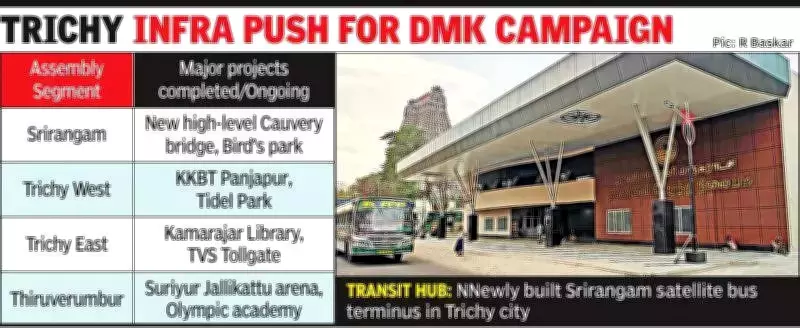
For instance, in the Srirangam constituency, where sitting MLA M Palaniyandi is seeking renomination, the DMK is spotlighting the satellite bus terminus and master plan development works at the Vayalur Murugan temple as significant completed projects. Similarly, the Trichy unit plans to leverage social media reels to promote the Panjapur integrated bus terminus (KKBT), noted as the state's second-largest and an air-conditioned facility, showcasing modern urban amenities.
Educational Initiatives and Strategic Political Calculations
The campaign also extends to educational infrastructure, with efforts to promote knowledge centers opened in Trichy city to support UPSC and TNPSC aspirants from rural areas. A Govindasamy, party coordinator for Trichy West, explained, "We are promoting the two knowledge centres opened in Trichy city to support UPSC and TNPSC aspirants for competitive exams from rural areas. Every constituency will list such projects to seek support." This highlights the party's attempt to appeal to students and young professionals by emphasizing investments in education and career development.
Moreover, the virtual campaign holds strategic significance for sitting MLAs and ministers in the central region who are planning to recontest. By showcasing completed projects in their respective constituencies, these candidates can leverage their track records to approach the party high command for renomination, positioning their achievements as a compelling case for a second term. This approach not only aids in candidate selection but also reinforces the party's narrative of effective governance and development.

A Digital-First Approach to Modern Electioneering
The DMK's early foray into virtual campaigning underscores a shift towards digital-first strategies in Indian politics, particularly in a tech-savvy state like Tamil Nadu. By utilizing platforms like Facebook, Instagram, and X, the IT wing aims to engage voters directly, bypassing traditional campaign methods that are often delayed by logistical and political negotiations. This initiative reflects a broader trend of political parties increasingly relying on social media to shape public opinion, disseminate information, and mobilize support in the lead-up to elections.
As the election season intensifies, the DMK's IT wing's early start could provide a competitive edge, allowing the party to set the agenda and frame the discourse around development and governance. By focusing on concrete projects and transparent communication, they seek to build a compelling narrative that resonates with a diverse electorate, from urban youth to rural communities, ultimately aiming to secure electoral success in the upcoming assembly polls.





