

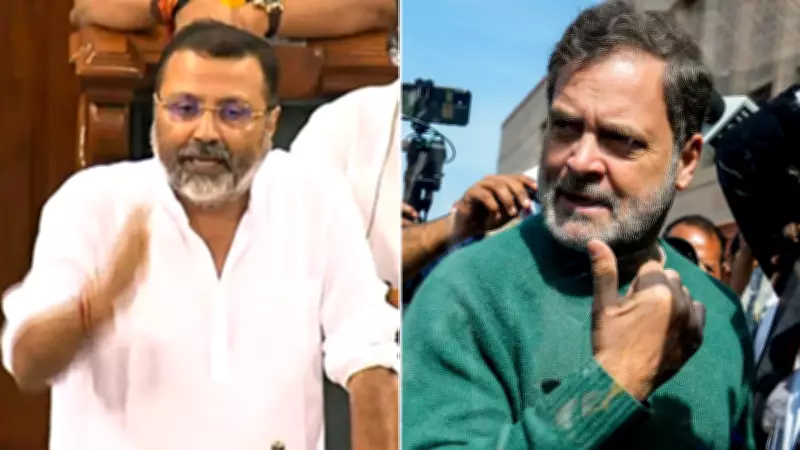
BJP MP Nishikant Dubey Initiates Substantive Motion Against Rahul Gandhi in Lok Sabha
In a significant parliamentary development, BJP MP Nishikant Dubey has formally submitted a notice to move a substantive motion against Leader of the Opposition Rahul Gandhi, seeking the termination of his Lok Sabha membership. The motion alleges that Gandhi misled the House, sparking widespread attention on this crucial parliamentary instrument and its historical implications.
Understanding the Substantive Motion: A Key Parliamentary Tool
A substantive motion is defined as a self-contained, independent proposal presented for the House's approval, crafted to express a definitive decision. According to the authoritative text Practice and Procedure of Parliament by M N Kaul and S L Shakdher, such motions encompass a range of critical parliamentary actions. These include motions for electing the Speaker and Deputy Speaker, the Motion of Thanks on the President's Address, adjournment motions on public importance, resolutions, discussions on general public interest, confidence or no-confidence votes in the Council of Ministers, resolutions for removing the Speaker or Deputy Speaker, motions declaring a member's seat vacant, and cases where leave of absence is denied by the House.
Substantive motions are always put to a vote, thereby formalizing the House's decision. As Kaul and Shakdher emphasize, "The conduct of persons in high authority can only be discussed on a substantive motion drawn in proper terms." The Constitution outlines specific procedures for such motions, including impeachment of the President, removal of judges from the Supreme Court or High Courts, the Comptroller and Auditor-General of India, the Chief Election Commissioner, as well as the Vice-President, Deputy Chairman of the Rajya Sabha, and the Speaker or Deputy Speaker of the Lok Sabha.

Procedural Framework for Substantive Motions
The process for moving a substantive motion requires the member who gave notice to personally move it, unless it is in a Minister's name, in which case another Minister may do so with proper attribution. Since Dubey is not a Minister, he must move the motion himself when permitted by the Chair. Notably, except for motions related to electing the Speaker or Deputy Speaker and the Motion of Thanks, no seconding is required. The mover also retains the right of reply, ensuring Dubey will have an opportunity to address the House.
Historical Precedents of Substantive Motions in Parliament
Substantive motions have been invoked multiple times in the Lok Sabha, leading to severe disciplinary actions against members. Key instances include:
- 2005 Cash-for-Query Scandal: Following a TV sting operation, a five-member committee investigated allegations against 10 MPs. The House adopted a motion expelling them after finding their conduct unethical and untenable.
- 2005-2006 MPLADS Misconduct: Another TV expose led to an enquiry into improper conduct regarding the Members of Parliament Local Area Development Scheme. The House adopted a motion reprimanding and suspending four members.
- 2007 Passport Fraud Case: After MP Babubhai K Katara was arrested for passport fraud, an enquiry committee found him guilty of grave misconduct, resulting in a motion for his expulsion, which was adopted.
- 2007 Misuse of Official Travel: Allegations against MP Rajesh Kumar Manjhi for misusing official air journeys led to a motion suspending him for 30 sittings and restricting travel privileges.
Substantive Motions in Judicial Impeachments
Beyond parliamentary discipline, substantive motions have played a role in judicial impeachments. In 1991, a motion signed by 108 MPs sought the removal of Supreme Court judge V Ramaswami for misconduct. An enquiry committee found him guilty, but the motion was defeated due to failing to meet the required majority thresholds. Similarly, in 2009, 57 Rajya Sabha members moved a motion against Calcutta High Court Justice Soumitra Sen for misappropriation of funds. The Rajya Sabha adopted the motion with a special majority, but Sen resigned before the Lok Sabha could proceed, halting further action.

Current Context and Implications
Nishikant Dubey's motion against Rahul Gandhi underscores the ongoing political tensions in Parliament. In his notice, Dubey stated, "If I, as a responsible public representative... fail to bring this to your kind notice, I would not be doing justice to my constitutional duty of upholding the unity, integrity and sovereignty of our country." He cited four alleged misdemeanors, framing the motion as a matter of national integrity. This move highlights the substantive motion's role as a mechanism for accountability among high-ranking officials, with potential outcomes ranging from reprimand to expulsion, depending on the House's decision.
As the Lok Sabha considers this motion, it draws from a rich history of using substantive motions to address misconduct, ensuring parliamentary decorum and constitutional adherence. The outcome will be closely watched, given its precedent-setting nature and impact on political dynamics.





