Tulsi Gabbard's Pre-SOTU Prayer Ignites Debate Over Her Religious Identity
A pre-State of the Union prayer has sparked significant questions about Tulsi Gabbard's faith, following pointed inquiries from British journalist Mehdi Hasan regarding her religious affiliation. The controversy emerged after Gabbard, a former Democratic presidential candidate and Trump aide, shared details of a Christian prayer session held before the President's address to Congress.
Mehdi Hasan's Public Query on Social Media
Mehdi Hasan took to X, formerly known as Twitter, to express his confusion, writing, "I'm confused. Did Gabbard convert to Christianity? I thought she was a proud Hindu." This comment came directly in response to Gabbard's own post, where she described participating in a 'Christian' prayer ahead of the State of the Union speech. Her message highlighted the importance of quiet moments, stating, "The quiet moments are often the most important. Last night just before Cabinet members walked onto the House floor for the President's State of the Union, we joined together in prayer, giving all thanks and praise to God, and praying for the clarity and strength to listen to Him, serve Him, and do His will."
Details of the Prayer Gathering
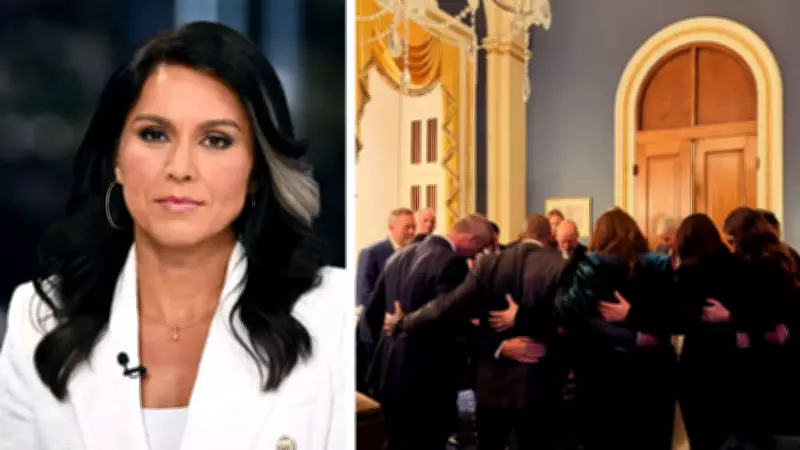
The post included a photograph showing Gabbard and other Cabinet members with heads bowed in prayer, captured shortly before they entered the House chamber. The setting appeared to be a private room or hallway within or near the US Capitol, used for preparation purposes rather than a designated religious venue. This prayer occurred before US President Donald Trump delivered the 2026 State of the Union Address to a joint session of the 119th US Congress in Washington, DC. The speech, lasting approximately one hour and 48 minutes, set a record as the longest State of the Union address in American history, covering topics such as the economy, immigration, trade, national security, and recognizing various individuals including athletes and military personnel.

Tulsi Gabbard's Longstanding Hindu Identity
Tulsi Gabbard has consistently and publicly identified as Hindu throughout her career. Born on April 12, 1981, in Leloaloa, American Samoa, and raised in Hawaii, she later embraced the Gaudiya Vaishnava tradition of Hinduism. She practices Vaishnavism, a branch focused on devotion to Vishnu and his avatars like Krishna. In a historic moment in 2013, when sworn into the US House of Representatives, Gabbard took her oath on the Bhagavad Gita, becoming the first Hindu member of the United States Congress. She has frequently discussed her faith in numerous interviews and public appearances, reinforcing her commitment to Hinduism.
Broader Implications and Public Reaction
This incident has stirred broader discussions about religious identity in politics, particularly how public figures navigate their personal beliefs in diverse settings. The prayer, though described as Christian, was part of a bipartisan gathering, raising questions about interfaith practices and political symbolism. Gabbard's actions have led to mixed reactions, with some defending her participation as a gesture of unity, while others, like Hasan, question potential shifts in her religious stance. As the story unfolds, it underscores the complex interplay between faith, politics, and public perception in contemporary American society.