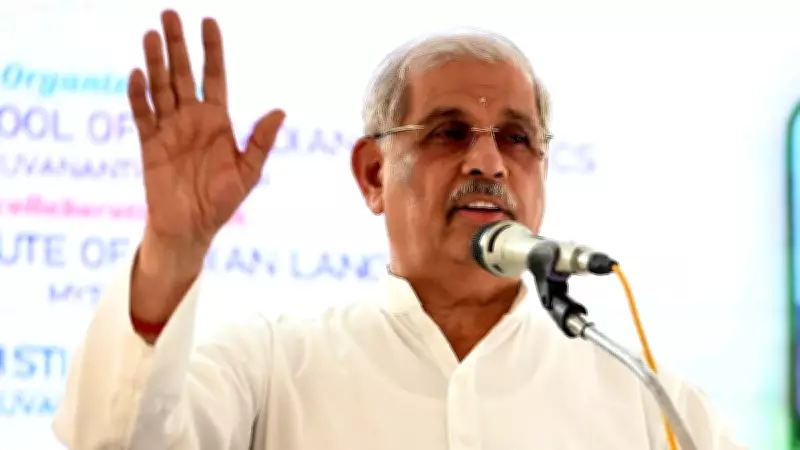
Kerala Governor Proposes Sanskrit-Based Hindi to Foster National Linguistic Harmony
In a significant address, Kerala Governor Arif Mohammed Khan has put forward a compelling suggestion for the wider adoption of Sanskrit-based Hindi across India. This proposal aims to tackle the longstanding linguistic divides that have often sparked debates in the country's diverse cultural landscape.
Addressing Vocabulary Barriers as a Key to Acceptance
Governor Khan articulated that the resistance to speaking Hindi in certain parts of India might not stem from a fundamental opposition to the language itself. Instead, he pointed to vocabulary barriers as a primary obstacle. By integrating more Sanskrit-derived terms into Hindi, he believes the language could become more accessible and less intimidating to non-native speakers.
This approach could potentially bridge communication gaps and promote a sense of unity without imposing cultural hegemony. The governor's insights highlight a nuanced understanding of India's linguistic diversity, where regional languages and Hindi often coexist in complex dynamics.

The Historical and Cultural Context of Sanskrit in Hindi
Sanskrit, as an ancient and classical language, has deeply influenced Hindi's vocabulary and structure. Emphasizing this connection could make Hindi more palatable to those who view it with suspicion due to political or regional sentiments. Governor Khan's suggestion taps into this rich heritage, proposing a linguistic solution that respects India's pluralistic ethos.
- Enhanced comprehension for speakers of other Indian languages with Sanskrit roots.
- Reduction in perceived linguistic imposition in southern and eastern states.
- Promotion of a more inclusive national language policy.
Potential Implications for Education and Governance
If implemented, this strategy could reshape how Hindi is taught and used in official contexts. Schools and government institutions might adopt a more Sanskrit-infused Hindi curriculum, making it easier for students from diverse backgrounds to learn. This could also streamline administrative communication across states, fostering better cooperation and understanding.
The governor's remarks come at a time when language politics remain a sensitive issue in India, with debates often flaring up over Hindi's role in education and public life. By focusing on vocabulary rather than imposition, this proposal offers a pragmatic path forward.
Broader Reactions and Future Steps
While the suggestion has sparked discussions among linguists and policymakers, its reception in non-Hindi speaking regions will be crucial. Proponents argue that it could demystify Hindi and reduce resistance, while critics may question its feasibility or impact on regional languages. Moving forward, pilot programs or studies might be needed to assess the effectiveness of this approach in real-world settings.
In conclusion, Governor Arif Mohammed Khan's advocacy for Sanskrit-based Hindi represents a thoughtful attempt to address India's linguistic challenges. By emphasizing vocabulary barriers over opposition, it opens new avenues for dialogue and unity in a multilingual nation.