

Himachal Pradesh Faces 'Catastrophic' Fiscal Crisis as Central Revenue Deficit Grant Ends
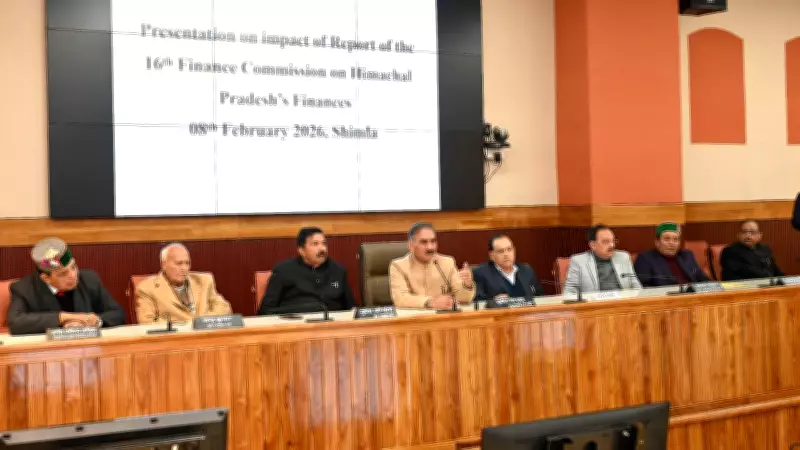
Principal Secretary (Finance) Devesh Kumar has issued a stark warning, asserting that the discontinuation of the Revenue Deficit Grant (RDG) constitutes an "abysmal injustice" to the people of Himachal Pradesh. In a detailed financial presentation made on Sunday, Kumar outlined a grim fiscal roadmap for the state in the financial year 2026-27, predicting severe consequences if the central support is withdrawn.
Presentation Highlights Impending Financial Breakdown
The presentation was delivered in the presence of Chief Minister Sukhvinder Singh Sukhu, Deputy Chief Minister Mukesh Agnihotri, all Cabinet ministers, and Congress MLAs. Kumar emphasized that Himachal Pradesh is a chronically revenue-deficient state and has never achieved economic self-sufficiency, relying heavily on central government assistance to meet expenditure commitments.
Kumar stated, "We are heading towards a catastrophic situation. It will be extremely difficult to manage the financial affairs of the state in the absence of RDG. There is a clear, significant resource gap of about Rs 6,000 crore, excluding developmental works, pending liabilities, and state schemes for FY 2026-27."

Historical Dependence and Structural Deficits
For the grant period of 2021-26, the 15th Finance Commission had allocated an RDG of Rs 40,000 crore to Himachal Pradesh. Kumar detailed the state's structural dependence, noting that annual borrowing averages around Rs 10,000 crore, with approximately Rs 1,300 crore paid as interest on previous loans annually. Since its inception, the state has largely operated on borrowed resources.
According to the 15th Finance Commission, Himachal Pradesh's revenue for 2021-26 was assessed at Rs 90,760 crore against an expenditure of Rs 1,70,930 crore, leaving a deficit of Rs 80,170 crore. This deficit was bridged through:
- Tax devolution of Rs 35,064 crore
- RDG of Rs 17,199 crore
- Other grants of Rs 9,714 crore
Kumar further highlighted that grants worth Rs 4,407 crore under "other grants" were not accepted by the Centre, and no compensatory calculations are available in the 16th Finance Commission report.
Potential Fallout from RDG Discontinuation
Kumar listed several drastic measures the state might be forced to adopt due to the withdrawal of RDG:
- Discontinuation of all major subsidies, including electricity, water, and food. Withdrawal of power subsidy alone could save nearly Rs 1,200 crore annually.
- Review of social security pensions, with current requirements of Rs 1,661 crore potentially reduced to Rs 500 crore, necessitating a reassessment of beneficiary numbers and eligibility.
- Freezing of Dearness Allowance (DA) at current levels, with no payment of DA/pay and pension revision arrears.
- Discontinuation of pension allowance and consideration of adopting a Unified Pension Scheme or reviving the New Pension Scheme for future recruitment to avail additional borrowing of about Rs 1,800 crore per annum.
State's Resource Analysis and Liabilities
The state's resources stand at about Rs 18,000 crore, while committed expenditure is around Rs 48,000 crore, covering salaries, pensions, subsidies, and social security. After including Rs 10,000 crore in borrowing, resources total about Rs 42,000 crore. The resource gap, previously filled by RDG, now poses a constraint for meeting budgetary allocations.
Kumar warned that due to financial constraints, developmental and capital expenditure is unlikely to be possible from state resources. The state may only carry out limited developmental work through Centrally Sponsored Schemes and Externally Aided Projects.
Key liabilities include:

- Inability to defray pay/pension revision arrears of about Rs 8,500 crore
- Inability to pay DA/DR arrears amounting to Rs 5,000 crore
- Rollover of developmental works worth Rs 2,000 crore to the next financial year
- Difficulty in providing matching grants for CSS and EAPs, clearing pendency of schemes like HIMCARE and SAHARA, and addressing court order liabilities of about Rs 1,000 crore
Conclusion and Call for Action
Kumar concluded that even if measures to increase revenue and decrease expenditure are undertaken, a resources gap will persist, underscoring RDG's role as a savior. He emphasized that hilly states like Himachal Pradesh were historically recognized with special category status due to such challenges.
"Himachal was formed on aspirations of the public and not as a financially viable unit. The impact of these recommendations is not confined to the incumbent government but adversely affects subsequent governments. In a nutshell, this is 'Abysmal Injustice' with the people of Himachal Pradesh," Kumar stated, summarizing the presentation's findings.
The warning highlights the urgent need for central support to prevent a fiscal collapse in the state, with potential repercussions for subsidies, pensions, and overall economic stability.





