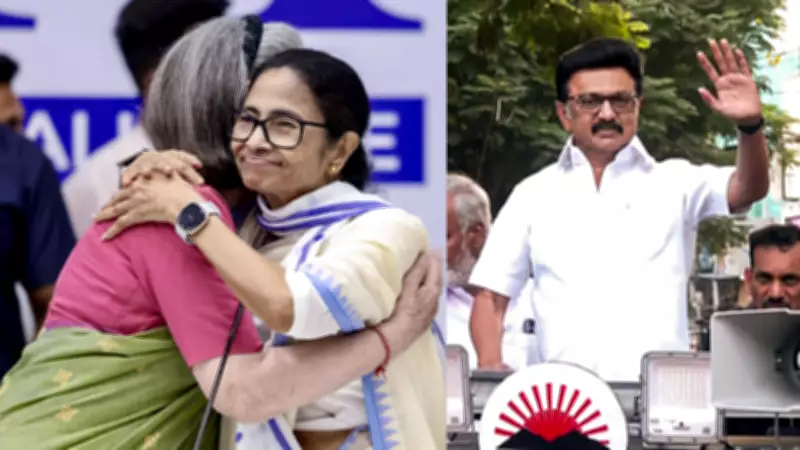
NEW DELHI: The opposition leaders assembled at the Constitution Club in New Delhi on Monday for the first high-level INDIA bloc meeting since the 2024 Lok Sabha elections and pushed visuals to project unity. Sonia Gandhi warmly embraced Mamata Banerjee. Rahul Gandhi, Mallikarjun Kharge, Akhilesh Yadav and other opposition leaders exchanged pleasantries before settling down for deliberations on strategy, Parliament and the road ahead.
While the opposition bloc came up with five agendas for the coming months, including a letter to the Chief Justice of India on SIR and vote 'chori' and a unified demand for the resignation of the Union education minister over the NEET paper leaks.
The biggest takeaway from the gathering, however, was not the agenda but the attendance sheet.

While Trinamool Congress chief Mamata Banerjee was reportedly among the strongest advocates for reviving the INDIA bloc's political engagement after the recent round of assembly elections, DMK chief MK Stalin chose to boycott the meeting altogether.
The absence was particularly striking because both Mamata and Stalin find themselves in remarkably similar circumstances. The two most powerful regional satraps recently suffered bruising electoral defeats that have fundamentally altered the political equations in their states. While Mamata lost power to the Bharatiya Janata Party after 15 years of rule and is now facing unprecedented rebellion inside her party, MK Stalin lost both the election and his ally Congress to the debutant Vijay this year. This is why their responses with respect to the INDIA bloc are completely different.
As TMC chief Mamata is moving closer to the INDIA bloc and Congress, Stalin appears to be moving away from both.
The divergent paths chosen by the two leaders offer perhaps the clearest indication yet of how the balance of power within the opposition bloc is being rewritten after the political upheavals in West Bengal and Tamil Nadu.
A meeting about more than unity
That the meeting itself was convened amid concerns about the future of the alliance became clear even before opposition leaders gathered in Delhi.
Speaking in Baramati earlier in the day, NCP (SP) chief Sharad Pawar acknowledged growing strains within the coalition and indicated that another round of consultations among senior leaders would be required to prevent further fissures.
"Since such a situation is emerging, we will, in the next eight to 15 days, invite the key leaders and try to find a solution. I am sure a solution will be found," Pawar said, referring to indications from the DMK-Congress situation.
"An appeal will be made that no one should take any extreme step," he added.
His remarks can be seen as a rare public admission that the INDIA bloc is now dealing not merely with electoral strategy against BJP-led NDA, but also with questions about its own cohesion.
Mamata's dominance to 'dependence' era
For much of the past decade, Mamata Banerjee approached opposition politics from a position of strength.
After defeating the Left front and subsequently emerging as the BJP's principal challenger in West Bengal, she cultivated the image of a leader who needed allies only on her own terms. The Trinamool Congress expanded beyond Bengal, attempted to position itself as a national force and frequently challenged Congress's claim to leadership of the opposition space.
Even within the INDIA bloc, Mamata often projected herself less as a partner and more as an equal pole of power.
The tensions were visible during seat-sharing negotiations ahead of the 2024 Lok Sabha elections and later assembly elections. She repeatedly asserted that Bengal's political realities could not be dictated by leaders in Delhi and brushed aside Congress's demands for a larger role in the state. At various points, she openly questioned Congress's electoral effectiveness and suggested that regional parties were carrying a disproportionate share of the anti-BJP burden.
The message was clear: Mamata did not believe she needed Congress as much as Congress needed her.

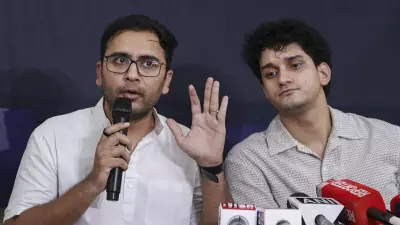
However, the assembly election defeat inflicted by the BJP not only ended the TMC's hold over power but also exposed vulnerabilities inside the party that had long remained hidden beneath its electoral dominance. The aftermath proved even more damaging than the defeat itself. The rebellion led by Ritabrata Banerjee, in which 58 of the party's 80 MLAs broke ranks, created the biggest crisis Mamata has faced since founding the Trinamool Congress in 1998.
"There was no way to raise our grievances within Trinamool," Ritabrata Banerjee said while explaining the rebellion, alleging that internal dissent had become impossible under the existing leadership structure.
The criticism reflected growing unease within sections of the party over the rise of Abhishek Banerjee and the concentration of authority around a shrinking leadership circle.
On Monday, 20 MPs have also written to send a letter to Lok Sabha Speaker "wanting to ally with NDA", party lawmaker Kakoli Ghosh Dastidar claimed. Faced with election defeat, party instability and persistent speculation about further defections, Mamata's political priorities seem to have inevitably changed. The TMC chief, who before assembly election challenged the BJP and said "will take over Delhi next", now finds herself in a situation where her national ambition has been replaced by the immediate task of preserving the party's relevance and unity.
It is in this context that her renewed interest in the INDIA bloc must be understood.
The alliance now offers Mamata something she urgently needs: a national political shield. Continued participation in a broad opposition platform allows her to remain relevant beyond Bengal, reassures nervous party leaders that the TMC is not isolated and makes it harder for rivals to portray her as a leader whose political influence has collapsed.
The Mamata Banerjee who arrived in Delhi on Monday was therefore very different from the Mamata Banerjee who often sparred with Congress over opposition leadership. For now, at least, the relationship has become less transactional and more strategic because the costs of political isolation are now far greater than they once were.
Stalin's calculation is the reverse
If Mamata's political circumstances have pushed her towards the INDIA bloc, Stalin's circumstances have pushed him away from it.
For years, the DMK-Congress relationship was regarded as one of the most stable partnerships in Tamil Nadu. Stalin was among the earliest regional leaders to publicly endorse Rahul Gandhi's leadership credentials while Rahul Gandhi fondly addressed him as "elder brother". The DMK consistently backed Congress on major national issues and emerged as one of the strongest supporters of opposition unity.
Unlike Mamata, whose relationship with Congress was frequently marked by friction, Stalin's equation with the party was built on predictability and mutual trust.
That equation has now come under unprecedented strain.
The Tamil Nadu assembly election dramatically altered the state's alliance equation. The rise of Vijay's TVK transformed what had long been a bipolar contest into a far more complex political battle. More importantly, as TVK emerged as the single largest party, Congress quickly jumped ship to align itself with Vijay rather than remain exclusively tied to the DMK's fortunes.
What was more heartbreaking for the DMK was that the Congress did not even talk or inform about its decision to switch alliance.
The DMK passed a resolution against the Congress, noting the grand old party, accusing it of backstabbing the party. Udhayanidhi Stalin explicitly stated that Congress "lacked minimum decency and gratitude" and should not be trusted in future alliances. Stalin's party also quickly wrote to Lok Sabha Speaker, requesting permission to sit separately from Congress in Parliament Unlike Mamata, whose immediate problem lies within her own organisation, Stalin's challenge comes from a rival political formation threatening to occupy the same ideological and electoral space. The TVK's emergence poses a direct challenge to the DMK's claim over anti-AIADMK and anti-BJP voters. Any move that strengthens Vijay simultaneously weakens the DMK's ability to reclaim its dominance.
Seen from Chennai, therefore, Congress's calculations may appear very different from how they look in Delhi.
While Congress may regard its engagement with TVK as a pragmatic adaptation to changing realities, the DMK sees it as an abandonment of a long-standing ally at a moment of vulnerability.
This explains why Stalin chose absence over participation.
The boycott was not merely symbolic. It was intended to communicate dissatisfaction with the direction in which the opposition alliance is evolving. The absence makes it clear that Stalin, or perhaps any regional satrap, would not want an opposition unity at the cost of political survival.
In contrast to Mamata, who at this time may see the INDIA bloc as a source of protection, Stalin may see it as a platform that could strengthen a rival (Congress), threatening the DMK's future.
On the other hand, Vijay's TVK, however, was not invited for the meeting and has not joined the INDIA bloc yet.
Since the inception, the Congress has always fought this internal battle of trying to lead the INDIA bloc as a national party against the BJP while seeking support from stronger regional forces. Leaders such as Mamata Banerjee, Stalin and Akhilesh Yadav commanded powerful state-level organisations and were frequently in a position to dictate terms.
Today, the balance has changed.
Speaking at Monday's meeting, Congress president Mallikarjun Kharge projected confidence rather than dependence.
"We have to fight unitedly against all anti-people policies of the government. We have to strengthen coordination both inside and outside Parliament," he told alliance partners while emphasising the need for continued cooperation.
Kharge also pointed to the opposition's coordinated resistance to the Centre's delimitation proposals as evidence that collective action could still yield results.
The tone reflected a party that increasingly sees itself as the anchor of the opposition. In fact, it was only Kharge from Congress who addressed the press conference after the meeting, while all the leaders sat on the same stage. Ironically, that growing centrality is producing opposite reactions among regional leaders.
The Sonia-Mamata hug
The warm exchange between Sonia Gandhi and Mamata Banerjee quickly became the defining image of the day. Yet its significance extends beyond personal chemistry or political symbolism.
It signifies a remarkable reversal in opposition politics.
The leader who once challenged Congress's centrality within the opposition is now among the strongest advocates of collective action. On the other hand, Stalin, whose party was once regarded as Congress's most dependable regional ally is increasingly questioning the value of remaining tied to the coalition.
That reversal tells us as much about the changing fortunes of regional parties as it does about Congress's gradual re-emergence as the opposition's central pole.
The INDIA bloc meeting was officially about coordination, strategy and preparing for future political battles. Unofficially, however, it can be seen from the lens of recent assembly elections, where it is trying to manage competing anxieties among its own constituents.
That is why the real story of Monday's meeting may not be about the resolutions passed inside the room. It would be about the divergent journeys of two regional giants who lost power around the same time but arrived at very different conclusions about what comes next.
And somewhere between Mamata's embrace and Stalin's empty chair probably lies the future of the INDIA bloc.