

Karnataka's Stand Against Central Legislation and the Fight for Gandhi's Legacy
In a significant political development, the Karnataka legislative assembly passed a resolution on February 4, 2026, opposing the Union Government's Viksit Bharat-Guarantee for Rozgar and Ajeevika Mission-(Gramin) Act of 2025. This new legislation replaced the long-standing Mahatma Gandhi National Rural Employment Guarantee Scheme, sparking intense debate about federal rights and the symbolic erosion of Gandhi's legacy in contemporary Indian politics.
The Political Divide and Federal Assertion
While the Congress-led Karnataka government exercised what it described as its constitutional right to challenge central decisions affecting state governance, the BJP-led opposition chose to walk out of the assembly debate. Opposition legislators raised slogans about unrelated corruption allegations rather than engaging with the substantive issues surrounding the employment scheme replacement. The political confrontation highlights growing tensions between state and central authorities in India's federal structure.
The resolution itself became a point of contention, with BJP members declaring it illegal while Congress representatives defended it as a legitimate exercise of state authority. This conflict may eventually involve the Governor's office, potentially escalating the constitutional dimensions of the dispute.

The Erosion of Gandhi's Symbolic Value
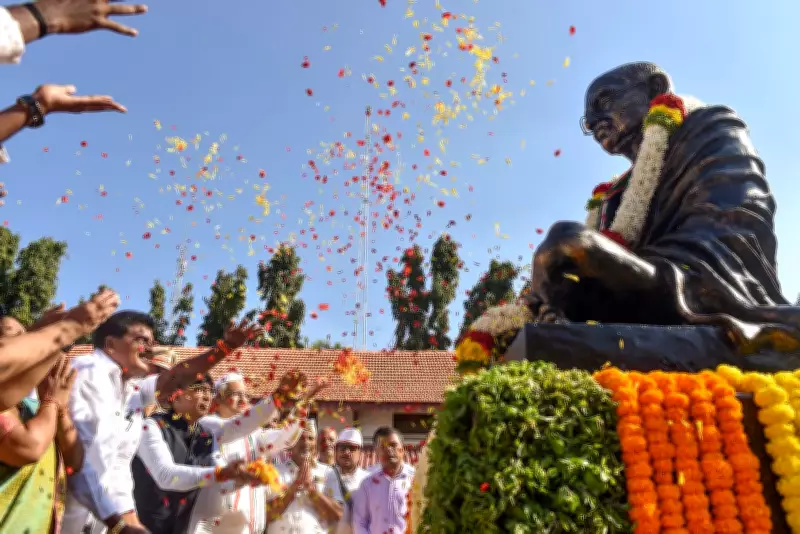
Beyond the immediate political and economic implications, the debate has centered on what many perceive as the systematic diminishing of Mahatma Gandhi's symbolic importance in national discourse. The replacement of his name in the employment guarantee legislation with the acronym RAM represents, according to critics, a calculated move to distance national policy from Gandhi's philosophical legacy.
Karnataka's assertive stance represents an attempt to reclaim Gandhi's image from what many view as political appropriation and distortion. The state government launched a public awareness campaign through newspaper advertisements featuring Gandhi in conversation with a character named Sangappa, who subtly represents central government perspectives.
Political Advertising and Symbolic Warfare
In January 2026, full-page government advertisements depicted Gandhi questioning the rationale behind replacing MGNREGA, with Sangappa offering what critics describe as cynical justifications about changing times rather than substantive policy defense. The advertisements highlighted the shift from employment as a right to employment as government charity, questioning why Gandhi's name should remain associated with programs whose fundamental principles have been altered.
The BJP responded with its own advertising campaign in February 2026, presenting a dramatically different portrayal of Gandhi. Their advertisements showed the Mahatma raising his cane threateningly against Congress leaders, accusing them of historical corruption. This imagery represents what historians describe as a dangerous distortion of Gandhi's commitment to nonviolence and reasoned discourse.
The Broader Context of Gandhi's Political Appropriation
Since 2014, Gandhi's image has been selectively utilized by various political forces, often reduced to symbolic fragments like the spectacles used in the Swachh Bharat Mission. Meanwhile, persistent social issues like manual scavenging and caste-based discrimination in sanitation work continue largely unaddressed, creating what critics call a disconnect between symbolic gestures and substantive social reform.
The Karnataka political battle occurs against a backdrop of increasing concern among historians and cultural observers about how Gandhi's legacy is being reshaped for contemporary political purposes. Artistic responses, including installations at the Kochi-Muziris Biennale, have attempted to reclaim Gandhi's complex legacy from simplistic political appropriation.

Implications for Historical Memory and Youth
As political parties engage in symbolic warfare over Gandhi's image, historians express particular concern about how younger generations will understand his legacy. When Gandhi is consistently portrayed as either a threatening figure with a raised cane or a benign symbol disconnected from his radical philosophy, the historical figure's complexity risks being lost entirely.
The current political moment represents what cultural observers describe as a critical juncture for how India remembers its foundational figures and principles. The battle in Karnataka extends beyond immediate policy disagreements to fundamental questions about historical memory, federal autonomy, and the role of symbolic politics in democratic discourse.





