

Kochi Corporation Faces Controversy Over Waste Biomining Agreement
Authorities in Kochi have ignited a significant controversy by signing a supplementary agreement with a private firm to biomine legacy waste at the Brahmapuram solid waste treatment plant. The decision was made without first quantifying the remaining garbage and without obtaining prior consent from the corporation council, drawing sharp criticism from opposition councillors who label the move as undemocratic and suspicious.
Unquantified Waste and Lack of Council Consent
According to corporation officials, the exact quantity of waste still requiring biomining remains unknown. An NIT team conducted a survey on March 6 to identify the precise amount of garbage left at the Brahmapuram premises. Initial estimates suggest around 1.96 lakh tonnes of waste remain after the first phase of biomining, with additional waste also present. The final figures will only be available once the NIT submits its survey report.
Mayor V K Minimol defended the agreement, stating that the first contract included a clause allowing for a supplementary agreement if additional waste needed treatment. "As per the supplementary agreement, we have to pay the cost of whatever quantity of waste is being biomined. We negotiated with the contractor and they have agreed to carry out biomining at Rs 1,672 per tonne," Minimol explained.

Opposition Alleges Undemocratic Process
Opposition leader V A Sreejith strongly criticized the mayor's actions, accusing her of keeping the corporation council in the dark. "When we discussed the matter in the council meeting, common understanding was that the biomining work could be awarded only after quantifying the waste. All of a sudden, mayor gave approval for signing an agreement with the private firm. She kept the corporation council in the dark," Sreejith stated.
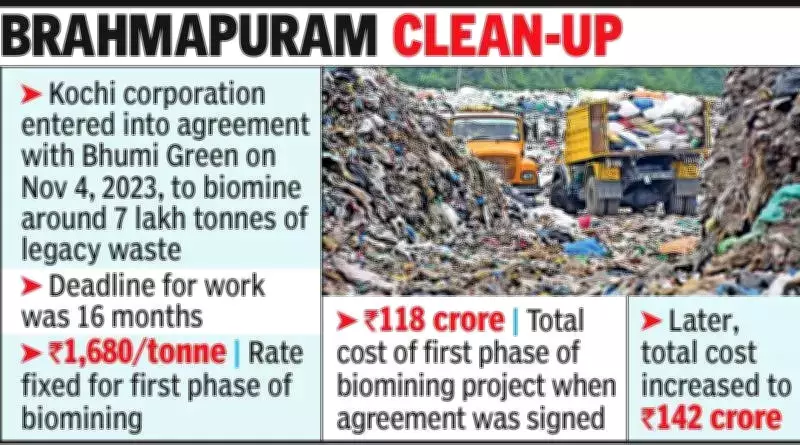
The private firm, Bhumi Green, had previously been awarded a contract to biomine approximately 7 lakh tonnes of legacy waste at Brahmapuram. The new supplementary agreement aims to address the remaining waste, but the lack of transparency and council approval has raised serious concerns about procedural integrity.
Cost Concerns and Waste Composition
Further complicating the issue are allegations regarding the nature of the remaining waste and associated costs. Sources within the Kochi corporation indicate that most of the waste yet to be biomined is biodegradable, which could be treated at a much lower cost compared to the previous contract.
During the initial agreement, the private firm justified higher rates by citing the need to transport refuse-derived fuel (RDF), a byproduct of biomining, to cement manufacturing units in other states. This transportation cost significantly escalated the overall expense, with biomining work priced at Rs 1,680 per tonne for the first 7 lakh tonnes.
However, with the remaining waste being primarily biodegradable, there will be minimal RDF production. Critics argue that if fresh tenders had been invited, the work could have been awarded to a competent firm at a substantially reduced rate, potentially saving public funds.
The controversy highlights ongoing challenges in municipal waste management and underscores the importance of transparent, democratic processes in civic decision-making. As Kochi grapples with its legacy waste problem, the corporation's handling of this agreement continues to face scrutiny from both political opponents and concerned citizens.






