Kolkata Interfaith Forum Hosts Critical Dialogue on Electoral Integrity Amid Voter List Revision
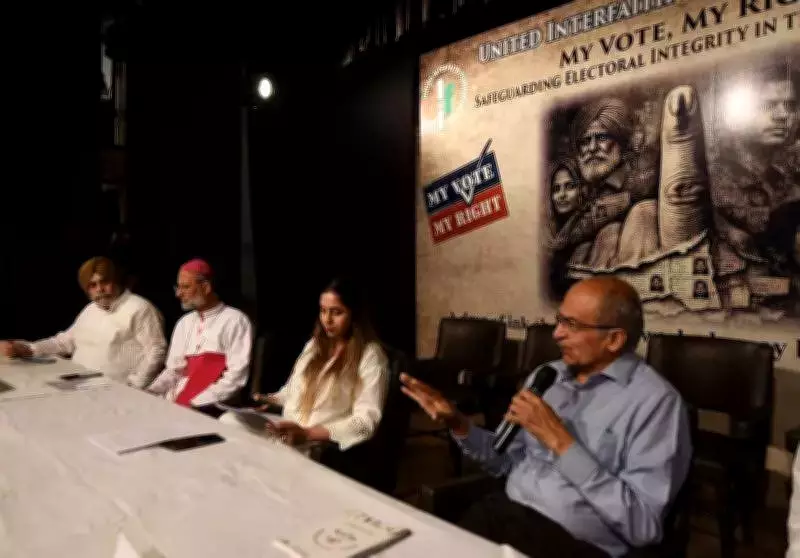
The United Interfaith Foundation organized a significant gathering in Kolkata on Saturday titled "My Vote, My Right: Safeguarding Electoral Integrity in the Context of SIR". This important event brought together a diverse group of political representatives, faith leaders, and civil society members to engage in a crucial conversation about democracy and citizenship. The timing proved particularly relevant as it coincided with the publication of West Bengal's final revised voter list, adding urgency to the discussions just weeks before the state's Assembly elections.
Constitutional Rights Beyond Paperwork
Speakers at the event emphasized that voting represents far more than mere administrative paperwork. They stressed that casting a ballot constitutes a fundamental expression of constitutional rights and called for increased vigilance, transparency, and collective responsibility in electoral processes. The panelists specifically examined the implications of the ongoing Special Summary Revision (SIR) of electoral rolls in Bengal, with concerns about how this administrative exercise might impact democratic participation.
Legal Perspectives on Electoral Inclusion
Senior Supreme Court advocate Prashant Bhushan delivered a powerful argument during the discussion, moderated by Chahat Ahluwalia. Bhushan asserted that democratic legitimacy depends not only on the technical accuracy of electoral rolls but equally on principles of inclusion and procedural fairness. "We already witnessed in Assam how the NRC exercise led to large-scale exclusion, and when its consequences became politically and socially untenable, corrective frameworks like the CAA were introduced," Bhushan noted.

He continued with a critical observation: "Now, with the SIR, we must ask whether we are repeating a cycle of administrative experimentation with fundamental rights. The Supreme Court in the Lal Babu Rai judgment made it clear that questions of identity and citizenship cannot be decided arbitrarily." Bhushan highlighted that more than one crore voters in Bengal have been called for hearings over what officials term 'logical discrepancies,' raising concerns about procedural burdens on citizens.
"In a country where millions possess no formal documentation due to poverty or displacement, the burden cannot unfairly shift onto the citizen," Bhushan argued. "Electoral revision must enhance integrity and not produce what I call a 'logical disruption' of democracy, where procedure overtakes justice."
Voices from Civil Society and Faith Communities
Satnam Singh Ahluwalia, member of the West Bengal Minorities Commission and secretary of the United Interfaith Foundation, echoed concerns about exclusionary practices. "Democracy cannot be reduced to paperwork. When revision processes begin to create fear among ordinary people, particularly the marginalized, we must collectively reaffirm that inclusion and not exclusion is the soul," he stated.
The Archbishop of Kolkata, Rev Elias Frank, offered a spiritual perspective on electoral participation. "In every voter stands a human story, a family, a future. Democracy is sacred because it recognizes that each life carries equal value. Administrative processes must be guided not only by rules but by compassion and accountability. To safeguard the vote is to safeguard human dignity itself," Frank emphasized.
Political Concerns About Transparency
Trinamool Congress Rajya Sabha MP Nadimul Haque raised specific concerns about the implementation of the SIR process in West Bengal. "A sitting Chief Minister of a state went to the Supreme Court to appeal for justice. The way SIR was conducted in the state lacked transparency. Lakhs of people were harassed and are anxious about their status," Haque reported, highlighting the human impact of administrative procedures.
The event served as a platform for cross-sector dialogue at a critical juncture in Bengal's electoral calendar, with participants urging for electoral processes that strengthen rather than undermine democratic participation as the state prepares for upcoming Assembly elections.