

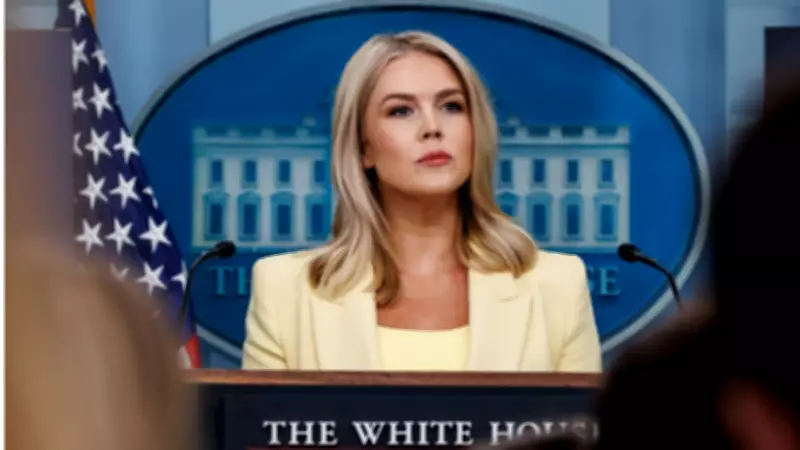
Karoline Leavitt Faces Widespread Online Mockery Over Bad Bunny Contradiction
Political figure Karoline Leavitt is experiencing significant online ridicule after social media users uncovered a glaring contradiction in her recent criticism of Puerto Rican superstar Bad Bunny. The controversy began when Leavitt publicly dismissed the artist ahead of his Super Bowl halftime performance, only for critics to discover she had previously incorporated one of his hit songs into her personal social media content.
The Initial Criticism and Subsequent Discovery
The backlash originated from comments Leavitt made surrounding both the Grammy Awards and the Super Bowl, where she targeted the internationally acclaimed rapper. However, eagle-eyed social media users quickly identified that on New Year's Eve, Leavitt had posted a 2025 recap video on Instagram set to a mash-up track titled "2025 End Now." The opening sample prominently featured Bad Bunny's chart-topping single "DTMF," which happens to be his most-streamed song on Spotify.
In the now-viral Instagram clip, Bad Bunny's music plays over various personal moments from Leavitt's life. The footage includes scenes from inside the Oval Office with her son Niko, highlights from the 2025 Super Bowl, intimate family gatherings, and professional appearances—including a notable clip featuring former President Donald Trump.

Social Media Reaction and Hypocrisy Claims
Online commenters immediately highlighted what they perceived as blatant hypocrisy. One user pointedly remarked, "Not her using bad bunny on her stuff," while another added with apparent amusement, "She probably has no clue lmao." A third observer humorously noted, "Bad bunny playing for the recap is the funniest shit I've seen so far this year. And we're only 19 days in she lowkey loves him like the rest of us."
The resurfaced Instagram post gained substantial traction after Leavitt delivered sharp criticism of Bad Bunny's remarks during his Grammy acceptance speech. While accepting his award, Bad Bunny addressed immigration enforcement issues, stating: "Before I say thanks to God, I'm going to say: ICE out. We're not savage, we're not animals, we're not aliens. We are humans, and we are Americans."
Leavitt's Official Response and Escalating Criticism
Two days following the Grammy ceremony, Leavitt responded during a press briefing. She characterized Bad Bunny's comments as "very ironic and frankly sad," particularly coming from celebrities who "live in gated communities, with private security, with millions of dollars to spend protecting themselves" while speaking out against law enforcement agencies.
Her criticism intensified as she continued: "You didn't hear this same type of uproar from celebrities in Hollywood when the previous administration allowed an invasion of our nation's borders and allowed innocent women and girls like Jocelyn Nungaray and Laken Riley to be killed, raped, and murdered at the hands of people who should have never been in our country in the first place."
Super Bowl Controversy and Trump's Reaction
The controversy reached its peak ahead of the Super Bowl halftime show, when Leavitt was questioned about whether Donald Trump would watch Bad Bunny's performance or instead tune into Turning Point USA's alternative broadcast called the All-American Halftime Show. Leavitt responded definitively: "I think the president would much prefer a Kid Rock performance over Bad Bunny. I must say that."
However, Trump later indicated through his Truth Social platform that he had indeed watched Bad Bunny's performance, describing it as "absolutely terrible." Video footage from his Mar-a-Lago watch party appeared to confirm that Trump opted to watch the official Super Bowl halftime show featuring Bad Bunny rather than the alternative broadcast, adding another layer of contradiction to the unfolding narrative.
The entire episode has sparked widespread discussion about celebrity political commentary, immigration discourse, and the perceived inconsistencies in public figures' statements versus their personal actions and preferences.






