The Rise of Mamata Banerjee: From Humble Beginnings to Political Icon
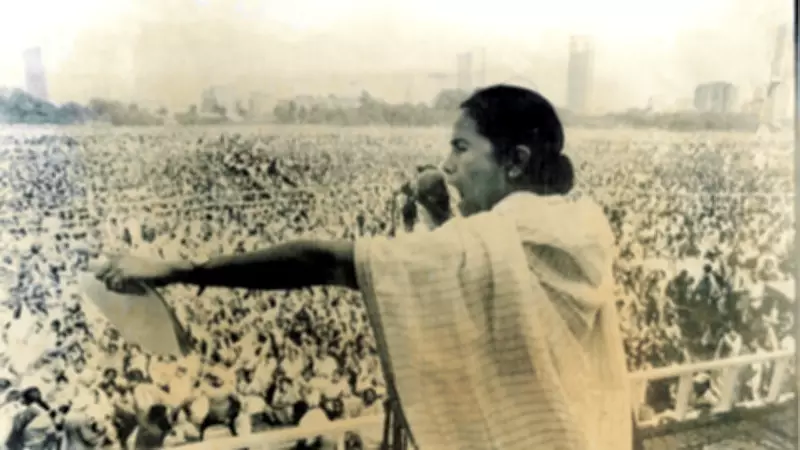
Mamata Banerjee, widely known as Didi across West Bengal, built her political career on resilience long before she attained power. Born on January 5, 1955, she had no political lineage to rely on. At the age of nine, she lost her father. Her political journey began within the ranks of the Indian National Congress, where she quickly emerged as an assertive young voice. By 1983, at just 28 years old, she was deeply involved in active politics when the party held a full session in Kolkata. Even at that early stage, those around her recognized a restless ambition—she was not content to remain in the background.
This instinct led to a stunning breakthrough in the 1984 general election, when she defeated veteran communist leader Somnath Chatterjee to become one of India's youngest Members of Parliament. This victory marked her arrival on the national stage, but her politics never strayed far from the streets of Bengal. She lost her seat in 1989, only to return in 1991, entering the government led by Prime Minister P.V. Narasimha Rao as the youngest Minister of State for Sports and Youth Affairs. Over the years, Banerjee crafted a distinctive image—a leader with simple habits and a sharp edge. She traveled in a Santro car, wore a white cotton saree and rubber slippers, and projected an austerity that resonated with the masses. Admirers saw fearlessness; critics saw defiance. Either way, she was never ignored. From the lanes of Kalighat to the center of power, she positioned herself as a maverick, challenging both the Congress and the Left at different points, refusing to be confined by political binaries. Her rise was fueled by confrontation as much as by connection, a combination that made her one of Bengal's most recognizable mass leaders.
The Fall: Anti-Incumbency and BJP's Surge
Decades later, that same defiant streak was on display when her dominance faced its toughest test. As the Bharatiya Janata Party surged and appeared poised to wrest Bengal from her grip, Banerjee reached out to her party workers with a familiar call to resist. "Wait for sunset. We will win. We will fight like tiger cubs," she said on Monday afternoon after arriving at the Bhabanipur counting center, where she was leading against Suvendu Adhikari, though her margin was narrowing with each passing hour. But this time, the sunset brought an end rather than a turnaround. After 15 years in power, the leader who had spent three decades shaping Bengal's political narrative saw her rule come to a close—marking the fall of one of India's most enduring and fiercely individual political journeys.

The BJP's surge across West Bengal pointed to something deeper than a routine electoral swing. The party's gains cut across both rural belts and urban pockets, dismantling Trinamool Congress strongholds that had held firm for years. At the heart of this shift was a growing disconnect between the state leadership and local realities. Mamata Banerjee's campaign centered heavily on her personal appeal, positioning herself as the face of governance across constituencies. But for many voters, that message no longer resonated. "Didi said she was the candidate everywhere, but when we looked at our broken roads and closed-down schools and local netas demanding 'cut-money' for every house repair, we didn't see her face. We saw faces of local bullies," said Animesh Mondal, a schoolteacher from North 24 Parganas, told TOI. The election was shaped not just by the BJP's rise, but by a sharp decline in Trinamool's own vote share. "This is a case of serious anti-incumbency where the Trinamool simply could not consolidate its vote share," said Zaad Mahmood, a political science professor at Presidency University.

Economic Concerns and Corruption
Economic concerns, particularly unemployment, played a decisive role. Despite repeated promises of industrial growth, many young people said opportunities remained scarce, forcing migration to states such as Karnataka, Maharashtra, and Gujarat. The state government's youth stipend scheme, intended as relief, appears to have backfired among aspirational voters. Allegations of corruption at multiple levels of governance emerged as a recurring theme in voter accounts. Importantly, dissatisfaction appeared to cut across communities that had traditionally backed the Trinamool. Mamata Banerjee's centralized approach, while effective in earlier elections, may have limited her ability to address corruption and inefficiencies at the grassroots. "She overlooked the corruption in her own backyard for too long," one analyst told TOI.
Shift in Muslim-Majority Districts
In a significant shift, voting patterns in Bengal's Muslim-majority districts broke away from the long-held trend of near-total support for the Trinamool Congress, altering the electoral arithmetic in a state where minority voters play a decisive role in 143 of 294 assembly seats. Across districts such as Murshidabad, Malda, and parts of South 24 Parganas, the minority vote fragmented, with support distributed among the Congress, CPM, ISF, AJUP, and in certain pockets, even the BJP.
Election Results: BJP's Landslide Victory
The TMC failed to open an account in 9 of 23 districts. The BJP won every seat in nine of West Bengal's 23 districts. The scale of the victory marks the BJP's first ascent to power in West Bengal, ending the 15-year rule of Didi. The party secured 206 seats in the 294-member assembly, crossing the two-thirds majority mark, while the TMC was reduced to around 80. In north Bengal, the BJP dominated the hill districts of Darjeeling, Kalimpong, Jalpaiguri, and Alipurduar, where the TMC and its allies failed to win a single seat. Across the wider north Bengal region, the BJP secured 40 of 54 seats, sharply reducing the TMC's presence. The results have reignited debate around the future of the Gorkha Territorial Administration (GTA). Union home minister Amit Shah had earlier promised a "permanent solution to the hill problems within the ambit of the Constitutional framework," which BJP MP Raju Bista interpreted as a signal that the GTA could be scrapped if the party came to power.
In the forested belt of Purulia, Bankura, and Jhargram—collectively known as Jungal Mahal—the TMC failed to win a single seat. Observers pointed to shifting support among the Kudmi-Mahato community, dissatisfaction over delayed Scheduled Tribe status, and internal divisions within the TMC. The BJP also made gains in the industrial district of Paschim Bardhaman, winning all nine seats—six of which had been held by the TMC in the previous election. Local TMC workers attributed the defeat to leadership issues. In the hills, Anit Thapa, chief of the Bharatiya Gorkha Prajatantrik Morcha and head of the GTA, said the loss was due to an "overall anti-establishment voting" trend. In Siliguri, defeated TMC leader Goutam Deb pointed to "SIR deletions and added factors concerning the administration" as reasons for the party's performance. Meanwhile, BJP leader Jitendra Tewari described the verdict as a mandate to "reindustrialise Bengal, create job opportunities and ensure safety of women."