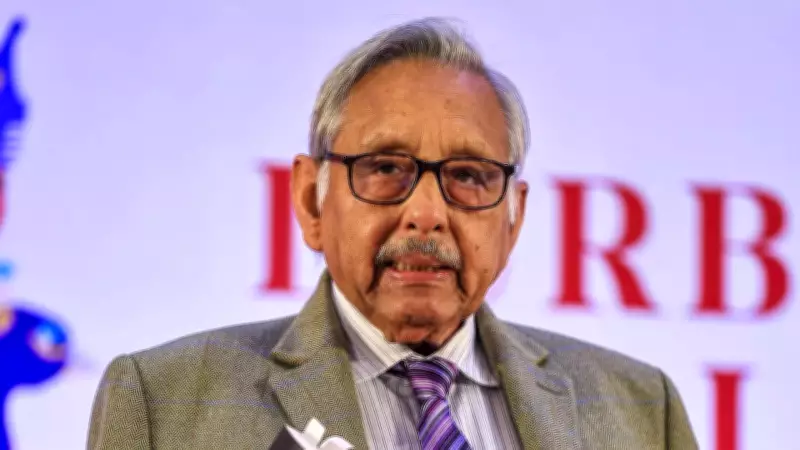
Congress Leader Mani Shankar Aiyar Defines Political Identity, Excludes 'Rahulian' Label
Veteran Congress leader Mani Shankar Aiyar on Wednesday provided a detailed clarification regarding his recent remarks where he described himself as a "Gandhian", a "Nehruvian", and a "Rajivian", but explicitly stated he is not a "Rahulian". The senior political figure elaborated on the reasoning behind his self-identification, emphasizing personal experiences and generational differences.
Explaining the 'Gandhian' Connection
Aiyar recounted a poignant childhood memory to justify his Gandhian affiliation. "I was six years old and my brother was four when Mahatma Gandhi picked us up in his arms and said 'ye mere aankhon ke suraj aur chand hain' (these are the sun and moon of my eyes)," he told PTI. This early encounter, he explained, profoundly influenced his political outlook and cemented his identity as a 'Gandhivaadi' from a very young age.
The 'Nehruvian' Influence During Formative Years
On his alignment with India's first Prime Minister, Jawaharlal Nehru, Aiyar highlighted the timing of Nehru's tenure. "I was six when he became the prime minister, and I was 23 when he ceased being one, so my entire growing-up years were steeped in the Nehruvian ethos," he stated. This period, covering his adolescence and early adulthood, immersed him in Nehru's vision and policies, making the Nehruvian label a natural fit for his ideological framework.

Why He Considers Himself a 'Rajivian'
Aiyar expressed deep admiration for former Prime Minister Rajiv Gandhi, despite Rajiv being two years his junior. "I call myself a Rajivian because it was he who astonished me by bringing me into the PMO and by doing the things he did... I could not believe it. That is how I became a Rajivian," he remarked. This professional opportunity and Rajiv Gandhi's actions left a lasting impact, fostering a strong association that Aiyar continues to acknowledge.
Absence of 'Indiravian' and 'Rahulian' Labels
The Congress leader clarified that he does not identify as an "Indiravian" due to his disapproval of Indira Gandhi's declaration of the Emergency. "I totally disapproved of Indira Gandhi converting our democracy into a tyranny by declaring an Emergency, albeit for only 18 months," he explained, underscoring his principled stance against that period of Indian history.
Regarding Rahul Gandhi, Aiyar pointed to significant age and experiential gaps. "How can one expect me to be a 'Rahulian' when the boy is about 30 years younger than me, and I haven't had an opportunity to work with him? That is why I cannot be a 'Rahulian' because he is far too much younger than me and far too distant from me in his political life," he asserted, making it clear that their lack of direct collaboration and generational divide preclude such an affiliation.
Context of Strained Ties with Congress Leadership
These remarks emerge against a backdrop of strained relations between Aiyar and the current Congress leadership. The controversy initially sparked when Aiyar praised the Pinarayi Vijayan-led government in Kerala, expressing confidence in the chief minister's continuation. At an international seminar in Thiruvananthapuram, he advocated for legal amendments to strengthen Panchayati Raj, referencing reports and insights from experts.
In response, the Congress party swiftly distanced itself from his comments. Party spokesperson Pawan Khera emphasized that Aiyar "has had no connection whatsoever with the Congress for the past few years" and speaks purely in a personal capacity. Congress general secretary Jairam Ramesh countered by expressing optimism about the Congress-led United Democratic Front's return to power in Kerala, reflecting the ongoing tension within party ranks.
Aiyar's detailed explanation not only sheds light on his personal political journey but also highlights the evolving dynamics and internal challenges facing the Congress party as it navigates leadership transitions and ideological debates.