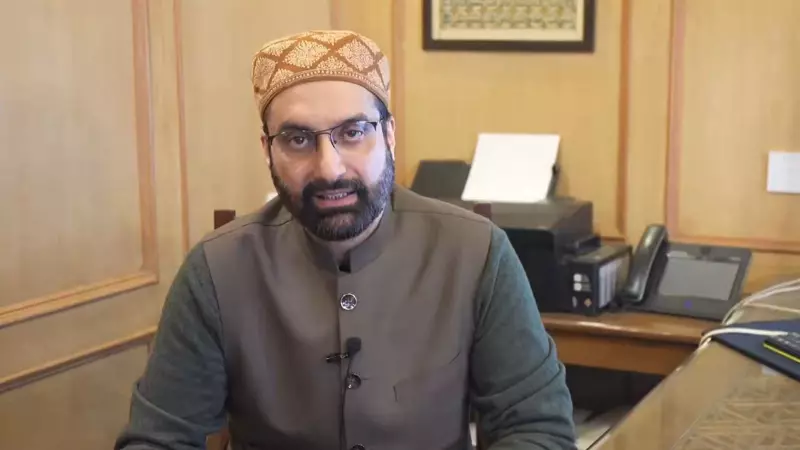
In a poignant start to the year, Kashmir's chief cleric, Mirwaiz Umar Farooq, revealed he was confined to his residence and prevented from leading Friday prayers at Srinagar's historic Jamia Masjid on January 2, 2026. Delivering his first Friday sermon of the year via a video message on social media platform X, the Mirwaiz spoke of an atmosphere of "enforced silence" in the region and recounted the traumatic events of the previous year.
A Message from Confinement, Not the Mosque
The Mirwaiz began his address by stating he was meeting his followers not from the pulpit of the Jama Masjid, as is traditional, but through a digital screen, as he had been "once again been put under arrest." He expressed his inability to move freely without official clearance or address press conferences, highlighting the severe restrictions on his religious and social role.
He directly addressed the recent pressure from authorities to remove references to the Hurriyat Conference from his social media profiles. Explaining his decision to comply, he stated that with Hurriyat constituents banned under the UAPA and their offices sealed, maintaining his social media presence was his last channel of communication. "I was left with little choice but to safeguard the minimal channel of communication available to me or face the risk of complete silencing," he said, while firmly asserting that his beliefs and convictions remained unchanged.

Reflecting on a Year of Tragedy: Pahalgam and Delhi
In his message, Mirwaiz Umar Farooq reflected on the painful memories of 2025, a year he described as marked by tragedy. He specifically highlighted two incidents that "shook us deeply" – the Pahalgam attack and the Red Fort blast in Delhi.
He emphasized that these acts of violence were condemned by everyone in the Kashmir Valley. The cross-border hostilities that followed the Pahalgam attack served as "a stark reminder of how fragile peace in the region continues to be." He connected these events to the broader, unresolved Kashmir conflict, arguing that despite the "unilateral changes" made in 2019 with the abrogation of Jammu and Kashmir's special status, the region remains in an unsettled state that can erupt at any time.
"The reality is that the Kashmir conflict continues to keep the region in an unsettled state that can erupt anytime. That is why wars are paused, not ended, and dialogue finds no takers," he stated.
A Widening Trust Deficit and a Climate of Fear
The Mirwaiz painted a grim picture of the current situation, pointing to a growing trust deficit between Kashmiris and New Delhi. He stated that Kashmiris often find themselves facing suspicion and attacks in other parts of India, and this gap in trust has widened, not shrunk.
He lamented that an "enforced silence is projected as acquiescence" and noted the powerlessness felt even by the elected government of the Union Territory. He spoke of a prevailing sense of hopelessness and an "existential crisis" stemming from fears of demographic change and the loss of identity since the state's reorganization.
The banning of socio-political institutions like the Awami Action Committee and the Ittihadul Muslimeen in the past year has extinguished much of the space for advocacy and dialogue, he claimed. "Today, we are operating in an environment where any expression of views contrary to the State, or any disagreement, is increasingly criminalised, branded as 'anti-national' and penalised," the Mirwaiz asserted.
Despite the bleak assessment, Mirwaiz Umar Farooq described Kashmiris as "natural optimists" and expressed a lingering hope for dialogue. He reminded his audience of his past engagements with Indian leadership, including Prime Ministers Atal Bihari Vajpayee and Manmohan Singh, and affirmed that his path of seeking peaceful resolution through dialogue remains unchanged as the new year begins.