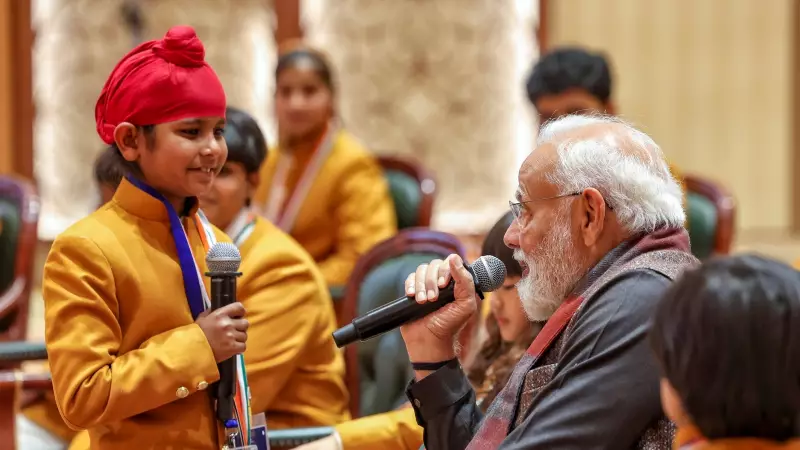
Prime Minister Narendra Modi, while addressing the nation on the solemn occasion of Veer Bal Diwas, drew a powerful connection between India's linguistic diversity and a national campaign to shed a colonial mindset. He cited the remarkable example of the recent Winter Session of Parliament, where a record number of lawmakers chose to speak in their mother tongues.
Parliament Speeches Herald a New Linguistic Pride
The Prime Minister revealed a significant parliamentary trend as a symbol of change. During the Winter Session, 160 Members of Parliament delivered speeches in their own native languages. He provided a detailed breakdown, noting that approximately 50 speeches were in Tamil, over 40 in Marathi, and around 25 in Bangla.
"This would be difficult to see in any other country. It is a matter of pride for all of us," PM Modi stated. He framed this development as a direct counter to a historical imposition. The PM attributed the origin of what he called a "slave mentality" to the policies introduced by British politician Thomas Macaulay in 1835, which he said persisted even after Independence.

"Macaulay had tried to crush the linguistic diversity of the country. As we become free of slave mentality, linguistic diversity is becoming our strength," he asserted during the event held in New Delhi on Friday, December 27, 2024.
Honouring Martyrdom and Youth on Veer Bal Diwas
The event was organized to commemorate the martyrdom of the Sahibzade Baba Zorawar Singh and Baba Fateh Singh, the young sons of Guru Gobind Singh. PM Modi paid rich tributes to their courage, describing them as embodying India's indomitable spirit.
He contrasted their valour with the cruelty of Mughal emperor Aurangzeb, stating that the fight was between the fundamental ideas of the country and religious fanaticism. "The story of the sacrifice of the Sahibzade should have been on the lips of every person, but unfortunately, even after Independence, 'gulami ki mansikta' (slave mentality) remained in the country," Modi observed.
Marking a decisive shift, he declared, "Bharat has now decided we must be free from this slave mentality." He announced a focused mission, noting that 2025 will mark 200 years since Macaulay's policy, and the coming decade will be dedicated to completely eradicating this mindset.
Celebrating Young Achievers and a Vision for Viksit Bharat
The same ceremony also saw the conferment of the Pradhan Mantri Rashtriya Bal Puraskar to 20 exceptional children for their outstanding achievements. Turning to the nation's youth, the Prime Minister expressed immense faith in Generation Z, stating that their generation would lead India towards the goal of a developed nation, or 'Viksit Bharat'.
"Earlier, the youth was scared to even dream... But today, the country is searching for talent, and giving it a platform," he said. He highlighted the National Education Policy (NEP) 2020 as a foundational reform designed to empower this new generation with more opportunities and a stronger sense of confidence.
PM Modi's address wove together historical reflection, contemporary political symbolism, and a forward-looking vision, positioning linguistic pride and the courage of the young—both past and present—as central pillars in India's journey to reclaim its cultural confidence and build its future.