For years, a shadowy figure known only through intelligence files and whispered accounts operated deep within the forests of India's Maoist heartland. Now, through revelations from surrendered cadres, the story of Dr Rafiq alias Mandip is coming to light. He is the only formally qualified MBBS doctor known to have joined the CPI (Maoist), dedicating years to providing critical medical services in the remote Dandakaranya region before moving to Jharkhand, where he remains at large.
From Punjab to the Red Corridor: The Making of a Rebel Doctor
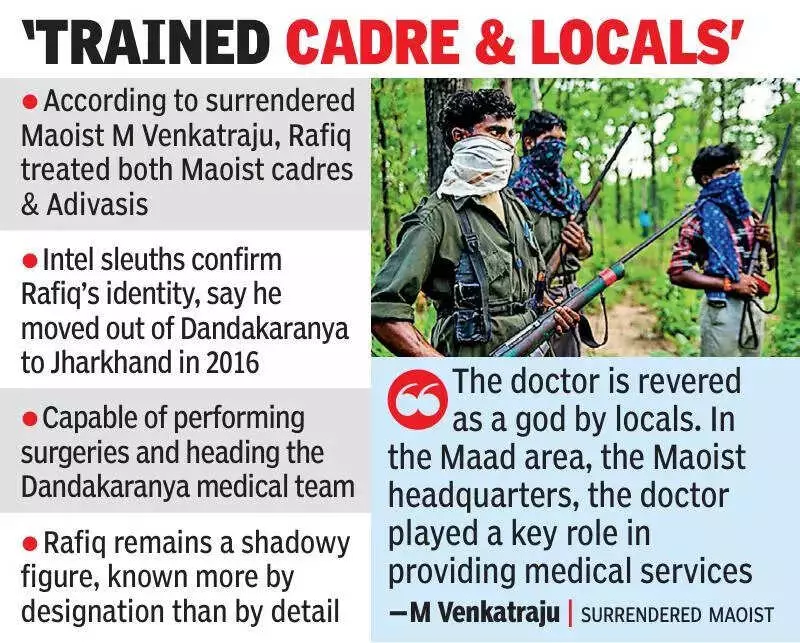
Originally from Punjab, Dr Rafiq's journey into the heart of the Maoist movement is a tale shrouded in mystery. Much of his work remained outside official records until surrendered Maoists like M Venkatraju, alias Chandar or CNN Chandu of the Jana Natya Mandali, began to share details. According to Chandu and anti-Naxal intelligence officials, Dr Rafiq was not just a medic for the armed cadres but a lifeline for the local Adivasi population, who had little to no access to formal healthcare.
He treated everyone from injured Maoist fighters to Adivasis suffering from common ailments, earning a god-like reverence in the isolated communities. People would travel from distant forest villages to see him for everything from fevers to emergency surgical procedures. His presence was first noted by police in 2013 based on arrested cadres' confessions, which described a "mystery doctor" capable of performing surgeries and leading the Dandakaranya medical team.

Building a Medical Legacy in the Forest
Dr Rafiq's contribution went far beyond treating patients. He systematically built medical capacity in an area where government services were scarce. He trained local youth and Maoist cadres in essential skills like first aid, stitching sutures for bullet wounds, and casualty evacuation. His system ensured that each Maoist dalam (squad) had at least one trained medical aide. This created a generation of underground paramedics, some of whom, like Ravi and Champa, continued his work even after he left the region in 2016.
Perhaps his most enduring legacy is the series of detailed medical manuals he authored. These documents standardized treatment for a range of critical conditions faced in the forest, including bullet injuries, malaria, snake bites, gastroenteritis, and wartime trauma care. These manuals circulated widely across Maoist divisions and were used by both cadres and civilians, becoming essential guides for survival. Chandu recalled a harrowing instance where Rafiq successfully removed a bullet lodged just centimetres from a fighter's heart, working with minimal resources.
Hybrid Medicine and an Enduring Shadow
In a pragmatic blend of modern and traditional knowledge, Rafiq's manuals also documented 'jadibuthi' or herbal medicine derived from forest plants. This knowledge, shared by Adivasi Vaddes (Pujaris), was incorporated to create a hybrid approach: use allopathy when available, and rely on proven herbal remedies when it was not. The manuals even acknowledged the cultural context, advising people to take medicine alongside performing puja if they believed a disease was a sign of an angry god.
While counter-insurgency operations like Operation Kagar intensify, Jharkhand is now seen as a relative safe haven, and it is from here that Dr Rafiq is believed to be operating. For the outside world, he remains an enigmatic figure—a qualified healer who chose a path of rebellion, leaving behind a complex legacy of medical service in one of India's most conflict-ridden landscapes. His wife, known as Rinki, was also reported to have treated senior Maoist leader Prashant Bose in 2018, indicating the family's deep involvement.