

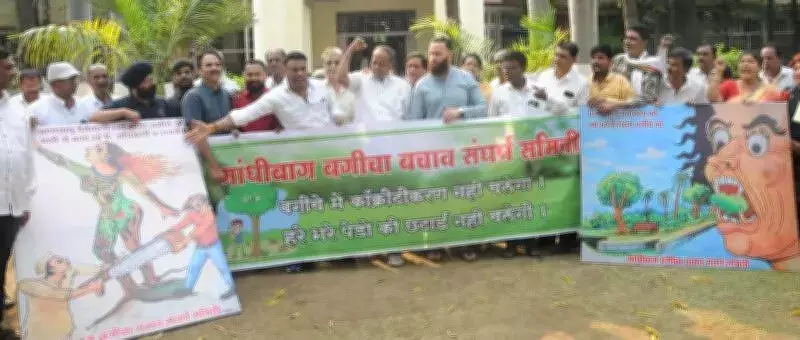
Nagpur Residents Rally Against Civic Body's Plan for High-Rise in City's Last Major Green Space
In a significant display of community resistance, residents of Central Nagpur gathered on Friday to vehemently oppose the Nagpur Municipal Corporation's (NMC) controversial proposal to construct an 18-storey commercial complex within Gandhibagh Garden. This green expanse is widely regarded as the sole remaining major open space in an already densely populated and congested locality, sparking fears of irreversible environmental and urban degradation.
Organized Protest and Memorandum Submission
Under the unified banner of the Gandhibagh Garden Bachao Sangharsh Samiti, the protest was spearheaded by former corporator Raman Paigwar and Congress corporator Wasim Khan. A large assembly of concerned citizens converged at the NMC headquarters, where they raised resonant slogans such as "Struggle on, save Gandhibagh garden" to amplify their demands. The culmination of the demonstration was the formal submission of a memorandum to Mayor Neeta Thakre, urgently calling for the immediate cancellation of the project to preserve this vital urban lung.
Details of the Proposed Development and Conflicting Claims
According to the Samiti, the NMC's plan involves erecting the commercial complex under a design-build-finance-operate-and-sell (DBFOS) model. This would entail merging the land of the existing G+1 Sokta Bhavan building with a substantial portion of Gandhibagh Garden. While the Sokta Bhavan structure occupies approximately 6,700 square feet, residents allege that nearly 68,404 square feet—equivalent to about one-third of the garden's total area of roughly 2 lakh square feet—has been earmarked for commercial exploitation.

However, conflicting narratives have emerged from within the civic administration itself. Deputy Municipal Commissioner (Garden Department) Ganesh Rathod stated he was unaware of the exact extent of garden space to be acquired. In stark contrast, a senior official from the NMC's project department claimed that only "around 300 square feet of the garden's space would be acquired" for the complex. This discrepancy highlights internal confusion and a lack of transparency regarding the project's scope. Residents further revealed that a letter of acceptance dated November 6, 2025, has already been issued to a developer, granting comprehensive development and sale rights, intensifying their apprehensions.
Environmental and Traffic Implications
The proposed development raises severe environmental and logistical concerns. Locals estimate that nearly 27 trees could be adversely affected if the plan proceeds, further diminishing the area's green cover. Additionally, the project includes provisions for parking space for 382 cars and 566 two-wheelers. Given that the Gandhibagh area, situated off Central Avenue, is officially designated as a congested zone, this influx of vehicles is expected to exacerbate existing traffic snarls on the busy arterial road, leading to potential gridlock and safety hazards.
Legal Context and Court Scrutiny
The protest gains added urgency against the backdrop of recent judicial intervention. On Thursday, the Nagpur bench of the Bombay High Court took suo motu cognisance of the absence of a designated playground in Hindustan Colony on Amravati Road and registered a Public Interest Litigation (PIL). The court directed authorities to thoroughly examine the availability of open recreational spaces across Nagpur. Residents argue that if the NMC proceeds with acquiring any portion of Gandhibagh Garden for commercial purposes, it could risk inviting contempt proceedings, as such a move would directly contradict the court's emphasis on protecting and augmenting public utility spaces.

Community Appeals and Mayoral Assurance
Emphasizing Gandhibagh Garden's critical role as the last remaining open green space in central Nagpur, residents have passionately urged Mayor Thakre to halt the project immediately. They have called for a transparent public hearing to discuss the implications and explore alternatives. The community warns that this fight transcends a single development; it is fundamentally about safeguarding the city's shrinking green lungs for future generations. In response, Mayor Thakre has assured the protesters that she will diligently look into their demands, though concrete action remains pending.
This unfolding situation underscores a broader urban challenge: balancing development with environmental preservation in rapidly growing cities. As Nagpur grapples with congestion and dwindling green zones, the outcome of this protest could set a precedent for how civic bodies address community concerns and legal mandates regarding public spaces.





