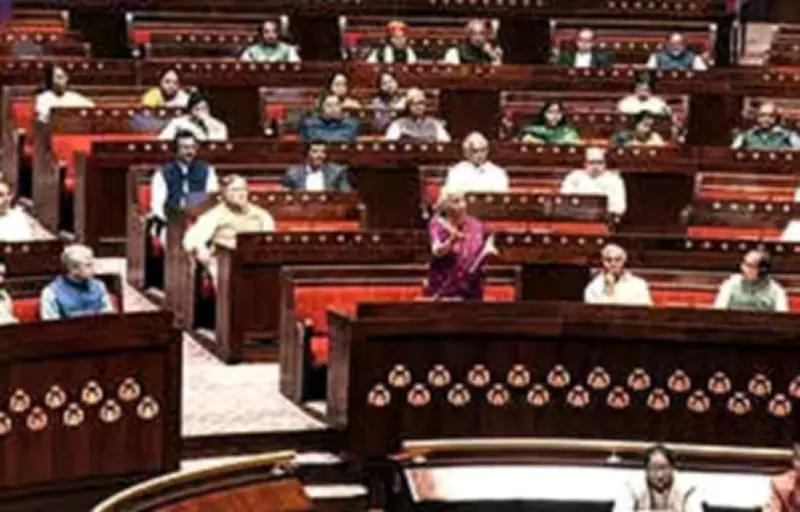
NDA Set to Strengthen Upper House Numbers in Crucial Rajya Sabha Elections
The ruling National Democratic Alliance (NDA) is poised to significantly bolster its representation in the Rajya Sabha following the upcoming biennial elections scheduled for March 16. A total of 37 seats across multiple states will be contested, with the outcome heavily influenced by strategic alliances and state-level political dynamics.
Key Retiring Members and Alliance Dynamics
The fate of several prominent political figures hangs in the balance as their terms conclude. Notable retiring members include veteran leader Sharad Pawar from the NCP-SP, Congress spokesperson Abhishek Manu Singhvi, RPI-A's Ramdas Athawale, DMK's Tiruchi Siva, and Shiv Sena UBT's Priyanka Chaturvedi. Their potential re-election or replacement will depend entirely on how effectively their respective parties coordinate with alliance partners in the complex electoral arithmetic.
Current projections indicate the BJP-led NDA's tally could surpass 130 seats in the 243-member Upper House, which currently has one vacancy each in Jharkhand and West Bengal. This anticipated gain of at least four additional members would further consolidate the ruling coalition's legislative influence.

State-Wise Vacancies and Political Advantages
The Rajya Sabha seats becoming vacant in April are distributed across ten states:
- Maharashtra: 7 seats
- Tamil Nadu: 6 seats
- West Bengal: 5 seats
- Bihar: 5 seats
- Odisha: 4 seats
- Assam: 3 seats
- Telangana, Chhattisgarh, Haryana: 2 seats each
- Himachal Pradesh: 1 seat
The NDA holds a distinct advantage as it governs six of these ten states: Maharashtra, Odisha, Bihar, Chhattisgarh, Haryana, and Assam. Meanwhile, opposition alliances control the governments in Himachal Pradesh, Tamil Nadu, Telangana, and West Bengal.
Maharashtra: The Crucial Battleground
In Maharashtra, the governing Mahayuti coalition is expected to secure six of the seven available seats, with the opposition Maha Vikas Aghadi (MVA) likely claiming just one. This significant advantage for the NDA in India's second-most populous state could prove decisive in the overall numbers game.
The MVA alliance faces considerable internal maneuvering as it must choose between candidates from Shiv Sena UBT and NCP(SP). A critical question remains whether the NCP will extend support to Sharad Pawar's candidacy amid ongoing discussions about a potential merger of the party's factions. NCP(SP) working president Supriya Sule has not ruled out nominating her father, stating that an MVA meeting will soon convene to finalize names.
The seven Rajya Sabha members from Maharashtra whose terms expire on April 2 are:
- Sharad Pawar (NCP-SP)
- Fauzia Khan (NCP-SP)
- Bhagwat Kishanrao Karad (BJP)
- Dhairyasheel Patil (BJP)
- Ramdas Athawale (RPI-A)
- Priyanka Chaturvedi (Shiv Sena UBT)
- Rajani Patil (Congress)
Bihar and West Bengal: Contrasting Scenarios
In Bihar, elections will be held for five seats, three of which are currently held by the governing NDA (including two by JDU). The principal opposition party, RJD, faces a mathematical challenge with only 25 MLAs. Even combined with Congress and Left parties, the opposition alliance strength reaches just 35—five short of the required number to retain a Rajya Sabha berth. This makes it extremely difficult for RJD to re-nominate MP and former Union minister Prem Chand Gupta to the Upper House.
West Bengal presents a different picture, where the governing Trinamool Congress is expected to win four of the five available Rajya Sabha seats, with the opposition BJP potentially securing one.
These biennial elections represent more than just routine parliamentary turnover—they offer a crucial snapshot of alliance stability, regional political equations, and the evolving balance of power in India's bicameral legislature. The outcomes will significantly impact the government's ability to pass legislation and shape national policy debates in the coming years.