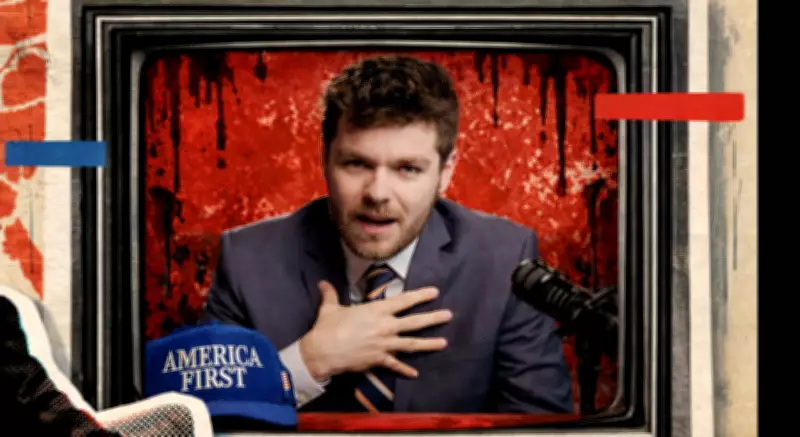
Nick Fuentes: The 27-Year-Old Far-Right Provocateur Shaping America's Political Fringe
Nick Fuentes, aged 27, stands as one of the most disruptive and controversial figures in contemporary American far-right politics. Depending on perspective, he is either a marginal provocateur amplified by media spectacle or a significant force reshaping the nationalist landscape. Over the past decade, Fuentes has meticulously built a loyal online following, established parallel political institutions, and repeatedly clashed with mainstream conservatives, all while moving between deplatforming and resurgence in the volatile digital economy.
From Libertarian Teen to "America First" Broadcaster
Nicholas Joseph Fuentes was born on August 18, 1998, in Illinois and raised in the predominantly white Chicago suburb of La Grange Park. Growing up Roman Catholic, he attended Lyons Township High School, where he served as student council president, before briefly studying politics and international relations at Boston University. Fuentes presents his political evolution as intellectual rather than purely emotional, tracing his roots to mainstream libertarian conservatism rather than immediate white nationalism.
Early influences included libertarian economics, Austrian and Chicago school thought, and the post-Ron Paul online Right. He consumed content from PragerU, participated in their "Prager Force" Facebook group, and listened extensively to conservative radio host Mark Levin. Fuentes credits Levin with planting early seeds about demographic concerns, recalling Levin's question: "America's becoming a majority non-white country. Does anybody think that's a good idea?" This marked the beginning of his shift from conventional Republican politics toward harder nationalist positions.

The Evolution of a Movement
In February 2017, while still at Boston University, Fuentes debuted America First with Nicholas J. Fuentes on the Right Side Broadcasting Network. That same year, he attended the Unite the Right rally in Charlottesville, Virginia, where torch-bearing demonstrators chanted antisemitic slogans. RSBN subsequently cut ties with him, prompting Fuentes to return to Chicago and begin independently livestreaming America First every weeknight.
Broadcasting from behind a wooden desk against a greenscreen, typically dressed in a suit and tie, Fuentes delivers commentary that often features extended monologues punctuated by expletive-laced tirades. His rhetoric has increasingly embraced white nationalist and Christian nationalist themes, though he denies being a "white supremacist," preferring "Christian conservative." He has praised Adolf Hitler, denied aspects of the Holocaust, opposed interracial marriage, and promoted the "Great Replacement" theory.
The Groypers and Political Confrontations
As Fuentes' audience grew, his followers coalesced into the "Groypers," named after a variant of the Pepe the Frog meme. This young, chronically online base uses irony, in-jokes, and meme culture to disseminate anti-immigration, antisemitic, anti-feminist, and anti-LGBTQ+ positions. In 2019, Groypers launched the first "Groyper War," confronting Turning Point USA founder Charlie Kirk at campus events over immigration and U.S. support for Israel.
These confrontations exposed deepening ideological rifts within conservatism. While Kirk promoted inclusive, free-market capitalism, Fuentes pushed a far more hardline, ethnically defined nationalist vision. In 2020, Fuentes founded the America First Political Action Conference (AFPAC) as a nationalist alternative to CPAC and established the nonprofit America First Foundation to promote "Nationalism, Christianity and Traditionalism."
January 6 and Its Aftermath
Following Donald Trump's 2020 election defeat, Fuentes became involved in the "Stop the Steal" movement. On January 6, 2021, he attended Trump's speech in Washington, D.C., and later used a bullhorn near the Capitol to urge the crowd forward. While Fuentes reportedly did not enter the Capitol building and hasn't been charged, numerous Groypers did enter, with at least seven later charged and sentenced.

The episode cemented Fuentes' notoriety and intensified scrutiny of his movement's internal culture. Some Groypers, at his urging, had publicly sworn extreme oaths, which Fuentes described as irony or dark humor. The aftermath revealed tensions within his movement, with former associate Jaden McNeil accusing Fuentes of dishonesty regarding frozen assets.
Deplatforming and Financial Controversies
Fuentes' growth has unfolded alongside repeated deplatforming. He has been banned from YouTube, Facebook, Instagram, Twitch, and payment services including Venmo and PayPal. X (formerly Twitter) reinstated his account after Elon Musk's acquisition, but he primarily relies on Rumble, Telegram, and his own platform, cozy.tv, for revenue.
Financial controversies have followed his career. In December 2020, French cryptocurrency investor Laurent Bachelier transferred approximately $250,000 in Bitcoin to Fuentes before dying by suicide. The donation roughly doubled in value within months, though Fuentes' accounts were temporarily frozen. Investigative reporting has also revealed his attempts to secure funding from established Republican donors, including a 2022 meeting with an employee of venture capitalist Peter Thiel. When no funding materialized, Fuentes publicly attacked Thiel, Trump, and J.D. Vance.
Breaking with MAGA and Current Influence
Initially a Trump supporter, Fuentes has increasingly criticized MAGA for what he describes as insufficient ideological purity. By late 2025, he was attacking the movement's stance on immigration, support for Israel, corporate influence, and Trump's personnel choices, declaring "MAGA is dead" and calling it a "cult." Despite these ruptures, he maintains relationships with some mainstream conservative media figures, appearing in a lengthy, cordial interview on Tucker Carlson's podcast.
Recent coverage frames Fuentes as punching above his weight within right-wing media. His America First livestream sometimes attracts up to one million views per episode, and Chicago Magazine recently ranked him the seventh most influential Chicagoan. He functions both as pariah and symbol, rejected by institutional conservatives but frequently invoked by liberal commentators as evidence of right-wing radicalization.
At 27, Nick Fuentes occupies a distinct space in American politics: neither institutional power broker nor marginal unknown, but a disruptive presence sustained by controversy, audience loyalty, and the dynamics of the online attention economy. His influence remains disproportionate to formal political power but real enough to provoke sustained scrutiny across the political spectrum.