

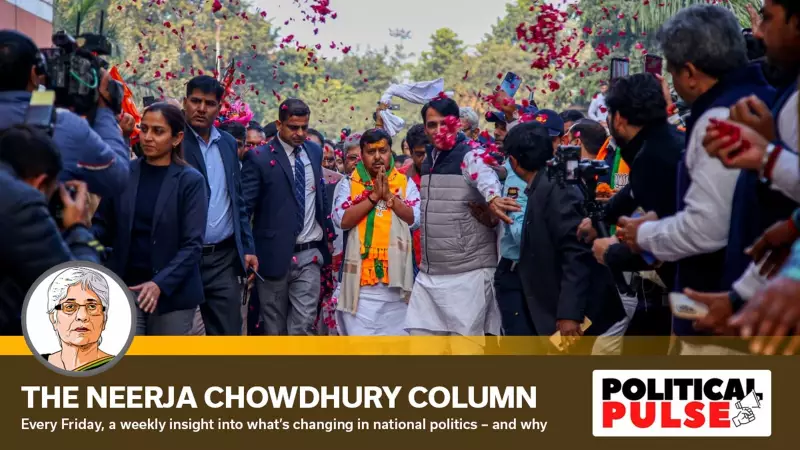
In a significant organisational reshuffle, the Bharatiya Janata Party (BJP) has elevated five-term Bihar MLA and state minister Nitin Nabin to the post of national working president. The decision, announced by the party's Parliamentary Board on Sunday, December 18, 2025, marks a strategic shift in the ruling party's leadership blueprint and offers key insights into its future direction.
The Surprise Elevation and the Centralised Command
The appointment concludes a prolonged period of speculation over the BJP's national presidency. The incumbent, J P Nadda, had received an extension until the 2024 Lok Sabha polls. Senior party insiders had hinted that the final choice would be unexpected, a prediction that came true with Nabin's selection. This move underscores that the ultimate authority within the BJP rests firmly with the duo of Prime Minister Narendra Modi and Home Minister Amit Shah. Despite the party's performance in the 2024 general elections, where it won 240 seats, the Modi-Shah leadership's control over the national organisation remains absolute, reinforced by subsequent assembly election victories in states like Haryana, Maharashtra, and Delhi.
A senior Union minister, in conversations prior to the announcement, emphasised that the BJP had evolved into a "well-oiled organisation" capable of running on systemic strength rather than relying solely on a charismatic party president. The strategic vision, he noted, would continue to flow from Shah under Modi's overarching leadership, with the organisational head ensuring smooth execution.

Karyakartaisation: Empowering the Ground Worker
Nitin Nabin's rise from a state-level minister and party worker to the BJP's top organisational post exemplifies a conscious strategy termed "karyakartaisation." This process involves devolving prominence to leaders who have risen through the party ranks, akin to the symbolic rise of a "chaiwalla" or the elevation of President Droupadi Murmu. It creates a powerful narrative of meritocracy and accessibility within a structurally strong, top-down party.
Nabin, 45, represents this new model. His political resume is built on organisational assignments, having served as co-incharge for the BJP's successful campaign in the Chhattisgarh Assembly elections in November 2023 and later as the in-charge for the Lok Sabha polls in the state. This pattern mirrors the party's approach in several states, where less prominent but loyal leaders—like Mohan Yadav in Madhya Pradesh, Bhajan Lal Sharma in Rajasthan, and Vishnu Deo Sai in Chhattisgarh—have been chosen as Chief Ministers over established stalwarts.
His relatively young age positions him as a long-term player, especially when contrasted with the leadership of other national parties. This signals the BJP's focus on grooming a next-generation leadership cadre that can carry the party forward for decades.
Broader Implications: RSS, Bihar, and Caste Calculus
The selection also highlights the BJP's successfully recalibrated relationship with its ideological parent, the Rashtriya Swayamsevak Sangh (RSS). After the 2024 elections, where the RSS's support was perceived as less overt, extensive behind-the-scenes parleys have led to a consensus. Nabin, described as low-key, non-controversial, and hardworking, reportedly enjoys the Sangh's blessings, ensuring organisational harmony.
Furthermore, the decision carries significant weight for Bihar's politics. Nabin's elevation as a Kayastha leader resonates with the BJP's upper-caste core supporters, some of whom have expressed unease with the growing prominence of OBC leaders in national politics. Simultaneously, it keeps the party's options open for a post-Nitish Kumar scenario in Bihar. The BJP's long-held ambition to install its own Chief Minister in the state could see an OBC face—such as Deputy CM Samrat Choudhary (Kushwaha) or Union Minister Nityanand Rai (Yadav)—taking the helm, with Nabin's national role facilitating that transition.

In essence, the elevation of Nitin Nabin is a multi-layered strategic move. It reinforces a centralised high command, promotes a loyal next-generation leadership from the ranks, manages key alliance relationships, and plays into crucial state and caste dynamics—all part of the BJP's meticulous long game for enduring political dominance.





