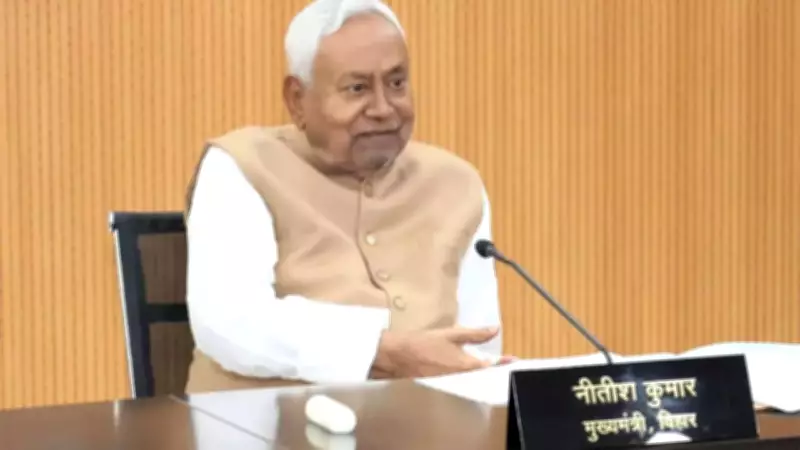
Nitish Kumar Concludes Two-Decade Tenure as Bihar Chief Minister
NEW DELHI: Following an unprecedented twenty-year rule over Bihar, Nitish Kumar has formally relinquished the chief ministerial position that he dominated for generations. This departure has ignited a fiery backlash from disgruntled supporters and sharp condemnation from opposition parties, who accuse the Bharatiya Janata Party (BJP) of systematically consuming its coalition partners, reminiscent of recent political maneuvers in Maharashtra.
A Quiet Exit After Decades of Political Maneuvering
Kumar's exit was marked by a characteristically subdued announcement via social media platform X, where he expressed his intention to focus on parliamentary duties. This low-key farewell mirrored the calculated, often frosty political shrewdness that defined his career post-2005, enabling him to retain the chief minister's chair regardless of shifting alliances or the numerical strength of his partners.
His political journey has been a masterclass in realignment, famously dubbed the 'Paltu Ram' strategy for its frequent turns. It began with orchestrating a majority to oust Lalu Prasad's Rashtriya Janata Dal (RJD) from power in Patna in 2005, only to later form alliances with the RJD and Congress under the 'Mahagathbandhan' in 2015, humiliating a BJP fresh from Narendra Modi's Delhi victory. Kumar rejoined the National Democratic Alliance (NDA) in 2017, switched back to the RJD-Congress combine in 2022, and ultimately realigned with the BJP in January 2024—each transition accompanied by his resignation and re-swearing as chief minister.

Ideological Shifts and a Unique Political Niche
These flip-flops extended beyond mere party loyalty to encompass ideology and key figures, transforming Kumar from a staunch 'never-Modi' critic to a willing partner of the Prime Minister. Through these shifts, he carved out a distinctive political identity as an Other Backward Class (OBC) leader who championed a 'Mandal-plus' agenda in Bihar's backward landscape, and as a strategic genius who built a personal voter base.
He stood apart as a rare north Indian OBC politician known for effective governance and a clean image, untainted by corruption scandals. Kumar's enduring connection with the electorate was evident during the 2025 assembly elections, even as concerns about his mental acuity grew due to public gaffes and prolonged absences.
BJP's Campaign and the Caste Strategy Blueprint
The opposition intensified claims that the BJP would install its own chief minister, mirroring Maharashtra's scenario. In response, the BJP amplified Kumar's campaign rallies and announcements, reinforcing the 'Jodya Modi-Nitish ke hit hoi' message of a prevailing Modi-Nitish partnership. Kumar's rise was further aided by the low governance standards set by former ally Lalu Prasad, allowing him and the BJP to consistently highlight 'clean administration' and 'crime' issues to keep the RJD on the defensive.
Kumar's true political cunning emerged in his strategy to counter the RJD's caste advantage in Bihar's OBC/Dalit-majority state. Hailing from the numerically small Kurmi caste, he fragmented the OBC vote by categorizing communities into 'backwards' and 'most backwards' based on developmental status. This move secured the loyalty of aspirational OBC groups while weaponizing 'Yadavisation' against rivals, polarizing 'Yadav vs non-Yadavs' to sustain his rule for two decades. A similar attempt with 'Dalits vs Maha Dalits' faltered due to political pressures.
The Women-Centric Welfare Game Changer
The pivotal shift occurred when Kumar targeted the pan-caste category of 'women' to build a personal constituency. From early initiatives like panchayat reservations and bicycles for girls to microfinance loans, self-help groups, and direct financial assistance, the Janata Dal (United) leader blended welfarism with development to secure a crucial voting bloc. While debates persist on whether women vote independently of family and caste, this approach consolidated pro-JDU support across levels, mitigating anti-incumbency factors.

Creating such personalized loyalty in Bihar's volatile caste-based politics is an unparalleled achievement since Lalu Prasad's ouster from Patna. Nitish Kumar's legacy as a strategist who reshaped Bihar's political landscape through caste calculus and women empowerment endures, even as his departure stirs fresh controversies over alliance politics in India.