

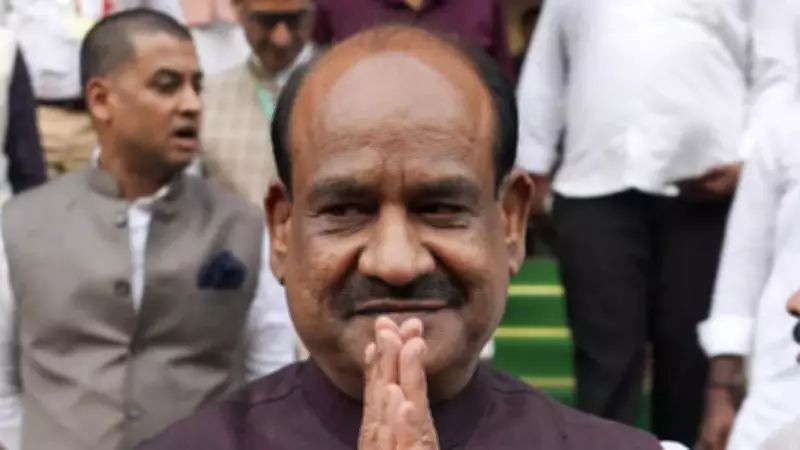
Opposition's No-Confidence Motion Against Lok Sabha Speaker Om Birla Set for Parliamentary Debate
In a move rich with political symbolism, the opposition is poised to bring its no-confidence motion against Lok Sabha Speaker Om Birla to the floor for discussion and voting as the second half of the Budget Session resumes on Monday. This parliamentary maneuver, while largely symbolic, underscores the deepening political tensions and strategic positioning ahead of crucial assembly elections.
Symbolic Gesture Amid Political Posturing
The motion, which accuses the Speaker of partisan functioning, stems from a series of flashpoints during the first part of the session. These include allegations of denying speaking time to Leader of Opposition Rahul Gandhi and the suspension of several MPs. However, the specifics of Birla's conduct are expected to take a backseat as the debate transforms into a broader political stage.
Given the numerical dynamics of the 543-member Lok Sabha, the motion faces an uphill battle. Removing the Speaker requires an effective majority—a majority of the present strength excluding vacant seats—a threshold the opposition is unlikely to meet. Thus, the exercise is widely viewed as political posturing rather than a genuine attempt to unseat Birla.

Opposition Unity and Internal Strains
The INDIA bloc intends to use this debate as an opportunity to project unity, particularly with high-stakes assembly elections looming in states like Tamil Nadu, West Bengal, and Kerala. This comes amid visible strains within the opposition alliance, with several leaders calling for a leadership rejig.
Veteran Congress leader Mani Shankar Aiyar emphasized that West Bengal Chief Minister Mamata Banerjee is central to the survival of the INDIA bloc. Meanwhile, leaders from Shiv Sena (UBT) and former media adviser to Prime Minister Manmohan Singh, Sanjaya Baru, have suggested that "new ideas" should lead or manage the bloc.
Initially, the Trinamool Congress (TMC) had decided not to back the resolution, buoying confidence among treasury bench members that Birla might receive support from outside the opposition. However, recent reports indicate that TMC MPs are likely to support the motion following directions from party chief Mamata Banerjee.
Additionally, the Congress and DMK are expected to present a show of unity, even as negotiations continue over seat-sharing for the Tamil Nadu polls. The Congress has issued a whip to its Lok Sabha members, mandating their presence in the House for three days to marshal maximum strength for an expected division of votes.
Broadening the Debate: Key Issues on the Table
Beyond the Speaker's conduct, the opposition plans to broaden the debate to include several other contentious issues. These are likely to encompass the proposed India-US trade deal, Russian oil imports, the Israel-Iran conflict, and the Jeffrey Epstein files.
In a previous speech, Rahul Gandhi accused Prime Minister Narendra Modi of "selling out" the country through the proposed trade deal with the US, claiming it has compromised national data, devastated farmers, and ruined the textile industry.
Government's Prepared Defense and Counterattacks
The treasury benches are prepared to mount a robust defense of Speaker Om Birla. A clear signal of government support came when Birla was sent to represent India at the swearing-in ceremony of Tarique Rahman as Prime Minister of Bangladesh on February 17.
Parliamentary Affairs Minister Kiren Rijiju is expected to lead the charge, accusing the opposition of politicizing an issue unrelated to the House's functioning. The government also plans to raise the alleged "insult" to President Droupadi Murmu after the West Bengal government changed the venue of the International Santhal Conclave she was scheduled to attend.
Prime Minister Narendra Modi recently criticized the West Bengal government, calling the episode "shameful and unprecedented" and asserting that the TMC administration has "crossed all limits" by insulting the President, who hails from a tribal community.
Furthermore, the ruling side may target the Congress over its plan for a controversial shirtless march at Bharat Mandapam during the AI summit in Delhi.

Historical Precedents of Such Motions
While rare, motions to remove the Speaker have historical precedents, often used to question the moral authority of the Chair rather than to achieve actual removal. Earlier in 2024, the opposition moved a similar motion against then Rajya Sabha Chairman and Vice-President Jagdeep Dhankhar, which was dismissed by Deputy Chairman Harivansh as an act of impropriety.
Since Independence, there have been at least three instances of such motions:
- In 1954, against India's first Lok Sabha Speaker G V Mavalankar, alleging impartiality.
- In 1966, against Speaker Sardar Hukum Singh, led by Madhu Limaye.
- In 1987, against Speaker Balram Jakhar, led by CPI(M) MP Somnath Chatterjee, which was ultimately rejected by the House.
As Parliament reconvenes, the no-confidence motion against Speaker Om Birla is set to ignite a fiery debate. While it is unlikely to alter the Speaker's position, the discussion will undoubtedly set the stage for the upcoming electoral battles, highlighting the intricate dance of symbolism and strategy in Indian politics.





