

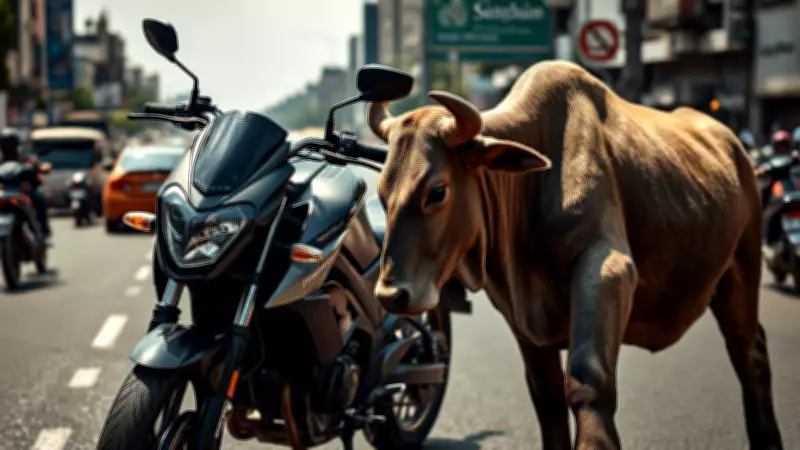
Software Engineer Battles Critical Brain Injuries After Collision with Stray Bull in Noida
A 29-year-old software engineer is fighting for his life with severe brain injuries after his motorcycle collided with a stray bull on an arterial road in Noida's Sector 168. This tragic incident has reignited urgent concerns about the persistent problem of free-roaming cattle on the city's streets and the grave dangers they pose to motorists and commuters.
Details of the Accident and Immediate Aftermath
Prakhar Bhardwaj, who works with the multinational IT company Wipro, had recently relocated to Noida from Bengaluru. He was returning home from his office in Greater Noida around 6:50 PM on Tuesday when the accident occurred. CCTV footage from the scene shows Bhardwaj riding on the wrong side along the Sector 168 stretch before crashing into a bull walking near the median verge of the road. The violent impact threw Bhardwaj across to the other lane as his motorcycle skidded away.
Family members confirmed that Bhardwaj was riding slowly and wearing a helmet at the time of the crash. In a social media post, his cousin Pranav Bhardwaj described how the bull appeared to panic and attacked him after the initial collision. "The impact knocked him off balance," Pranav stated, adding that the family later collected the CCTV footage from a nearby housing society to understand the sequence of events.

Critical Medical Condition and Treatment
Bhardwaj was initially rushed to a private hospital in Noida for emergency care before being transferred to a specialized facility in Delhi for advanced treatment. Doctors at the Delhi hospital confirmed he had sustained severe brain injuries. According to family accounts, his spectacles shattered during the fall, causing additional damage to his eyes and head. His right eye was badly injured, and although he regained consciousness on Thursday, his condition remains critical and unstable.
Dr. DK Gupta, chairman of Felix Hospital in Noida where Bhardwaj was first admitted, explained that the patient was referred to a higher facility almost immediately after initial stabilization due to the seriousness of his injuries. An eyewitness who helped transport Bhardwaj to the hospital revealed that he lay bleeding on the road for nearly 20 minutes before receiving assistance. "When I reached the spot, there was a large crowd but no ambulance. With the help of an auto driver, I took him to the nearest hospital," the eyewitness told reporters.
Police Investigation and Official Response
Police authorities stated that no formal complaint had been filed by the family as of yet. A senior officer described the incident as a collision on a single carriageway and confirmed that the circumstances were being thoroughly investigated. The lack of immediate police action has raised questions about accountability and enforcement regarding stray animal hazards on public roads.
Growing Stray Cattle Crisis in Noida
Residents across Noida have expressed deep frustration over the escalating stray cattle problem, warning that more such incidents are inevitable without decisive intervention. Cattle are frequently seen wandering on busy thoroughfares, including the Noida elevated road, creating constant hazards for motorists.
Locals in sectors such as 76, 75, 78, and 62 reported that cattle regularly wander onto carriageways near vegetable markets and informal feeding points. A resident of Sector 78, who also serves as a traffic volunteer, lamented that repeated complaints to authorities have yielded minimal action. "There is a T-point in Sector 76 where people regularly feed cattle, which only worsens the problem," he explained. "Abandonment of cattle is a major issue. At the very least, there should be proper fencing along arterial roads. Without sustained enforcement, incidents like this can have grave consequences."
Systemic Challenges and Administrative Data
Urban planners and road safety experts have long warned that stray animals on high-speed corridors fundamentally undermine traffic safety. Despite periodic drives by civic agencies to impound cattle, residents describe enforcement as sporadic and short-lived, failing to address the root causes.

District administration data reveals that Noida has 19 gaushalas (cattle shelters) with a combined capacity of 13,000 cattle, of which nearly 10,000 currently house stray animals. The animal husbandry department records over 64,000 cattle owned by villagers across the district, highlighting the scale of the challenge.
Officials explained that most stray cattle are actually owned animals left to roam during the day due to a lack of grazing land. Many are traced to villages in Noida and Greater Noida, where owners release them because of insufficient feeding arrangements. Even when authorities impound cattle and shift them to gaushalas, owners often reclaim them, creating a cyclical problem that persists despite removal drives.
This systemic failure forces commuters to navigate around cattle on busy roads daily, putting countless lives at risk. The accident involving Prakhar Bhardwaj serves as a stark reminder of the urgent need for comprehensive solutions to Noida's stray cattle crisis before more tragedies occur.





