

Parliament Session Highlights Deepening Stalemate Between Government and Opposition
The recent week in Parliament concluded with a familiar and troubling pattern: the government successfully advancing its agenda while the Opposition struggled to make its voice heard. This dynamic has become entrenched over the years, raising critical questions about accountability and democratic discourse in India's legislative bodies.
Government's Dominance and PM Modi's Signature Rhetoric
President Droupadi Murmu addressed both Houses, outlining the government's broad policy priorities, followed by Finance Minister Nirmala Sitharaman presenting the Budget. However, during the discussion on the motion of thanks for the President's address in Lok Sabha, the Opposition faced significant hurdles in contributing to the debate.
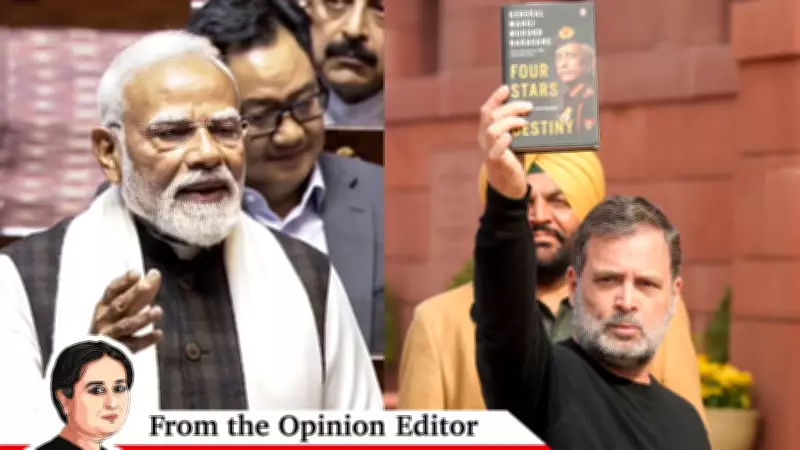
A confrontation erupted when Leader of Opposition Rahul Gandhi read excerpts from an unpublished book by former army chief General MM Naravane, relating to Prime Minister Narendra Modi's decision-making during a crisis. This led to the suspension of eight Opposition MPs, further stifling dissent.

Although PM Modi could not speak in Lok Sabha, he delivered a 97-minute address in Rajya Sabha. His speech adhered to a well-established template, emphasizing a narrative of India Before Modi and After Modi. He portrayed 2014 as a pivotal rupture, with Naya Bharat rising from the erasure of the old country, framed in apocalyptic and messianic terms.
Modi highlighted India's ceaseless forward motion under his leadership, citing events, milestones, and schemes. He also referenced global recognition of India's rise, mentioning the India-EU and India-US trade deals as evidence of the world opening its doors.
Anti-Congressism as a Core Theme
A key takeaway from the PM's speech was the persistent theme of anti-Congressism, which remains visceral and abiding for the Modi-BJP alliance. Despite the Congress party's declining electoral fortunes, it is still viewed as the primary opponent, overshadowing regional parties.
This acknowledgment in Modi's speeches subtly recognizes the Congress as the only rival capable of offering a nation-wide, big-ideas platform, even in its weakened state, due to the narrower focus and limited reach of regional parties.
Modi further centered himself as the main character in India's story, using a rude slogan from the JNU campus and speaking in the third person to reinforce this portrayal, rendering others as mere props.
Opposition's Ineffectual Response and Self-Limiting Strategies
If the government's approach followed a familiar style, with the Speaker and administration collaborating to restrict Opposition spaces, the Congress-led Opposition must introspect on its own role. The question arises: what did it do to break a syndrome that harms it more, denying it the right to speak and breathe?
The answer lies in Rahul Gandhi's actions, which mirrored a reflexive pattern rather than a strategic escape from government-imposed constraints. By focusing on the Naravane memoirs, he drove the entire Opposition out of Lok Sabha without participation, preventing MPs from poll-bound states like Assam, West Bengal, Kerala, and Tamil Nadu from speaking.
This strategy not only made the BJP's task easier but also backfired by feeding into Modi's cult of personality. Rahul Gandhi's approach mimics and underlines Modi's self-portrayal as the central figure, limiting the Opposition's ability to explore diverse methods of opposition.
Rahul must critically assess whether his point in Parliament was worth the cost. Citing the Naravane memoirs to challenge Modi's decision-making on China raises a paradoxical question: is Congress advocating for a hyper-muscular leader, contradicting its critique?
Alternative Approaches and the Path Forward
In contrast, Mallikarjun Kharge's performance in Rajya Sabha demonstrated a different possibility. Though not a riveting speaker, Kharge focused on the Modi-led government as a whole, rather than solely targeting Modi. He held his ground, addressing a wide range of issues, including social justice, communal amity, parliamentary processes, and safety nets for workers and farmers, even critiquing aspects of the India-US deal.

This highlights a need for the Opposition to move beyond pessimistic and self-limiting strategies. With the PM adeptly hijacking such tactics to bolster his own narrative, the Congress must develop greater political and imaginative resources to juggle various forms of opposition effectively.
The Parliament session underscores a frozen dynamic where both government and Opposition seem unmoving. For democracy to thrive, breaking this syndrome is imperative, requiring introspection and innovation from all sides involved.





