

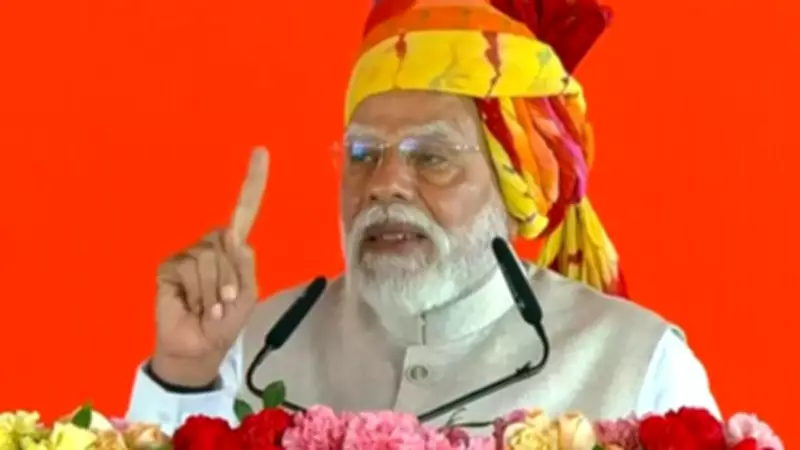
PM Modi Launches Scathing Attack on Congress at Ajmer Rally
Prime Minister Narendra Modi delivered a blistering critique of the Congress party during an election-season rally in Ajmer on Saturday, intensifying his political offensive by accusing the opposition of engaging in divisive tactics and deliberately tarnishing India's global reputation.
Congress Transformed Into 'Muslim League Maoist Congress'
In his address, Modi made the provocative claim that Congress has fundamentally transformed from its original identity. "There was a time when Congress INC stood for Indian National Congress," Modi stated. "Today, that INC has been replaced by MMC - Muslim League Maoist Congress."
The Prime Minister elaborated on this characterization by drawing historical parallels. "History bears witness that the Muslim League harbored animosity toward India and played a role in dividing our nation," he asserted. "Similarly, Maoists oppose India's economic progress, constitutional framework, and democratic successes. They operate through covert attacks, and Congress now follows this pattern by seeking opportunities to defame the country."

Modi emphasized the gravity of this transformation, declaring, "The nation will never pardon such actions by the Congress party."
Youth Congress Summit Protest Draws Sharp Criticism
The Prime Minister specifically referenced the February 20 protest organized by Youth Congress members at the AI Impact Summit in New Delhi, describing it as a calculated attempt to embarrass India on an international stage.
"When global leaders and foreign guests speak positively about India's achievements, every citizen feels a sense of pride," Modi explained. "However, Congress deliberately orchestrated a theatrical display aimed at undermining India's standing before these distinguished international visitors."
Modi attributed this behavior to electoral frustration, noting, "Congress has suffered continuous electoral defeats across the country. Driven by this anger, the party is now seeking revenge by damaging India's international image."
Allegations of Weakening National Security
Turning to matters of defense and national security, the Prime Minister accused Congress of having a longstanding record of undermining India's armed forces during its previous administrations.
"Defaming the country and weakening our military capabilities has been a consistent pattern for this party," Modi charged. He cited alleged shortages of essential equipment, delays in implementing critical policies like 'One Rank, One Pension', and various defense-related scandals that occurred under Congress governments.
"Our soldiers were left waiting for basic necessities including proper weapons and uniforms during those periods," Modi claimed, contrasting this with developments over the past eleven years.
Contrasting Security Records
Modi highlighted what he described as significant security achievements under his administration, mentioning surgical strikes and Operation Sindoor as examples of successful military operations.
"Our armed forces have demonstrated exceptional bravery and achieved victory in every mission and battlefield engagement," the Prime Minister stated. "Yet even in these matters of national pride, Congress has chosen to propagate false narratives promoted by India's adversaries."
He concluded this portion of his address with a broader indictment: "Congress consistently opposes policies and initiatives that benefit the country and its citizens. This fundamental opposition to India's progress explains why the nation is delivering a decisive political lesson to the party."
Criticism of Congress Rule in Rajasthan
Addressing local concerns in Rajasthan, Modi also criticized Congress's previous governance in the state, alleging widespread corruption, examination paper leaks, and neglect of agricultural communities that caused distress among farmers.
The Prime Minister's Ajmer rally represents a significant escalation in political rhetoric as election campaigning intensifies, with national security and patriotism emerging as central themes in his critique of the principal opposition party.






