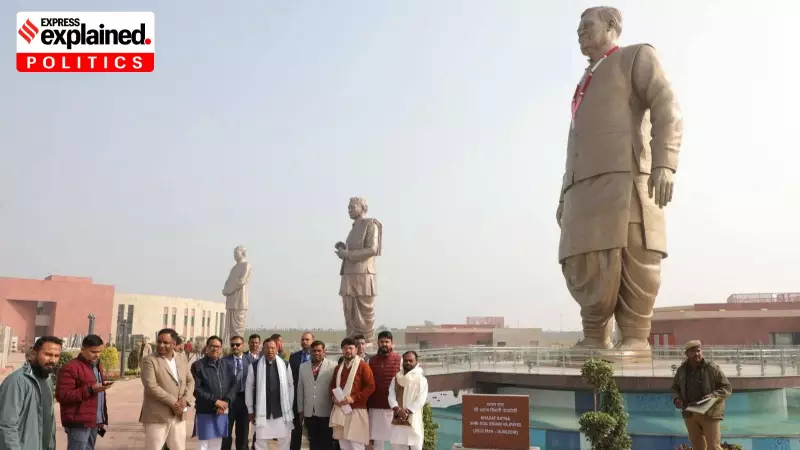
Prime Minister Narendra Modi inaugurated the Rashtra Prerna Sthal in Lucknow on Wednesday, December 25, 2025. The centrepiece of this new national inspiration site is a set of three grand, towering bronze statues honouring foundational icons of the Bharatiya Janata Party and its ideological lineage: Dr. Syama Prasad Mookerjee, Pandit Deen Dayal Upadhyay, and former Prime Minister Atal Bihari Vajpayee.
The Three Pillars of the BJP Pantheon
The inauguration ceremony highlighted the enduring political and philosophical legacy of these three leaders, whose lives and work were instrumental in shaping opposition politics and building a credible alternative to the Congress party's dominance in the decades following India's independence.
Syama Prasad Mookerjee: The Founding Visionary
Born in 1901, Syama Prasad Mookerjee was a brilliant scholar and the youngest vice-chancellor of Calcutta University, following in the footsteps of his father, the renowned jurist Ashutosh Mookerjee. His political journey, which began in 1929, saw him emerge as a leading Hindu nationalist voice by the mid-1930s. He served as president of the Hindu Mahasabha between 1943 and 1946.

After Independence, Prime Minister Jawaharlal Nehru appointed him as the Minister of Industry and Supply in the interim government. However, significant differences, particularly over the Liaquat-Nehru Pact of 1950, led to his resignation. This period coincided with the Rashtriya Swayamsevak Sangh (RSS) seeking a political voice after being implicated in Mahatma Gandhi's assassination.
Mookerjee joined hands with the RSS to form a new political party. This collaboration resulted in the birth of the Bharatiya Jana Sangh (BJS) at a national convention in Delhi on October 20-22, 1951, with Mookerjee at the helm. In the first general elections, the BJS contested 94 seats and won three, with Mookerjee securing the Calcutta South East constituency.
Demonstrating early coalition-building skills, he forged a joint Opposition of 38 members in the first Lok Sabha, despite the Congress's overwhelming majority. He was a staunch critic of Nehru's Kashmir policy and died under mysterious circumstances in detention in Kashmir on June 23, 1953, at the age of 51, after being arrested for leading a satyagraha.
Deen Dayal Upadhyay: The Ideological Architect
Deen Dayal Upadhyay, born in 1916 near Mathura, was a key founder of the BJS and served as its president in 1967. A protege of RSS chief M.S. Golwalkar, Upadhyay is best known for formulating the philosophy of Ekatma Manavvad (Integral Humanism) in 1959. This doctrine, derived from his study of Indian scriptures, remains a core economic and social philosophy for the BJP.
As the party's general secretary, he played a crucial role in nurturing a generation of young leaders. In the 1960s, he spearheaded efforts to unite the opposition against the Congress. A landmark moment was the 1963 alliance with socialist leader Ram Manohar Lohia and Gandhian J.B. Kripalani for key by-elections.
His strategic acumen bore fruit in the 1967 general elections, where the BJS became part of successful anti-Congress coalitions in several states, including Uttar Pradesh, Bihar, Madhya Pradesh, Punjab, and Haryana. This significantly weakened the Congress under Indira Gandhi. Upadhyay's life was cut short when his body was found near the Mughalsarai railway junction on February 11, 1968.
Atal Bihari Vajpayee: The Coalition Builder and Statesman
Atal Bihari Vajpayee's political career spanned from the first Lok Sabha elections in 1951-52 until his retirement in 2009. If Mookerjee founded the BJS and Upadhyay nurtured it, Vajpayee was the leader who first brought the party to power at the Centre.
A brilliant orator and poet, Vajpayee was known for his moderate persona and cross-party appeal. He was instrumental in the formation of the Janata Party in 1977 to oppose the Emergency, serving as External Affairs Minister. After the revival of the saffron party as the BJP, he, along with L.K. Advani, rebuilt it from a low of just two seats in 1984.

His greatest achievement was leading the National Democratic Alliance (NDA), a multi-party coalition, to victory and serving as Prime Minister from 1998 to 2004. He managed to keep diverse allies together while advancing the BJP's core agenda, changing the perception of the party as a difficult coalition partner. Vajpayee's legacy includes nurturing most of the BJP's top leadership, including Narendra Modi, and establishing the party as a natural party of governance.
A Lasting Legacy in Bronze
The Rashtra Prerna Sthal immortalises the journey of India's principal opposition force. The statues represent three distinct but interconnected phases: foundation, ideology, and governance. From Mookerjee's defiant nationalism and Upadhyay's philosophical framework to Vajpayee's inclusive statesmanship, the site encapsulates the evolution of a political movement that grew from the margins to the centre of Indian power.
The inauguration by Prime Minister Modi not only honours these stalwarts but also reinforces the contemporary BJP's connection to its ideological roots and its narrative of a continuous struggle for national resurgence, providing a physical space for inspiration and reflection on the party's historical trajectory.