

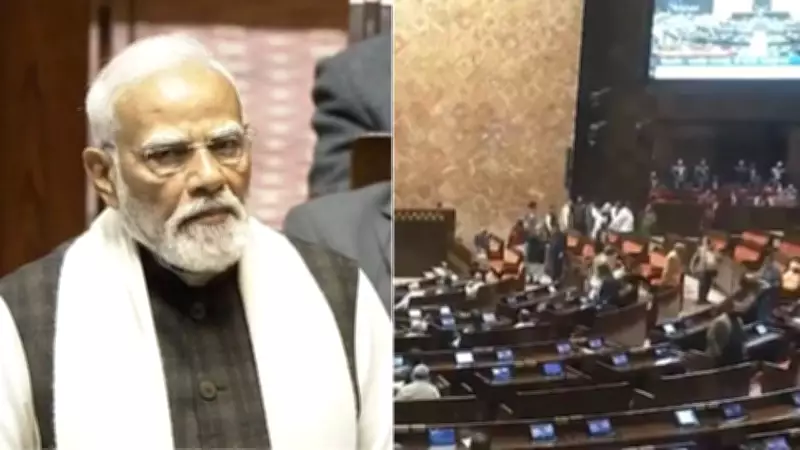
Parliamentary Drama as PM Modi's Speech Triggers Opposition Walkout
Prime Minister Narendra Modi delivered a significant address in the Rajya Sabha on Wednesday, speaking amidst continuous sloganeering by Opposition members. The Prime Minister's speech was marked by strong criticism of the Congress party, accusing them of historical failures and what he termed as "protecting infiltrators" during their governance periods.
Targeted Remarks and Immediate Walkout
During his parliamentary address, Prime Minister Modi made a pointed remark directed at Leader of Opposition Mallikarjun Kharge, which immediately escalated tensions in the House. This comment prompted immediate protests from Opposition benches, leading to a coordinated walkout by multiple opposition parties shortly after the Prime Minister began speaking.
Modi emphasized that the National Democratic Alliance government has spent a substantial portion of its decade-long tenure correcting what he described as past mistakes, particularly in areas of economic management and border security. The Prime Minister's speech came during the debate on the Motion of Thanks to the President's Address, a crucial parliamentary tradition.

Speaker's Preventive Measures for Parliamentary Decorum
In a related development, Lok Sabha Speaker Om Birla revealed that he had specifically advised Prime Minister Modi against attending the House during the President's Address debate. Birla stated that this recommendation was based on specific intelligence inputs suggesting the possibility of an inappropriate incident occurring near the Prime Minister's chair.
The Speaker explained that this preventive measure was taken to maintain parliamentary order and protect the dignity of parliamentary proceedings. "The decision was made in the interest of maintaining decorum and preventing potential disorder," Birla stated, adding that the Prime Minister had agreed to this request for the greater good of parliamentary traditions.
MEA Clarifies India's Energy Security Priorities
The Ministry of External Affairs issued a clear statement regarding India's oil import policies, emphasizing that national interest and energy security remain paramount in all decisions. MEA spokesperson Randhir Jaiswal directly addressed recent claims about India potentially halting Russian crude purchases, stating that no such commitment has been made publicly.
"India's oil import decisions are guided by comprehensive considerations including national interest, prevailing market conditions, and global geopolitical developments," Jaiswal clarified. The statement effectively dismissed suggestions that India has agreed to shift its oil supplies from Russia to other nations like the United States or Venezuela.
Cricket Captain Confirms India's World Cup Plans
India's T20 captain Suryakumar Yadav provided clarity regarding the team's participation in the upcoming World Cup match against Pakistan. Yadav confirmed that the Indian team will strictly adhere to the ICC schedule and has already made travel arrangements for their Colombo fixture.
"Our flight to Colombo is booked and we are going as per plan," the captain stated, addressing speculation about India's participation. He emphasized that India has not refused to play the match and that further clarity would emerge closer to the tournament date.
Cooperative Ride-Hailing Platform Launched Nationwide
Union Home and Cooperation Minister Amit Shah inaugurated Bharat Taxi, India's first cooperative-led ride-hailing platform, marking a significant development in the country's transportation sector. Following successful pilot programs in Delhi-NCR and Gujarat, the service is now poised for nationwide expansion.
Driver-Owned Model with National Ambitions
Minister Shah outlined the unique cooperative structure of Bharat Taxi, where drivers themselves become owners and direct beneficiaries of the platform's profits. "This is not a government entry into the taxi business but a cooperative model where drivers are the true stakeholders," Shah explained during the launch event.

The minister projected that Bharat Taxi would expand across all Indian states within the next three years, creating what he described as a "more equitable and sustainable" model for ride-hailing services compared to existing corporate platforms.
Key Features of the Bharat Taxi Initiative
- Cooperative ownership model with drivers as primary stakeholders
- Direct profit sharing with service providers
- Initial rollout in Delhi-NCR and Gujarat regions
- Planned nationwide expansion within three years
- Government facilitation without direct business operation
These developments across political, diplomatic, sports, and economic spheres highlight significant movements in India's current affairs landscape, with implications for parliamentary functioning, international relations, sports diplomacy, and economic innovation.





