

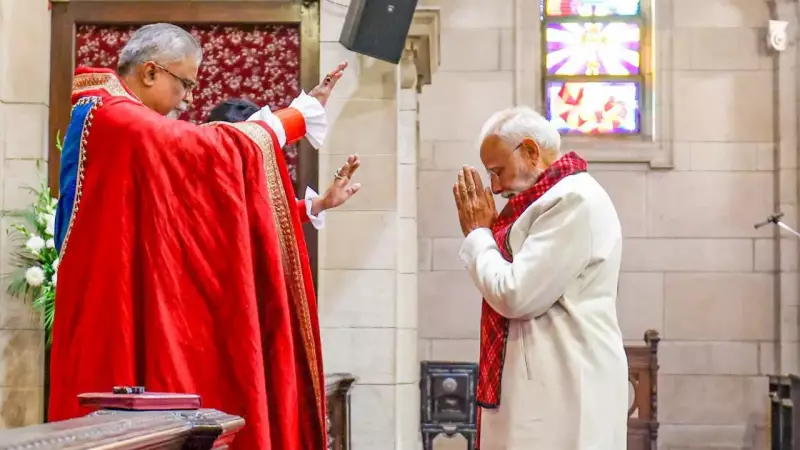
Prime Minister Narendra Modi participated in a Christmas celebration at the Cathedral Church of the Redemption in New Delhi on Thursday, engaging with a large gathering of Christians. This event is part of the ruling Bharatiya Janata Party's (BJP) ongoing initiative to build stronger ties with minority communities across the nation.
PM's Message and BJP's Concerted Efforts
During the service, the Prime Minister reflected on the core values of the festive season. He stated that the service embodied the eternal ideals of love, peace, and compassion. He expressed hope that the spirit of Christmas would foster greater harmony and goodwill within Indian society.
In a parallel effort, BJP National President JP Nadda also joined Christmas festivities. He attended a program at the Christian Higher Secondary School, organized by the Mao Naga Christian Fellowship Delhi (MNCFD). In his address, Nadda emphasized the government's developmental focus on the northeastern states, a region with a substantial Christian population.

A Pattern of Engagement and Political Backlash
Prime Minister Modi's participation is not an isolated event but part of a consistent pattern of engagement. In 2024, he addressed a Christmas celebration organized by the Catholic Bishops’ Conference of India. The previous year, in 2023, he attended an Easter event at the Sacred Heart Cathedral and also hosted a Christmas program at his official residence.
However, the opposition, notably the Congress party, was quick to criticize these gestures. They targeted the Prime Minister over reported incidents of vandalism and harassment against Christians in certain parts of the country. Congress shared a video on social media platform X, allegedly showing members of right-wing groups damaging Christmas decorations in Raipur, Chhattisgarh—a state governed by the BJP. They claimed this exposed the party's contradictory stance.
Challenges and Electoral Significance
The BJP's outreach to the Christian community over recent years has seen limited success. A segment of the community remains distrustful, primarily due to the perceived antipathy towards religious conversion from factions within the larger Sangh Parivar. This sentiment has contributed to the enactment of stringent anti-conversion laws in several states since the BJP's political influence expanded post-2014.
The Christian vote holds significant electoral weight in key states. Kerala boasts the highest absolute Christian population in India at over 18% (2011 Census), and is scheduled for assembly polls in a few months. Tamil Nadu, which also goes to polls around the same time, has the second-highest Christian population at over 6%. In Goa, Christians constitute over 25% of the population. However, their political influence is most pronounced in the northeastern states of Nagaland, Mizoram, and Meghalaya, where they form a dominant majority.
The BJP's current efforts are strategically aimed at bridging this gap and making inroads into these politically crucial regions ahead of upcoming elections.






