

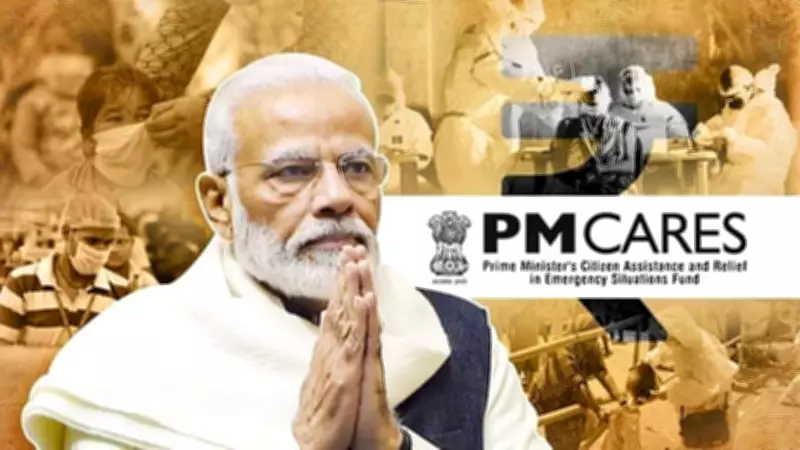
PMO Invokes Parliamentary Rules to Block Questions on Key Relief Funds
The Prime Minister's Office (PMO) has formally communicated to the Lok Sabha Secretariat that parliamentary questions and matters pertaining to the PM CARES Fund, the Prime Minister's National Relief Fund (PMNRF), and the National Defence Fund (NDF) are not admissible under the established rules governing the conduct of business in the Lok Sabha. This development, based on information obtained by The Indian Express, underscores a significant procedural stance regarding the transparency and accountability of these high-profile funds.
Legal Grounds Cited for Inadmissibility
On January 30, the PMO referenced specific provisions of the Rules of Procedure and Conduct of Business in Lok Sabha to justify its position. According to Rule 41(2)(viii), questions must not relate to matters that are not primarily the concern of the Government of India. Additionally, Rule 41(2)(xvii) stipulates that questions should not raise issues under the control of bodies or persons not primarily responsible to the Government of India.
The PMO's reasoning hinges on the fact that the corpus of these funds is entirely constituted through voluntary public contributions, rather than allocations from the Consolidated Fund of India. This distinction places them outside the direct purview of governmental oversight as defined by parliamentary rules.

Background and Structure of the Funds in Question
The PM CARES Fund was established as a Public Charitable Trust on March 27, 2020, in response to the COVID-19 pandemic. Its primary objective is to address emergency situations and provide relief to affected individuals. Registered under the Registration Act, 1908, in New Delhi, the fund reported a total balance of Rs 6,283.7 crore as of March 2023, according to its latest published accounts.
Similarly, the PMNRF, initiated in January 1948, utilizes public contributions to offer immediate assistance to families impacted by natural disasters, accidents, and riots. The NDF is dedicated to supporting the welfare of armed and paramilitary forces personnel and their dependents.
Legal and Judicial Perspectives on Fund Oversight
In January 2023, the Central Government informed the Delhi High Court that the PM CARES Fund is not created under the Constitution or any parliamentary law, thereby not qualifying as a state under Article 12. This classification exempts it from certain transparency mandates, including provisions of the Right to Information (RTI) Act.
The Supreme Court reinforced this stance in August 2020, refusing to order a transfer of funds from PM CARES to the National Disaster Response Fund (NDRF). The court emphasized that the two funds serve distinct purposes and noted that PM CARES, as a public charitable trust, does not require audit by the Comptroller and Auditor General of India.
Implications for Parliamentary Scrutiny
The PMO's directive implies that in scenarios where questions or notices regarding these funds arise during zero hour or special mentions, the admissibility conditions outlined in the rules may be invoked to restrict discussion. This move has sparked debates about the balance between parliamentary accountability and the operational autonomy of charitable trusts funded by public contributions.
Officials from the PMO and the Lok Sabha Secretariat have not publicly commented on this communication, leaving room for further legal and political interpretations. The decision highlights ongoing tensions in governance mechanisms concerning funds that, while publicly supported, operate outside traditional governmental frameworks.






