

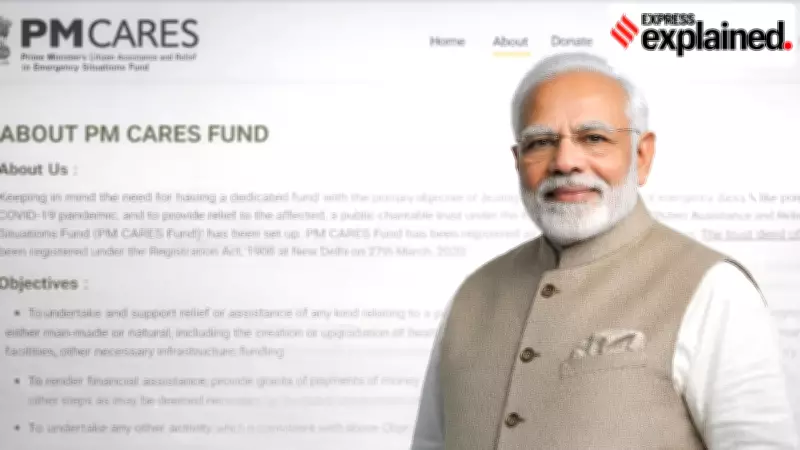
PMO Directs Lok Sabha to Reject Questions on PM CARES and Two Other Funds
The Prime Minister's Office (PMO) has formally communicated to the Lok Sabha Secretariat that parliamentary questions and matters concerning the PM CARES Fund, the Prime Minister's National Relief Fund (PMNRF), and the National Defence Fund (NDF) are not permissible under the established rules governing business in the lower house of Parliament. This directive, reported by The Indian Express, was issued on January 30, 2026, and cites specific procedural rules to justify the exclusion.
Parliamentary Rules Cited for Inadmissibility
The PMO's instruction references Rule 41(2)(viii) and Rule 41(2)(xvii) of the Rules of Procedure and Conduct of Business in Lok Sabha. These rules stipulate that questions must not relate to matters not primarily the concern of the Government of India or raise issues under the control of bodies not primarily responsible to the government. The PMO argues that since these funds are constituted entirely from voluntary public contributions and are not drawn from the Consolidated Fund of India, they fall outside the purview of parliamentary scrutiny.
Overview of the Three Funds
PM CARES Fund: Established on March 27, 2020, in response to the COVID-19 pandemic, this public charitable trust aims to provide relief in emergency situations. Registered under the Registration Act, 1908, it reported a total balance of Rs 6,283.7 crore as of March 2023, according to its latest published accounts.

Prime Minister's National Relief Fund (PMNRF): Created in January 1948 to assist displaced persons from Pakistan, this fund now primarily offers immediate relief to families affected by natural disasters, accidents, and riots.
National Defence Fund (NDF): This fund supports the welfare of Armed Forces personnel, including paramilitary forces, and their dependents. It is administered by an Executive Committee chaired by the Prime Minister.
Government's Historical Stance on PM CARES
In January 2023, the Centre informed the Delhi High Court that the PM CARES Fund is a public charitable trust not established under the Constitution or any parliamentary law. An affidavit stated that the trust is not owned or controlled by the government, with board members holding public office merely for administrative convenience. Consequently, it does not qualify as a public authority under the RTI Act, exempting it from transparency mandates.
Supreme Court's Previous Ruling
On August 18, 2020, the Supreme Court dismissed a petition seeking to transfer funds from PM CARES to the National Disaster Response Fund (NDRF). The court emphasized that the two funds serve distinct purposes and noted that PM CARES, as a charitable trust, does not require audit by the Comptroller and Auditor General of India, unlike the NDRF.
Reasoning Behind the PMO's Directive
The PMO's rationale for barring questions aligns with its earlier court submissions, highlighting that these funds rely on voluntary donations rather than government allocations. This positions them as independent entities, thereby limiting parliamentary oversight under the cited rules.
Implications for Parliamentary Accountability
This move raises questions about transparency and accountability for funds associated with the Prime Minister's Office. While the PMO asserts compliance with procedural norms, critics may argue it restricts legislative scrutiny of significant public resources. The decision underscores ongoing debates over the governance of charitable trusts in India's political landscape.






