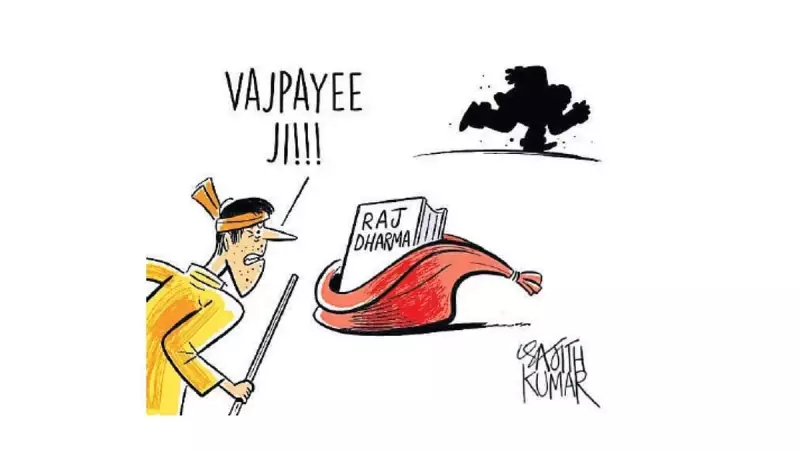
A recent editorial cartoon published by Deccan Herald has ignited conversations and offered a pointed, visual critique of contemporary political conduct in India. The artwork, rich in symbolism, delves into the ancient Indian concept of 'Raj Dharma'—the moral and ethical duties of a ruler—juxtaposing it against the realities of modern governance.
The Visual Metaphor of Raj Dharma
The cartoon employs classic satirical tools to convey its message. Central to the imagery is likely a figure representing political authority, placed in a context that highlights a contradiction between professed values and actionable governance. The essence of Raj Dharma, which enjoins leaders to uphold justice, righteousness, and public welfare above all else, is contrasted with contemporary political maneuvers often seen as self-serving or divisive.
Without copying the source, the illustration's power lies in its ability to condense complex political discourse into a single, impactful frame. It prompts the viewer to reflect on the state of democratic accountability and the responsibilities those in power bear towards the citizenry. The cartoon does not merely report an event but offers an interpretative critique of the political ethos.

Satire as a Mirror to Society
Editorial cartoons have long served as a crucial pillar of democratic discourse, using humor and exaggeration to question authority and highlight societal issues. This particular piece continues that tradition within the Indian context. By focusing on Raj Dharma, it taps into a deep-seated cultural and philosophical ideal, making its commentary resonate with a wide audience familiar with the term's weight and historical significance.
The reaction to such cartoons is often polarized, underscoring their effectiveness. Supporters view them as a necessary check on power, while critics may see them as biased or disrespectful. This dynamic itself is a testament to the vibrant and often contentious nature of India's public sphere, where media, art, and politics continuously interact.
Broader Implications for Political Discourse
The publication of this cartoon is more than a fleeting news item; it is a cultural moment that reflects ongoing debates about governance, morality in public life, and the role of the media. It raises critical questions: How is Raj Dharma defined in today's political landscape? Is it a relic of the past or a living standard against which leaders are measured?
In an era of intense political polarization, such satirical works force a pause for reflection. They cut through dense policy debates and rhetorical speeches to present a stark, often uncomfortable, visual truth. The cartoon's legacy will be its success in reinvigorating public conversation about the foundational principles of leadership and justice in the world's largest democracy.
Ultimately, this piece of editorial art from Deccan Herald serves as a modern-day parable. It reminds both the rulers and the ruled of the timeless compact of righteous governance, challenging all stakeholders to consider the gap between ideal and reality. In doing so, it reaffirms the indispensable role of a free press and satirical expression in holding power to account.