

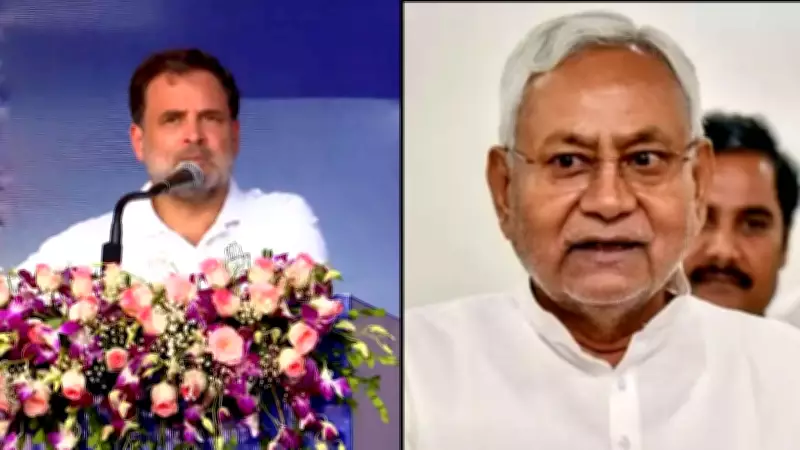
Rahul Gandhi Accuses BJP of Controlling Nitish Kumar, Issues Warning on Tamil Nadu Politics
Congress leader Rahul Gandhi has launched a sharp attack on the National Democratic Alliance (NDA), making serious allegations against both the Bharatiya Janata Party (BJP) and former Bihar Chief Minister Nitish Kumar. Speaking at a campaign rally in Thoothukudi, Tamil Nadu, Gandhi intensified his political criticism ahead of upcoming elections.
"Compromised" Leadership and BJP Control Allegations
In his address, Rahul Gandhi specifically targeted Nitish Kumar, claiming the veteran politician was "compromised" during recent political developments. Gandhi pointed to Kumar's transition to the Rajya Sabha after his long tenure in Bihar politics, suggesting this move represented a quiet political shift orchestrated by external forces.
"The BJP has perfected the art of controlling regional leaders," Gandhi asserted during his speech. "Nitish Kumar's situation is a clear example of how independent political voices are being systematically brought under central control."

Warning Against Tamil Nadu Political Influence
Beyond the Bihar-focused allegations, Rahul Gandhi turned his attention to Tamil Nadu politics, where he accused the BJP of attempting to establish what he described as a "fully controlled government" in the southern state. His remarks came as part of campaigning for the DMK–Congress alliance, which is preparing for upcoming electoral battles.
"The people of Tamil Nadu must recognize these attempts to undermine their political autonomy," Gandhi warned the Thoothukudi audience. "We cannot allow external forces to dictate the political future of this proud state."
Campaign Context and Electoral Atmosphere
The allegations were made during a period of heightened political activity in Tamil Nadu, with parties ramping up their outreach efforts as elections approach. Gandhi's speech added to the already heated electoral atmosphere, positioning the DMK–Congress alliance against what they portray as increasing central interference in state politics.
Political observers note that Gandhi's dual focus – on both Bihar's recent political developments and Tamil Nadu's future – represents a strategic attempt to connect regional concerns with national political patterns. The reference to Nitish Kumar's Rajya Sabha entry serves as a specific example in what Gandhi framed as a broader pattern of political control.
As campaigning intensifies across Tamil Nadu, these allegations are likely to feature prominently in the opposition's critique of the ruling coalition at the national level. The DMK–Congress alliance appears to be framing the upcoming elections not just as a state contest, but as a referendum on political autonomy and regional representation within India's federal structure.






