

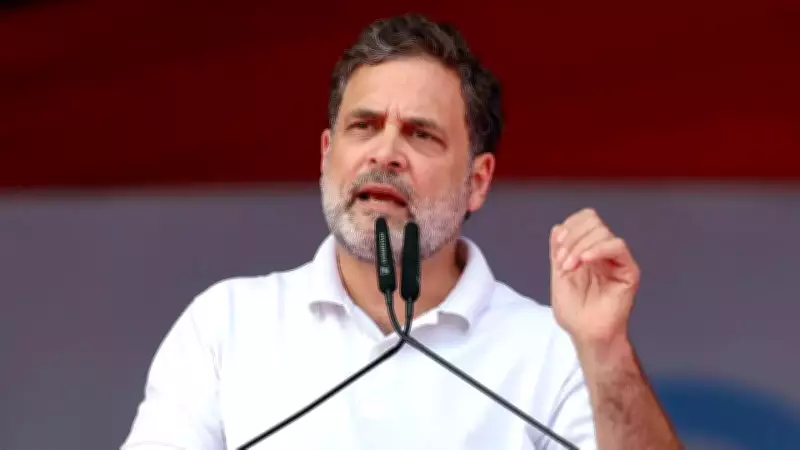
Rahul Gandhi Condemns Modi Government's Foreign Policy Stance
Lok Sabha Leader of Opposition Rahul Gandhi launched a sharp critique against Prime Minister Narendra Modi's administration on Friday, targeting its foreign policy decisions. This criticism emerged in the context of a recent waiver issued by the United States, permitting India to continue purchasing Russian oil. Gandhi alleged that the current foreign policy approach is not a genuine strategy but rather stems from the "exploitation of a compromised individual," directly implicating PM Modi.
Social Media Outburst and Allegations
Expressing his disapproval on X, Rahul Gandhi retweeted a video shared by the Congress party, which featured his speech in the Lok Sabha addressing concerns about India's trade sovereignty. In his post, he emphasized, "India's foreign policy should emerge from the collective will of our people, rooted in our history, geography, and spiritual ethos based on Satya and Ahimsa. What we are witnessing today is not policy; it is the result of the exploitation of a compromised individual." In the video, Gandhi explicitly blamed Prime Minister Modi, labeling him as "compromised" and questioning his autonomy in decision-making. He stated, "The US will dictate who we can or cannot buy oil from—whether it's Russia or Iran, the US will decide. But our Prime Minister will not decide."
Congress Party's Broader Criticism
Earlier in the day, the Congress party intensified its attack on the central government following the US announcement of the waiver. Congress general secretary Jairam Ramesh took to X to question the duration of what he termed "American blackmail." In a post, he wrote, "Trump ka naya khel, Dilli dost ko kaha, Putin se le sakte ho tel, kab tak chalega ye Ameriki blackmail (Trump's new game; told his friend in Delhi you can get oil from Putin; how long will this American blackmail continue?)." These remarks highlight the party's concerns over perceived external influence on India's energy policies.

Background of the US Waiver and Global Context
The US Treasury Department issued a temporary 30-day waiver, allowing Indian refiners to purchase Russian oil. US Treasury Secretary Scott Bessent explained that this move aims to stabilize global energy supplies amidst escalating tensions in the Middle East. He noted, "President Trump's energy agenda has resulted in record-high oil and gas production. To ensure oil continues flowing into the global market, we are issuing this waiver for India." Bessent added that Washington expects India to increase energy imports from the United States in the future, stating, "India is an essential partner, and we fully anticipate that New Delhi will ramp up purchases of US oil." He further clarified that the temporary measure is intended to "alleviate pressure caused by Iran's attempt to take global energy hostage."
Implications for India's Energy Security
This waiver comes at a critical juncture as India faces potential risks of energy supply disruptions due to heightened tensions in the Middle East. The situation worsened after a joint US-Israel military strike on Iran on February 28, which resulted in significant casualties, including senior officials. India relies heavily on the region for its oil imports, sourcing nearly 40 percent of its crude from there, with a substantial portion transported through the strategically vital Strait of Hormuz. Recent Iranian strikes on vessels in the area have raised fears of partial closure of this strait, which could impact approximately 40 percent of India's crude imports.
Russia's Response and Supply Adjustments
In response to these developments, Russia has signaled its readiness to redirect crude shipments to India to mitigate potential supply disruptions caused by the conflict. According to Reuters, around 9.5 million barrels of Russian oil are currently positioned near Indian waters and could be delivered within weeks. This potential shift in supply aims to offset the risks posed by the volatile situation in the Middle East, ensuring India's energy needs are met despite geopolitical challenges.
The ongoing debate underscores the complex interplay between domestic politics, international relations, and energy security, with Rahul Gandhi and the Congress party urging for a foreign policy that prioritizes national sovereignty and independence.






