

Rahul Gandhi Launches Scathing Attack on PM Modi, Alleges Compromise and US Control
Leader of Opposition in Lok Sabha Rahul Gandhi delivered a blistering critique of Prime Minister Narendra Modi on Monday, asserting that the Prime Minister is "compromised" and incapable of participating in a parliamentary debate. Speaking at the Adivasi Adhikar Samvidhan Sammelan in Vadodara, Gandhi targeted Modi's recent address on the West Asia conflict and his government's trade policies.
"100% Under Trump's Control"
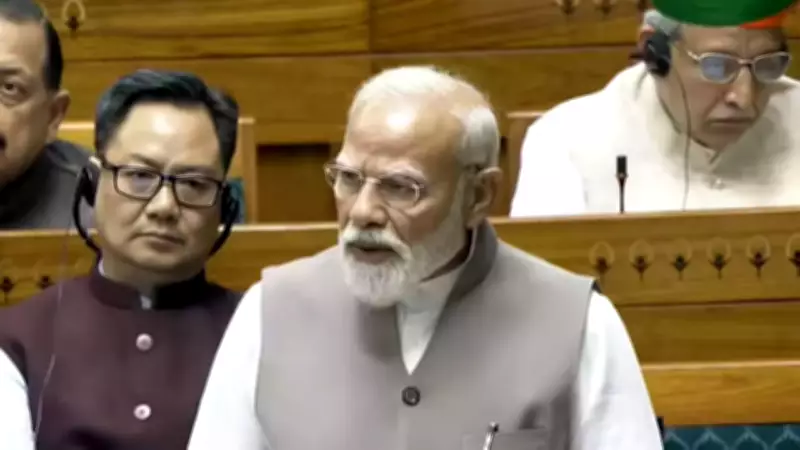
Rahul Gandhi made explosive allegations about the Prime Minister's relationship with the United States. "I've heard that the Prime Minister gave a 25-minute speech. But I guarantee he cannot participate in a debate in Parliament because he is compromised," Gandhi declared. He specifically pointed to Modi's Lok Sabha address on the West Asia situation, noting that "Narendra Modi spoke for 25 minutes but did not say a single word against America."
The Congress leader went further, claiming "Narendra Modi is 100% under the control of Trump." This accusation forms the core of Gandhi's critique of the government's foreign policy approach, particularly regarding the ongoing tensions in West Asia.

Criticism of Trade Policies and Agricultural Impact
Beyond foreign policy, Rahul Gandhi attacked the government's economic decisions, particularly those affecting Indian agriculture. He alleged that trade agreements with the United States would devastate Indian farmers.
"Narendra Modi has opened India's agricultural sector to America through a trade deal," Gandhi stated. "Here, we have small farms, while in America, there are large farms spanning thousands of acres. Here, people work by hand, and there, work is done with large machines. If American goods start coming to India, our farmers will be ruined."
Allegations of Undermining Tribal Rights
The opposition leader also accused the BJP and RSS of systematically eroding tribal rights and identity. He argued that the term "Vanvasi" was being deliberately used to dilute the constitutional identity of Adivasis.
"Adivasi means the original inhabitants of India -- the rightful owners of this land, water, and forests ('jal-jangal-jameen')," Gandhi explained. "But RSS-BJP has introduced a new term -- 'Vanvasi,' which implies that you only live in forests, not that you are the rightful owners of these resources."
He connected this linguistic shift to broader policy concerns, stating: "Narendra Modi and BJP leaders fold their hands before the statue of Birsa Munda, but they attack the very ideas for which Birsa Munda fought and was martyred. When BJP takes away the land, water, and forests from Adivasis, it is not just an attack on Birsa Munda, but also on the Constitution."
Congress Leaders Echo Criticism
Other Congress leaders joined in criticizing the Prime Minister's parliamentary address. Party spokesperson Pawan Khera questioned the timing and intent behind Modi's speech, suggesting electoral considerations. "Perhaps this speech was given keeping the upcoming elections in mind," Khera remarked. He also raised concerns about energy prices, hoping for assurances about stable LPG, petrol, and diesel costs.
Congress MP Jairam Ramesh delivered particularly sharp criticism on social media platform X, describing Modi's speech as "a master class in self-boasts, cowardice, and partisan dialogue-baazi (dramatic dialogue)." Ramesh specifically noted the absence of condemnation for US-Israeli air assaults on Iran, while acknowledging Iran's own unacceptable actions.
Ramesh also responded to Modi's reference to the COVID-19 pandemic, calling the government's response "uniquely catastrophic" and recalling "lakhs of migrants walking barefoot to their homes, thousands dying from oxygen shortages, and millions left unemployed."
Prime Minister's Address on West Asia Challenges
Prime Minister Modi's speech, which prompted these criticisms, focused on the serious implications of the West Asia conflict for India. He described the situation as "worrisome" and outlined multiple challenges facing the nation.

"This war has also posed unprecedented challenges for India," Modi stated. "These challenges are economic, related to national security, and humanitarian as well." He highlighted India's extensive trade relations with affected countries and the region's importance as a crucial trade route.
The Prime Minister specifically addressed energy security concerns: "In particular, a large part of our needs for crude oil and gas is met by this very region." He assured that the government has prioritized domestic LPG consumers amid supply uncertainties and is working to ensure uninterrupted availability of petrol and diesel. India maintains strategic petroleum reserves exceeding 5.3 million metric tons as a buffer against disruptions.
Escalating Regional Tensions
The political exchanges occur against a backdrop of escalating tensions in West Asia. The February 28 killing of Iran's Supreme Leader Ayatollah Ali Khamenei in joint US-Israeli strikes triggered retaliatory attacks by Iran and significant disruptions in key maritime routes including the strategically vital Strait of Hormuz.
These developments have created complex diplomatic and security challenges for India, which maintains important relationships with multiple actors in the region while depending heavily on Middle Eastern energy supplies.
The sharp political debate reflects broader divisions in Indian politics regarding foreign policy orientation, economic priorities, and the protection of constitutional rights for marginalized communities.





