Since 2008, Rajasthan's political landscape has evolved far beyond routine elections, marked by mass protests, internal rebellions, administrative reshaping through new districts, and a final leadership reset. For years, power alternated between the Congress and the Bharatiya Janata Party (BJP), but beneath this cyclical pattern, significant shifts were underway. Movements like the Gujjar agitation, former deputy chief minister Sachin Pilot's rebellion, and the creation of 19 new districts under Ashok Gehlot fundamentally altered the political dynamics. By 2023, the BJP's return with Bhajan Lal Sharma as a new face signified not merely a power shift but a deeper transformation in how Rajasthan's politics operates.
2008: When the Streets Took Over
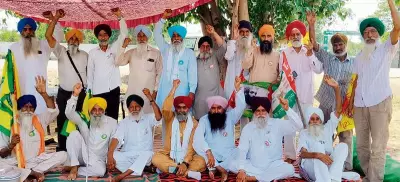
The first major jolt came in May–June 2008, when the Gujjar reservation agitation reached its zenith. Led by Kirori Singh Bainsla, the protests turned violent—railway tracks were blocked, highways shut down, and large parts of the state came to a standstill. The agitation resulted in 37 deaths, including that of a policeman, and dozens were injured as clashes intensified in areas like Bharatpur and Dausa. The Army had to be called in to restore order, a move that forced the government's hand. A 5% reservation under the Special Backward Class (SBC) category was promised—but the issue kept resurfacing over the next decade, demonstrating how powerful street mobilization had become in shaping policy.
2008, 2013, 2018, and 2023: The Familiar Cycle
Rajasthan's politics has long followed a pattern of alternating governments. In 2008, the Congress, led by Ashok Gehlot, came to power, beginning another phase of the cycle. By 2013, the tide turned decisively as the BJP, under Vasundhara Raje, swept the state with 163 seats. The pattern repeated in 2018, when Congress returned with 100 seats and Gehlot became chief minister for the third time. However, this tenure saw visible internal tensions between Gehlot and Sachin Pilot. Continuing the cycle, the BJP regained power in 2023, reinforcing Rajasthan's reputation for maintaining a revolving-door policy while electing governments.

2020: Crisis from Within
That tension exploded in July 2020. In one of the biggest political crises in the state, Sachin Pilot and 18 Members of the Legislative Assembly (MLAs) rebelled against their own Ashok Gehlot-led Congress government. They moved to Manesar, demanded a leadership change, and pushed the government to the brink. Pilot was eventually removed as deputy chief minister, but the message was clear—the biggest threat to governments was no longer the opposition but internal dissent. The instability did not end there. In September 2022, another flashpoint emerged when Congress MLAs resisted a leadership change proposed by the party high command. Rajasthan had, in many ways, become the center of Congress's internal power struggle.
New Players, New Equations
While the two main parties were busy managing crises, new political forces were quietly expanding their base. The Rashtriya Loktantrik Party (RLP), founded in 2018 by Hanuman Beniwal, tapped into Jat discontent and began influencing outcomes in key regions. Its role in alliances—especially around the 2024 Lok Sabha elections—showed how regional players could no longer be ignored. Then came the Bharat Adivasi Party (BAP) in 2023, led by Rajkumar Roat. The party gave voice to tribal concerns—reservation, neglect, and even demands for a separate Bhil Pradesh. With four MLAs and one Member of Parliament (MP), it signaled a deeper political awakening in southern Rajasthan.
2023: Redrawing the State
In March 2023, Chief Minister Gehlot announced one of the biggest administrative changes in Rajasthan's history—the creation of 19 new districts, formally notified in August 2023. Districts like Anupgarh, Balotra, Beawar, Deeg, Didwana-Kuchaman, and Neem ka Thana were carved out, taking the total from 33 to 50. In December 2024, the successive BJP government scrapped nine of these 19 districts, reversing the total to 41. On paper, it was about governance—bringing administration closer to people. Politically, it reshaped local power dynamics across regions like Shekhawati, Mewat, Hadoti, and the tribal belt.

2023 Election: Same Pattern, New Turn
The November 2023 Assembly election followed Rajasthan's familiar pattern. The BJP returned to power with 115 seats, while Congress dropped to 69. But what followed broke the old script.
December 2023: A New Face, A New Phase
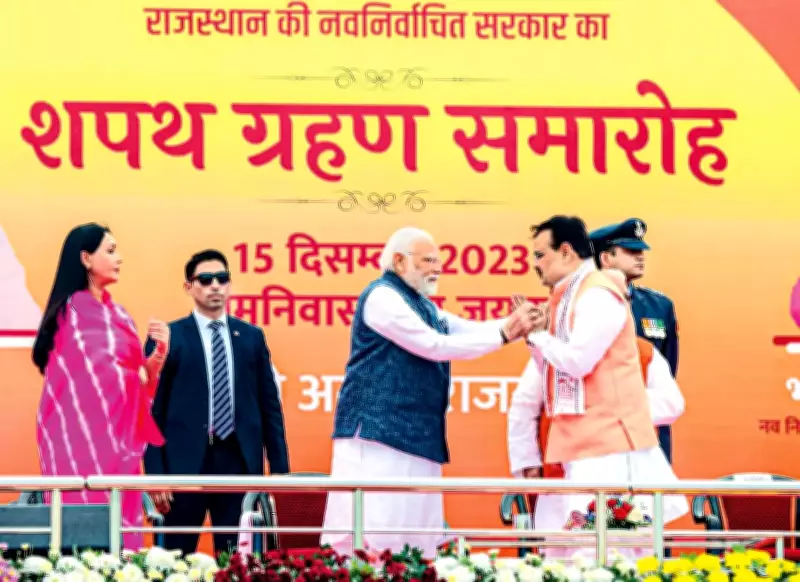
On December 12, 2023, the BJP chose Bhajan Lal Sharma—a first-time MLA—as chief minister. For nearly two decades (2003–2023), Rajasthan politics had revolved around two towering figures—Gehlot and Raje. Sharma's appointment marked a clear shift away from that era. It also reflected a deeper strategy. From leaders like Bhairon Singh Shekhawat to Raje, the BJP traditionally relied on strong, recognizable faces. This time, it chose a relatively low-profile leader—signaling tighter central control and a move away from personality-driven politics.