

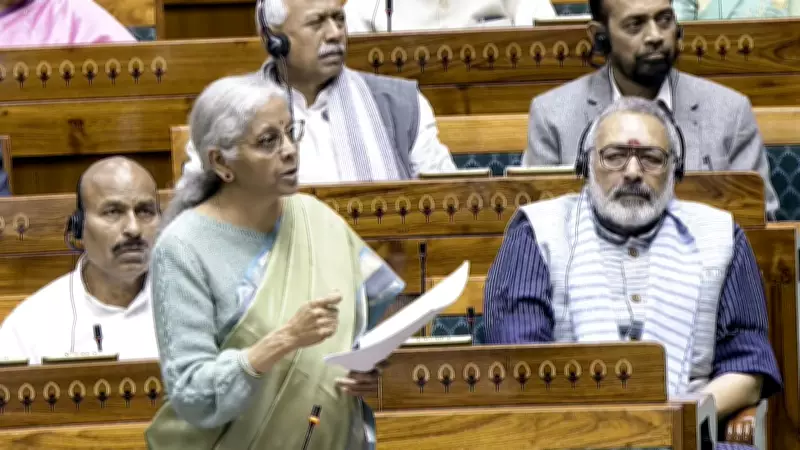
Sitharaman Rebuts Opposition Claims on Farmers, WTO, and Data in Budget Debate
Union Finance Minister Nirmala Sitharaman delivered a sharp response to Leader of Opposition Rahul Gandhi in the Lok Sabha on Wednesday, countering allegations over the India-US trade deal and defending the provisions of the Union Budget. She accused the previous Congress-led UPA government of surrendering India's interests at the World Trade Organization (WTO), putting farmers and the food security system at significant risk.
WTO Agreement and Farmer Concerns
Sitharaman highlighted that in 2013, the Congress government signed a WTO agreement in Bali without securing India's interests in public stockholding of grains. "This would have severely constrained procurement and the public distribution system," she stated, explaining that it could have halted procurement from Indian farmers post-2017 and disrupted ration distribution to the poor. She credited the current government with fighting to introduce a peace clause in 2017, which enabled ration provision during the Covid-19 pandemic and ongoing farmer procurement. "If Congress had its way, Indian farmers would have been on the streets. They are the ones selling Indian farmers," Sitharaman asserted, emphasizing that Prime Minister Narendra Modi remains steadfast in protecting national interests.
Data Security and AI Initiatives
Addressing Gandhi's remarks on data and artificial intelligence, Sitharaman rejected claims that Indian data is flowing unchecked to foreign shores. She outlined government efforts to incentivize data centers within India, allocating Rs 1,000 crore to ensure data retention and create job opportunities for Indian youth. "We are incentivising data centres so that the data remains in India and Indian youth get jobs," she said, dismissing the opposition's concerns as unfounded.

Budget Allocations for Food, Fertilizer, and Fuel Security
Sitharaman detailed budgetary provisions aimed at enhancing food, fertilizer, and fuel security. She cited allocations of Rs 2.27 lakh crore for food security and Rs 4,064 crore for the food processing industry, noting that food inflation is currently at its lowest, unlike during the UPA era when it reached double digits. To counter global uncertainties, the Budget includes an economic stabilization fund of Rs 50,000 crore for unanticipated challenges and a technology security fund of Rs 9,800 crore to address the weaponization of technology.
- Rs 2,500 crore allocated for nuclear power to ensure energy autonomy.
- Rs 600 crore allotted for the green energy mission to promote sustainable energy sources.
- Customs rebates provided for Special Economic Zones (SEZs) impacted by tariffs to facilitate domestic market sales.
Regional Focus and Industrial Schemes
Responding to criticism that the Budget ignored West Bengal, Sitharaman referenced the Purvodaya initiative, which allows states to select and highlight regions. She mentioned reducing the Tax Collected at Source (TCS) on tendu leaf collection in Jangalmahal areas from 5% to 2%, benefiting regions like Bankura, Purulia, and Midnapore. Additionally, she announced support for city economic regions, offering states up to Rs 1,000 crore annually for development projects, with cities like Kolkata and Howrah eligible to apply.
Clarification on GST and Tax Issues
Sitharaman also addressed Trinamool Congress MP Abhishek Banerjee's claims about taxes on essential items. She clarified that since the introduction of GST in 2017, there has been no tax on milk, education, books, or healthcare services. "Even pencil sharpener, erasers – all have zero GST. Healthcare and life insurance has also come down to zero," she stated, questioning the accuracy of the opposition's facts.
In her comprehensive reply, Sitharaman reinforced the government's commitment to safeguarding farmer welfare, ensuring data sovereignty, and bolstering economic resilience through strategic budgetary measures.






