

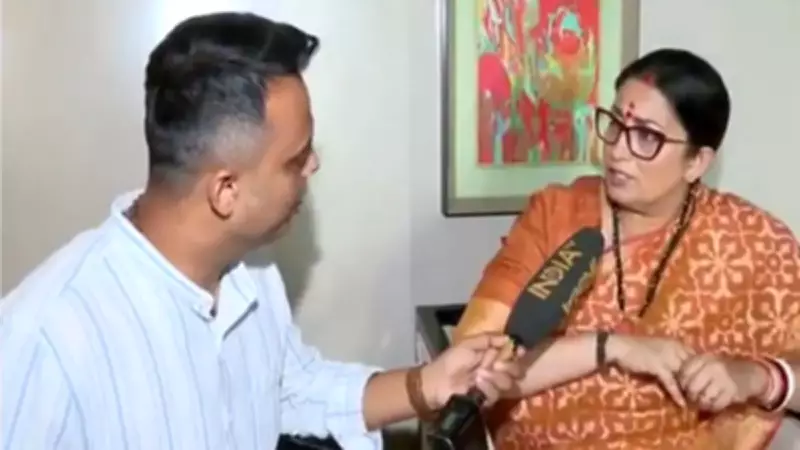
Smriti Irani Questions TMC's Commitment to Women After Quota Bill Fails in Lok Sabha
Union Minister Smriti Irani has launched a sharp critique against the Trinamool Congress (TMC), questioning the party's claims of supporting women's empowerment after the Women's Reservation Bill failed to pass in the Lok Sabha. In an exclusive statement, Irani highlighted the irony of TMC's stance, given the bill's collapse due to insufficient support from opposition parties, including those in West Bengal.
Background on the Women's Reservation Bill Failure
The Women's Reservation Bill, which aims to reserve one-third of seats in the Lok Sabha and state legislative assemblies for women, was recently introduced in Parliament but did not secure the necessary votes to proceed. The bill's failure has sparked widespread debate, with many pointing fingers at opposition parties for not rallying behind it. According to parliamentary records, the bill required a two-thirds majority for passage, but it fell short amid political disagreements and procedural hurdles.
Smriti Irani emphasized that the TMC, which often positions itself as a champion of women's rights, did not provide adequate backing to ensure the bill's success. She argued that this lack of support undermines the party's credibility on gender issues, especially in West Bengal, where women's participation in politics is a key topic.

Irani's Critique of TMC's Stance
In her remarks, Irani stated, "How can the TMC claim to support women when they failed to stand up for the Women's Reservation Bill in the Lok Sabha?" She pointed out that the bill's failure is a setback for gender equality in India, and opposition parties like the TMC share responsibility for this outcome. Irani further noted that the TMC's rhetoric on women's empowerment does not align with its actions in Parliament, where crucial votes on such bills are decided.
She also referenced the broader political context, suggesting that the TMC's focus on regional politics in West Bengal may have diverted attention from national issues like women's representation. Irani called for greater accountability from all political parties, urging them to prioritize bipartisan support for gender-centric legislation.
Implications for West Bengal and National Politics
The failure of the Women's Reservation Bill has significant implications for West Bengal, a state with a high percentage of women voters and active female political leaders. Irani's comments are seen as part of a larger political strategy to challenge the TMC's dominance in the region by highlighting perceived inconsistencies in its policies. This issue could influence upcoming elections and public perception, as women's rights remain a critical voter concern.
Moreover, the incident underscores the challenges in passing progressive legislation in India's fragmented political landscape. Experts suggest that without cross-party cooperation, bills aimed at social reform, such as the Women's Reservation Bill, may continue to face obstacles. Irani's critique serves as a reminder of the need for political unity on matters of national importance.
Looking Ahead: Calls for Action and Unity
In conclusion, Smriti Irani's statements have reignited discussions on women's political representation in India. She has called on the TMC and other opposition parties to reassess their commitment to gender equality and work collaboratively to revive the Women's Reservation Bill. As the debate continues, it remains to be seen how this will impact political dynamics in West Bengal and beyond, with potential repercussions for future legislative efforts.
Key Points from the Article:

- The Women's Reservation Bill failed to pass in the Lok Sabha due to lack of support from opposition parties.
- Smriti Irani criticizes TMC for not backing the bill, questioning its claims of supporting women.
- The failure highlights political divisions and challenges in advancing gender equality legislation.
- This issue could affect TMC's credibility in West Bengal and influence voter sentiment.
- Irani urges bipartisan cooperation to ensure the bill's passage in the future.





