

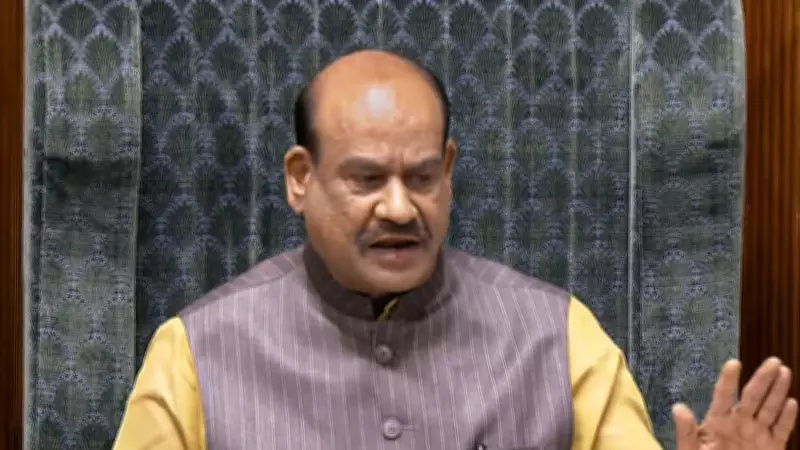
Speaker Om Birla Reveals He Personally Requested PM Modi to Avoid Lok Sabha Session
In a dramatic revelation that has sent shockwaves through political circles, Lok Sabha Speaker Om Birla disclosed on Thursday that he personally requested Prime Minister Narendra Modi not to attend the House where he was scheduled to speak on Wednesday. This unprecedented move came as the Lok Sabha passed the Motion of Thanks on the President's Address without the Prime Minister's customary reply to the discussion.
Credible Information About Planned Incident
Speaker Birla explained his extraordinary decision by stating he had received credible information that several Congress members planned to create an unprecedented incident after reaching the Prime Minister's seat. "When the Leader of the House was scheduled to speak on the Honourable President's address, I got credible information that several members from the Congress can execute an unprecedented incident after reaching the Honourable Prime Minister's seat," Birla revealed during the parliamentary proceedings.
The Speaker expressed deep concern about the potential consequences, stating: "I saw such a scene in the House; if this incident had taken place, such an unpleasant scene would have destroyed the nation's democratic traditions. To prevent this, I requested the Honourable Prime Minister that he should not come to the House."

Congress MPs' Protest and Banner Display
The context for these developments emerged from Wednesday's chaotic scenes in Parliament when Congress MPs marched toward the treasury benches holding a large banner featuring Prime Minister Modi's photograph with the slogan "Jo uchit samjho wo karo" (Do what you think is appropriate). This protest led to the adjournment of the Lok Sabha amid pandemonium.
Birla strongly condemned this behavior, describing it as unprecedented in parliamentary history. "The behaviour of some members yesterday was unprecedented. Never did such a thing happen. The Opposition members' behaviour in the Speaker's chamber was a black spot," he declared, expressing his disappointment at the erosion of parliamentary decorum.
Congress Strongly Denies Allegations
Outside Parliament, Congress leaders vehemently rejected the Speaker's claims about any planned harm to the Prime Minister. Priyanka Gandhi Vadra categorically denied the allegations, stating: "It is an absolute lie. There is no question of anybody raising hands on the Prime Minister, trying to hurt him or any such thing. There is no question. So, it is absolutely wrong for anybody to say that there was any such plan, there was no such plan."
Vadra further accused the government of using the Speaker as a shield, saying: "I am sorry, the Prime Minister is hiding behind the Speaker. They are making the Speaker say all this because yesterday he did not have the guts to come to the House. Because three women were standing before his bench... what nonsense is this."
Broader Political Implications
Congress MP and party whip Manickam Tagore echoed these sentiments, suggesting that the Prime Minister was avoiding parliamentary accountability. "This Prime Minister is afraid to hear the Leader of Opposition and afraid to come to the Lok Sabha and afraid to speak during the Motion of Thanks on the President's Address. To cover his fear, he is ready to blame even the women MPs... History will remember this clearly," Tagore asserted.
Speaker Birla emphasized the importance of maintaining parliamentary traditions, stating: "It is sad that the Leader of the House cannot speak in the House. But I am thankful to him that he accepted my request... If you do not follow decorum, the House won't run... The country has seen how the women members reached the treasury benches yesterday. You can speak what you wish to, but such behaviour is not acceptable."

This extraordinary sequence of events highlights the deepening tensions between the government and opposition in Parliament, raising serious questions about security protocols, parliamentary decorum, and the functioning of democratic institutions in India. The Speaker's unprecedented intervention to prevent a potential incident marks a significant moment in India's parliamentary history that will likely have lasting political repercussions.





