

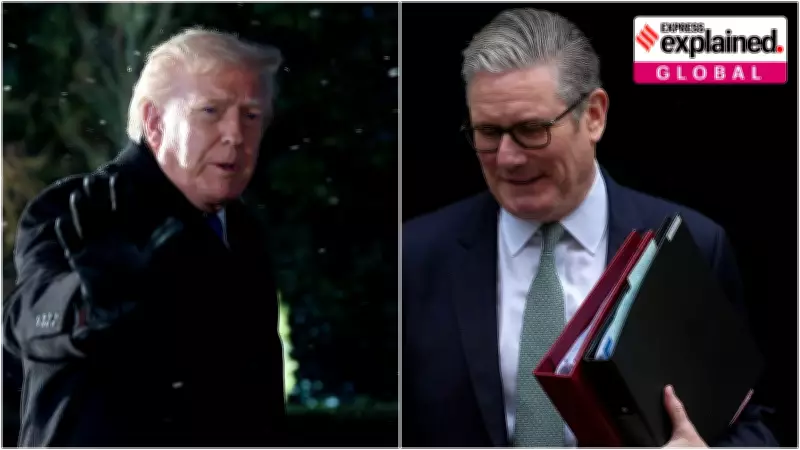
Starmer's Narrow Escape and Trump's Resilience in Epstein Scandal Fallout
UK Prime Minister Keir Starmer narrowly survived demands for his resignation this week after facing intense scrutiny over his US ambassador pick's connections to convicted sex offender Jeffrey Epstein. In contrast, US President Donald Trump, who has numerous mentions in Epstein's files, continues to enjoy robust political support without similar threats to his position. This stark asymmetry in accountability highlights fundamental differences between British and American political landscapes, leadership reputations, and public trust ecosystems.
The Crisis of Institutional Vetting in British Polity
As political theorist Walter Bagehot noted in The English Constitution, the UK Prime Minister serves as the "efficient" engine of the state, distinct from the symbolic monarchy. When this operating system faces validity questions, it escalates from mere scandal to potential national crisis. Starmer's government represents the primary mechanism upon which the nation relies, making any failure in judgment particularly damaging.
The controversy erupted when the US Department of Justice released Epstein's private correspondences, revealing that former ambassador Peter Mandelson's association with Epstein was closer than previously known. Although Mandelson was sacked in September and isn't implicated in sexual misconduct, the files show he allegedly passed confidential government information to Epstein during critical periods.

The Peter Mandelson Saga: From 'Prince of Darkness' to Epstein Liaison
Peter Mandelson, 72, has long been known as a background fixer with the nickname 'Prince of Darkness.' Starmer selected him as ambassador to Trump's America despite vetting processes flagging Epstein links, citing Mandelson's Washington connections and deal-making skills. The Epstein files reveal three serious allegations:
- The €500 Billion Eurozone Leak: Mandelson allegedly informed Epstein about a massive European bailout package hours before its 2008 announcement, enabling front-running in currency markets.
- The £20 Billion Asset Sale Memo: A confidential 2009 briefing on UK plans to sell state assets was reportedly forwarded to Epstein, revealing the government's "bottom line" on privatization.
- The $75,000 Transfers: Bank records from 2003-2004 show payments from Epstein-linked accounts to accounts associated with Mandelson and his husband.
These revelations suggest Epstein potentially exploited the UK's post-2008 economic recovery through direct access to Mandelson as Business Secretary and Trade Envoy Andrew Mountbatten-Windsor.
Asymmetric Accountability: Starmer's High-Trust vs. Trump's High-Conflict Ecosystems
The accountability expected from Starmer far exceeds that from Trump, despite Trump having 38,000 direct mentions in Epstein files. This discrepancy illustrates "the integrity paradox"—where consequences for infractions correlate with how strongly a leader endorses a high-integrity brand.
Trump operates in a "high-conflict" political environment where transgression has become normalized. His administration, led by Attorney-General Pam Bondi, has successfully framed the Epstein files as a partisan "Deep State" attack, creating "scandal saturation" that shields him. Trump's populist brand has effectively decoupled his political power from personal conduct scrutiny.
Conversely, Starmer must answer to Britain's "high-trust" ecosystem. His premiership relies on the sanctity of the Ministerial Code—a constitutional framework that depends on institutional shame for enforcement in the absence of a written constitution. The prospect that Downing Street officials might be compromised by Epstein's circles threatens the social contract between state and citizens, explaining the intense public outrage.
Broader Implications for Political Trust and Governance
This episode underscores how different political systems process scandal. In the UK, where institutional trust remains a cornerstone, any breach can trigger existential crises for leadership. In the US, where political conflict is entrenched and scandal frequent, leaders can develop immunity through narrative control and base loyalty.

Starmer's statement that he would "never walk away from the mandate I was given to change this country" reflects his recognition of this trust-based compact. Meanwhile, Trump's continued support demonstrates how American politics increasingly rewards resilience against allegations, regardless of their substance.
The Epstein files thus serve as a revealing lens on contemporary governance, showing how national context, leadership branding, and public expectations create dramatically different consequences for similar associations.





