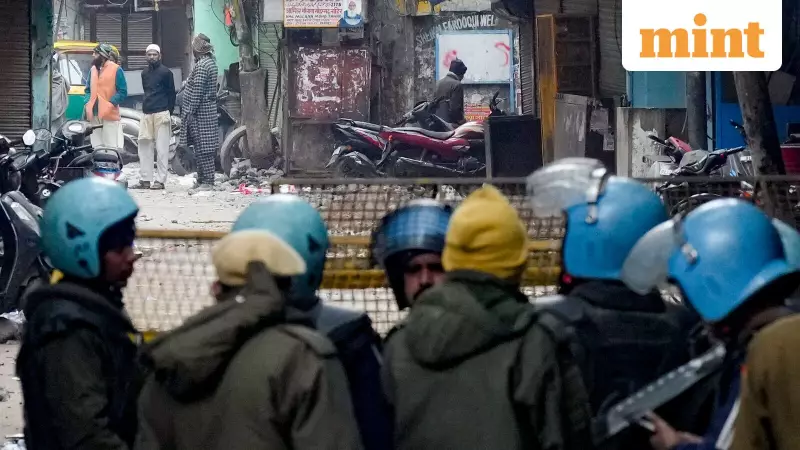
Fresh tensions erupted in Delhi's historic Turkman Gate area early Wednesday, leaving at least five police personnel injured after a demolition drive near a century-old mosque led to stone-pelting. The violence, though quickly contained, evoked dark memories of a brutal chapter from India's Emergency era, when the same locality witnessed a massacre in 1976.
The Ghost of 1976: A Dark Chapter Recalled
The recent clash immediately drew parallels to the Turkman Gate massacre of 1976, a tragic event detailed in economist Ashok Chakravarti's book The Struggle Within: A Memoir of the Emergency. That year, Sanjay Gandhi's aggressive family planning campaign merged with a 'beautification drive' for the capital.
After a hostile reception from local residents, predominantly Muslim, Sanjay Gandhi—who held no formal government office—reportedly ordered the demolition of structures around Turkman Gate to clear the view to Jama Masjid. The first bulldozer arrived on 13 April 1976.

The situation worsened after 15 April, when Sanjay Gandhi and Delhi Governor Krishan Chand inaugurated the Dujana House family planning camp nearby. Chakravarti's account states that rickshaw pullers, vendors, and even passers-by were forcibly taken for sterilizations, sparking widespread anger in Turkman Gate, Jama Masjid, and Chandni Chowk.
The Fateful Day of Violence
On 19 April 1976, as bulldozers resumed work, massive protests erupted. Police responded with lathi charges and tear gas, arresting women and children. The crowd, swelling to an estimated 5,000 to 6,000, began pelting stones.
Police then opened fire. Protesters retaliated with a Molotov cocktail, attacking a bulldozer. This triggered more police firing, which continued randomly throughout the day. Another group attacked the old Turkman Gate police station, leading to reinforcements being met with stones and acid bulbs thrown from rooftops.
By the time the dust settled, independent researchers estimated around 400 people dead and over 1,000 wounded. Chakravarti's book recounts that bulldozers were sent overnight to clear both rubble and bodies, dumping them at a distant rubbish heap. Demolitions continued unabated for ten more days.
Aftermath and Legacy
Years later, the Shah Commission investigated the massacre and named Sanjay Gandhi among those culpable for the excesses. However, no action was ever taken against the accused.
Wednesday's incident, though on a far smaller scale, served as a stark reminder of the area's volatile history. It underscores how urban development drives in densely populated, historic neighborhoods can reopen old wounds and trigger conflict, linking present-day actions to the unresolved traumas of the past.