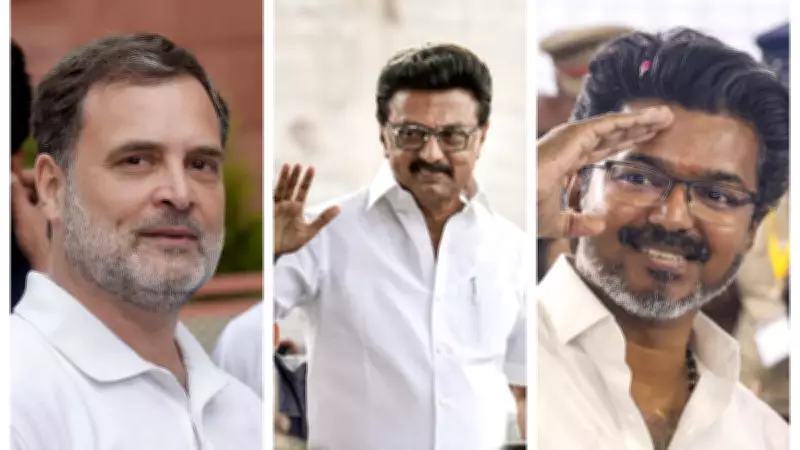
The political landscape in Tamil Nadu has witnessed a seismic shift as the Congress party formally ended its decades-old alliance with the Dravida Munnetra Kazhagam (DMK) ahead of the 2026 Assembly elections. The divorce, long speculated, was confirmed after Congress leader Rahul Gandhi refused to share the dais with DMK President M K Stalin during an election rally, a man he once affectionately called his 'elder brother'. The breaking point, however, was the rise of actor-politician Vijay and his party, Tamizhaga Vetri Kazhagam (TVK), which the Congress saw as a viable alternative to the DMK.
The Final Straw: Rahul Gandhi's Snub
The first public indication of the rift came when Rahul Gandhi declined to appear alongside Stalin at a joint rally in Chennai. Sources within the Congress revealed that Gandhi was uncomfortable with Stalin's alleged reluctance to cede seats for Congress candidates and his perceived closeness to Vijay. 'The chemistry was gone,' a senior Congress leader said. 'Rahul felt that Stalin was no longer the same leader who fought alongside us against the BJP.'
Stalin, for his part, had been dismissive of Congress's demands for a larger share of seats, offering only 10 constituencies out of 234. The Congress, which had contested 25 seats in 2021, found this unacceptable. The final nail in the coffin was Stalin's decision to hold a separate rally with Vijay, signaling a potential alliance with the TVK.

Vijay's Rise: A Game Changer
Vijay, a hugely popular film star, entered electoral politics in 2024 with the launch of TVK. His anti-incumbency rhetoric and appeal among youth and rural voters made him an attractive partner for the Congress, which was looking for a fresh face to counter the DMK's dominance. 'Vijay represents a new generation of politics,' said a Congress strategist. 'He is not tainted by corruption allegations that have dogged the DMK.'
The Congress high command, under Rahul Gandhi's direction, decided to explore a tie-up with TVK. After weeks of negotiations, the two parties announced a pre-poll alliance, with Congress agreeing to contest 30 seats and TVK the rest. 'This is a strategic move to offer a credible alternative to the people of Tamil Nadu,' said Congress spokesperson Pramod Tiwari.
DMK's Reaction: Betrayal and Defiance
The DMK leadership reacted with anger and disbelief. 'We have stood by Congress through thick and thin,' Stalin said in a press conference. 'But they have chosen to walk out on us for a film star. This is a betrayal of the secular alliance.' DMK allies, including the Left parties and the Indian Union Muslim League, expressed solidarity with Stalin, but some admitted that the Congress's departure could weaken the coalition.
Political analysts believe that the split could benefit the AIADMK, which has been struggling to regain its footing after consecutive defeats. 'The Congress-DMK divorce fragments the anti-BJP vote,' said analyst N. Sathiya Moorthy. 'It might allow the AIADMK to emerge as a kingmaker in a hung assembly.'
What Lies Ahead
With the Congress and TVK now allied, the 2026 elections promise to be a multi-cornered contest. The DMK will rely on its strong organizational network and welfare schemes, while the AIADMK will bank on its traditional vote bank. The BJP, which has been trying to expand its footprint, may find new opportunities in the fractured landscape.
For Rahul Gandhi, the decision to break with Stalin is a high-risk gamble. If the Congress-Vijay alliance succeeds, it could rejuvenate the party's fortunes in Tamil Nadu. If it fails, it may further marginalize the Congress in a state where it has been a junior partner for decades. 'We are confident that the people will choose change,' said Rahul Gandhi. 'Tamil Nadu deserves better.'