

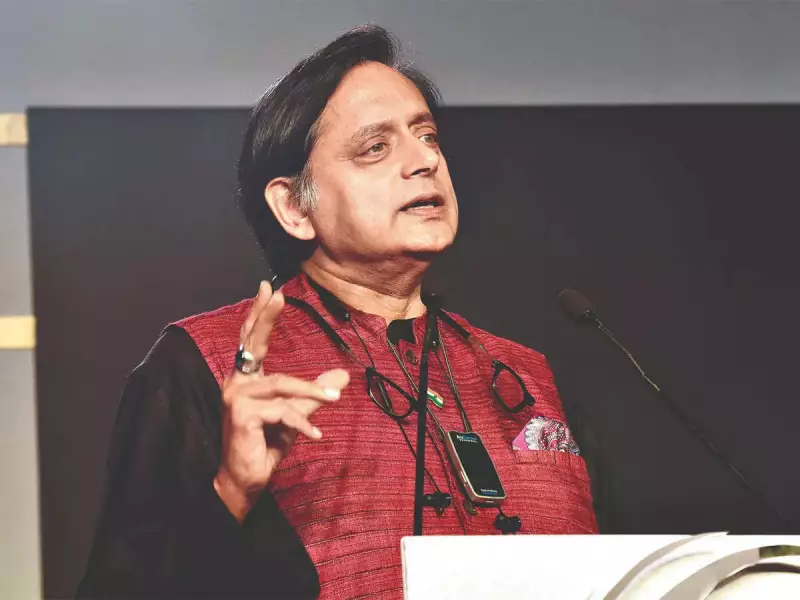
Senior Congress leader Shashi Tharoor expressed significant appreciation for Prime Minister Narendra Modi's recent address at the Ramnath Goenka Lecture, describing it as a powerful combination of economic vision and cultural revival. The event, organized by the Indian Express, took place on Monday and saw Tharoor in attendance despite battling a severe cold.
Tharoor's Positive Assessment of PM's Address
Shashi Tharoor highlighted several key aspects of the Prime Minister's speech that resonated with him. He noted that PM Modi spoke extensively about India's "constructive impatience" for development, a concept that reflects the nation's growing ambition and determination to progress rapidly. The Prime Minister positioned India not merely as an "emerging market" but as an "emerging model" for the global community, emphasizing the economy's remarkable resilience in challenging times.
Tharoor particularly appreciated how the Prime Minister addressed criticism about being in constant "election mode" by countering that he was actually in "emotional mode" to solve people's problems. This distinction, according to Tharoor's observations, reflected a deeper commitment to addressing citizens' concerns beyond political considerations.

Cultural Renaissance and Post-Colonial Mindset
A substantial portion of the Prime Minister's lecture focused on what he described as dismantling Macaulay's 200-year legacy of "slave mentality." Tharoor observed that this theme formed a central part of the address, with PM Modi advocating for a 10-year national mission to restore pride in India's heritage, languages, and traditional knowledge systems.
While endorsing this cultural initiative, Tharoor added a nuanced perspective, suggesting that "the Prime Minister should have acknowledged how Ramnath Goenka had used English to raise a powerful voice for Indian nationalism." This remark highlighted the complex relationship between colonial legacies and modern Indian identity.
Context of Tharoor's Recent Controversies
Tharoor's positive comments about the Prime Minister's lecture come against the backdrop of recent controversies surrounding his own statements. Just days earlier, he had stirred debate within political circles by arguing that reducing senior BJP leader LK Advani's decades of service to a single episode was unfair, despite the significance of that episode.
These remarks had created internal discomfort within the Congress party, which later clarified that Tharoor speaks for himself. The party emphasized that his continued presence in the Congress Working Committee reflects the organization's democratic character and capacity to accommodate diverse viewpoints.
Additionally, Tharoor had recently commented on the prevalence of dynastic politics across parties, describing it as a "grave threat" to Indian democracy. He had suggested that India needed to transition from "dynasty to meritocracy," comments that were quickly seized upon by the BJP as a "very insightful piece" on the country's political culture.
Despite these contextual tensions, Tharoor's assessment of the Prime Minister's lecture remained notably positive. He concluded that the address served as both an economic outlook and a cultural call to action, effectively urging the nation to maintain its restlessness for progress while reconnecting with its cultural roots.






