Tipu Sultan Portrait Ignites Political Firestorm in Maharashtra
History sometimes escapes textbooks and appears framed on walls, sparking contemporary political battles. In Malegaon, Maharashtra, a portrait of 18th-century Mysore ruler Tipu Sultan briefly displayed in the office of newly-elected deputy mayor Shaan-e-Hind Nihal Ahmed has triggered a statewide political controversy that rapidly escalated beyond municipal boundaries.
From Portrait Removal to Violent Protests
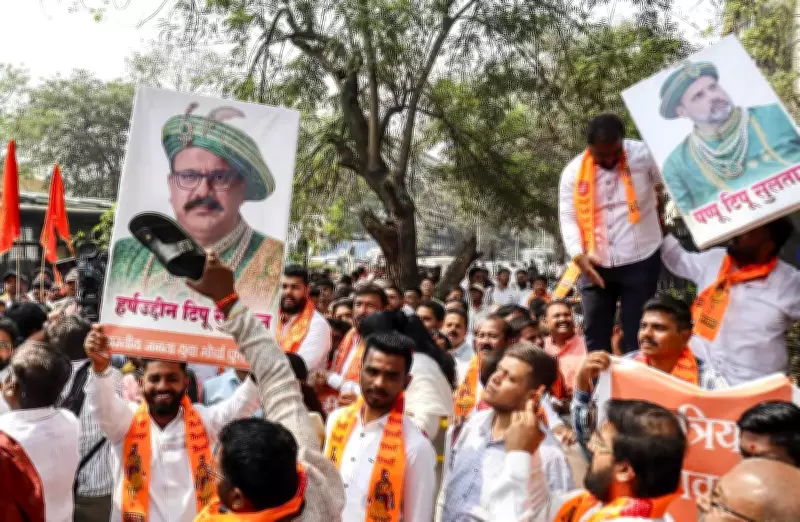
Within just 48 hours, the portrait was removed by civic authorities, but the controversy had already ignited a war of words between Maharashtra Chief Minister Devendra Fadnavis and state Congress chief Harshwardhan Sapkal. The situation deteriorated further as protests erupted across multiple cities, culminating in stone-pelting incidents in Pune that left eight people injured, including police personnel, journalists, and political workers from both sides.
The Malegaon Municipal Corporation acted after Shiv Sena corporators objected to the portrait's display. Civic chief Ravindra Jadhav confirmed that officials consulted the state government's official protocol list, which specifies leaders whose portraits may be displayed in government offices. "Tipu Sultan's name is not included in the list. Therefore, the portrait was removed from the deputy mayor's office," municipal officials stated.

The Controversial Comparison That Fueled the Fire
The controversy centered not merely on the portrait's presence but on Congress leader Harshwardhan Sapkal's statement comparing Tipu Sultan with Chhatrapati Shivaji Maharaj as belonging "to the same league of valour." Chief Minister Fadnavis immediately denounced this comparison as "unacceptable" and declared that the Congress politician should be "ashamed."
Deputy mayor Nihal Ahmed defended the historical relevance of Tipu Sultan, stating: "Tipu Sultan fought against the British and was acknowledged for his bravery at that time. There are roads named after him in Mumbai and Nagpur. This is an attempt to divert attention from our work. Some people are unable to digest that two Muslim women are mayor and deputy mayor in Malegaon."
Historical Figures as Political Symbols
The episode reopened longstanding historical debates about two iconic figures who occupy very different spaces in Indian historical consciousness. Chhatrapati Shivaji Maharaj, born in 1630, founded the Maratha state and established Hindavi Swarajya, representing resistance, self-rule, and regional pride deeply embedded in Maharashtra's socio-political identity.
Tipu Sultan, born in 1751, ruled the Kingdom of Mysore during intense conflicts with the British East India Company. While celebrated by many historians for his sustained anti-colonial resistance, he remains a contested figure in regions like Karnataka and Kerala due to accounts of forced conversions and temple desecrations.
Political Mobilization and Ideological Divisions
In Maharashtra, Shivaji Maharaj occupies an almost sacred position across political lines, particularly within BJP and Shiv Sena narratives where he symbolizes indigenous sovereignty and cultural assertion. BJP Pune city president Dheeraj Ghate asserted: "Sapkal's remarks deeply hurt the sentiments of all those who idolise Chhatrapati Shivaji Maharaj as a deity. It is a deliberate attempt to create a rift in society."
For the Congress, Tipu Sultan has represented anti-colonial resistance and inclusive historical nationalism, with Congress governments in southern states celebrating Tipu Jayanti as commemorations of freedom fighting. This divergence reflects deeper ideological differences in how political parties mobilize historical narratives for contemporary purposes.
Escalation and Damage Control
The controversy quickly spread beyond Malegaon, with BJP and right-wing organization supporters protesting in Nagpur, Nashik, Ahilyanagar, Sangli, Solapur, Chhatrapati Sambhajinagar, Nanded, Latur, and other locations. In Pune, the situation turned violent when stone-pelting erupted between BJP and Congress workers outside Congress Bhawan.

Additional Commissioner of Police Manoj Patil reported: "As the sloganeering was on from both sides, someone hurled a stone. This set off stone pelting by members from either side. Two women constables, two reporters and two workers each from BJP and Congress were injured."
Amid mounting criticism, Sapkal later clarified his remarks, stating: "My statement was misinterpreted by the BJP for political benefits. I said that there cannot be anyone like Shivaji Maharaj, and Tipu Sultan took inspiration from him." He expressed regret, describing Shivaji Maharaj as "my ideal, my inspiration and my pride" and appealed for calm.
Broader Political Reactions
Other political leaders weighed in as the debate widened. AIMIM chief Asaduddin Owaisi defended Tipu Sultan, noting: "In 1799, Tipu Sultan died fighting the British. He did not sit in jail and write love letters to the British." Meanwhile, Telangana BJP president N Ramchander Rao countered that by glorifying Tipu Sultan, the AIMIM "is distorting history."
The episode illustrates how historical figures continue to function as potent political signifiers in contemporary India. Portraits in public offices are rarely neutral decorations—they signal affiliation, narrative positioning, and ideological alignment. As demonstrations spread and leaders traded charges over historical interpretation, the controversy demonstrated that in Indian politics, the past remains an active participant in present-day conflicts, with images on walls speaking as loudly as political speeches delivered beneath them.