

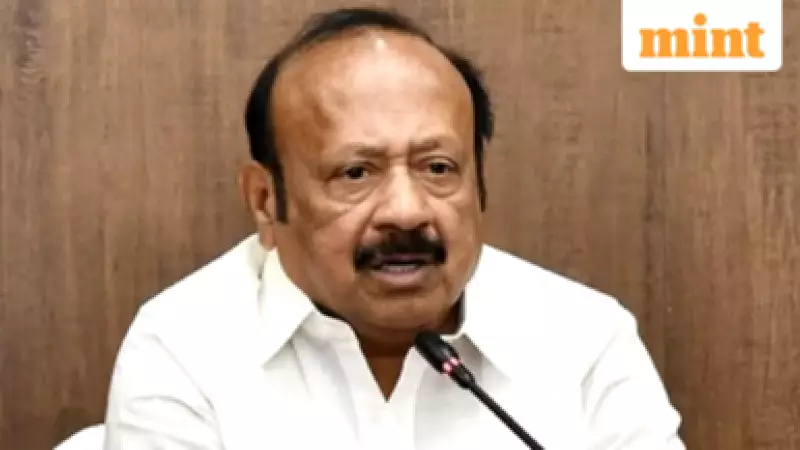
Tamil Nadu Minister's Remarks on Hindi-Only Education Ignite Political Firestorm
Tamil Nadu Agriculture Minister MRK Panneerselvam has stirred significant controversy with his recent comments about migrant workers from North India, reigniting the long-standing debate over language policies in education. During an event in Chengalpattu near Chennai, the minister made statements that have drawn both criticism and defense from political factions across the state.
Controversial Comments on Education and Employment
Minister Panneerselvam asserted that individuals from North India migrate to Tamil Nadu primarily to perform low-skilled jobs such as cleaning tables and selling pani puri. He attributed this employment pattern directly to what he described as a "Hindi-only education" system prevalent in their home states. The minister contrasted this situation with Tamil Nadu's educational approach, emphasizing the state's two-language policy that incorporates English proficiency.
"Those from the north are coming to Tamil Nadu to clean tables... they are coming here to work as construction labourers and pani puri sellers as they have only learnt Hindi," Panneerselvam was quoted as saying. "But our children have gone abroad... as we follow a two-language policy and learned English well. They are going abroad and getting opportunities to earn in crores... in USA, London."

DMK's Defense of the Minister's Statements
The ruling Dravida Munnetra Kazhagam (DMK) has come forward to defend Minister Panneerselvam, insisting that his remarks were not intended to be derogatory. DMK spokesperson TKS Elangovan clarified that the minister was highlighting systemic issues in education and employment within BJP-ruled states rather than disparaging migrant workers themselves.
Elangovan explained: "It's about the other states treating their people. They are not giving proper education. Their system of education is against their growth. That's why they are coming here. Tamil Nadu is providing good education and employment and is also treating people from other states in a decent way."
The spokesperson further alleged that BJP-governed states neglect their citizens' educational and employment needs, characterizing the party as more focused on religious matters than political governance. This defense frames Panneerselvam's comments as a critique of policy failures rather than personal criticism of migrant communities.
AIADMK's Strong Condemnation of the Remarks
In sharp contrast, the opposition All India Anna Dravida Munnetra Kazhagam (AIADMK) has strongly condemned Minister Panneerselvam's statements. AIADMK spokesperson Kovai Sathyan described the remarks as "highly condemnable" and emphasized the vital contributions migrant workers make to Tamil Nadu's economy.
Sathyan highlighted the challenging circumstances faced by migrant workers in the state, referencing specific incidents of violence against laborers from Odisha and Bihar. "They don't get a safe home for contributing to the development and welfare of Tamil Nadu economy, that's how they are treated," he stated, questioning the minister's characterization of their situation.
The AIADMK spokesperson stressed Tamil Nadu's traditional hospitality ethos, encapsulated in the phrase "Vandharai Vaazha Vaikkum Thamizhagam" (Tamil Nadu shelters those who come in search of livelihood). He argued that derogatory remarks contradict this welcoming spirit and undermine the state's economic achievements, which he noted are significantly supported by migrant labor.
Broader Implications for Language Policy Debates
This controversy has reignited discussions about India's complex language education policies and regional disparities in economic opportunities. The incident touches upon several sensitive issues:

- The ongoing tension between Hindi imposition concerns and regional language preservation
- Economic migration patterns within India and their relationship to educational systems
- Political narratives around development and employment in different states
- The treatment and integration of migrant workers in host communities
The debate reflects deeper questions about how education policies influence employment prospects and how political parties frame these issues for electoral advantage. As migrant workers continue to play crucial roles in state economies across India, their treatment and representation in political discourse remain significant matters of public concern.
This incident demonstrates how language policy discussions in India frequently intersect with questions of economic opportunity, regional identity, and political strategy, creating complex debates that resonate far beyond educational circles.





