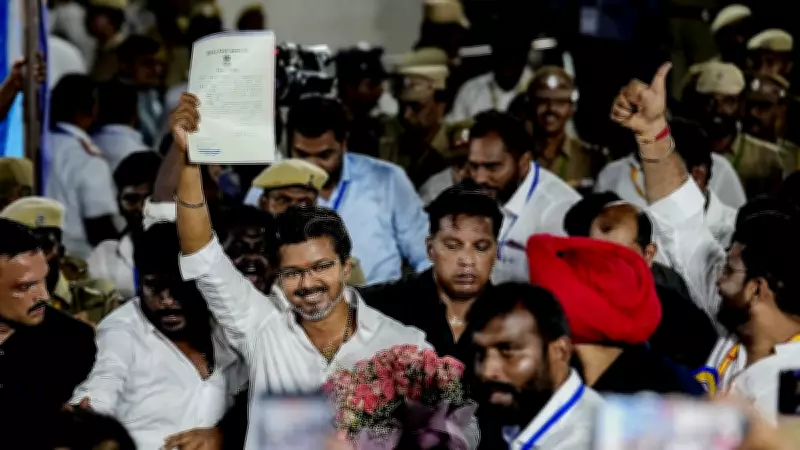
In a stunning political upheaval, actor-turned-politician Vijay and his party, Tamilaga Vettri Kazhagam (TVK), have shattered the six-decade-long Dravidian duopoly in Tamil Nadu. According to the latest trends from the 2026 Tamil Nadu Assembly Elections, TVK is leading or has won in 107 of the 234 seats, just 11 short of the majority mark of 118. This performance is being compared to the historic 1967 elections, when a fledgling DMK overthrew the Congress government, riding high on the anti-Hindi agitation.
A Historic Shift
For over 60 years, Tamil Nadu politics has been dominated by the DMK and AIADMK, with power alternating between these two Dravidian parties. Vijay's TVK has now emerged as a formidable third force, challenging the established order. The party's strong showing has left political analysts and rivals alike in shock.
Election Performance
As of the latest updates, TVK leads in 107 constituencies, while the DMK and AIADMK are trailing with significantly lower numbers. The magic number to form a government is 118, and TVK is within striking distance. If the party manages to secure the support of independents or smaller allies, it could form the next government in the state.

Comparison to 1967
The 1967 elections were a watershed moment in Tamil Nadu's political history, as the DMK, then a young party, defeated the formidable Congress. The DMK's victory was fueled by the anti-Hindi agitation and a wave of regional pride. Similarly, Vijay's TVK has capitalized on anti-incumbency and a desire for change among the electorate.
Vijay, who has a massive fan following from his film career, has managed to translate his popularity into political capital. His campaign focused on issues like corruption, unemployment, and regional identity, resonating with voters across the state.
Reactions and Implications
Political parties have reacted with caution. The DMK and AIADMK have not yet conceded defeat, as final results are still awaited. However, the writing is on the wall: Tamil Nadu's political landscape has been irrevocably altered.
If TVK forms the government, it will mark the first time in over six decades that a non-Dravidian party rules the state. This could have profound implications for state and national politics, as Vijay's party is seen as a potential ally for national coalitions.
The election results are a testament to the changing political dynamics in Tamil Nadu, where voters are increasingly looking for alternatives to the traditional Dravidian parties. Whether TVK can sustain this momentum remains to be seen, but for now, Vijay has achieved what many thought was impossible.