

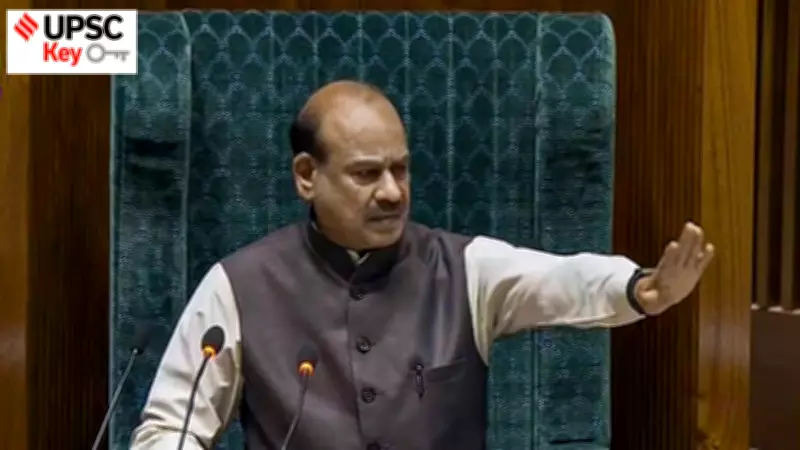
Opposition Moves No-Confidence Motion Against Lok Sabha Speaker Om Birla
The Opposition has submitted a notice for a no-confidence motion against Lok Sabha Speaker Om Birla, following repeated clashes in the House. This development holds significant relevance for UPSC aspirants, particularly in the context of Indian Polity and Governance.
Constitutional and Procedural Aspects
According to Article 94(c) of the Constitution, a resolution for the removal of the Speaker requires a written notice to the Secretary-General of the Lok Sabha, with at least fourteen days' notice. The motion must be backed by at least two Members, and a quorum of fifty members must stand in its favor. Historically, such motions have been rare, with only three instances occurring in 1954, 1966, and 1987, none of which resulted in the Speaker's removal.
The Speaker's roles and powers include presiding over House proceedings, maintaining order, and casting a vote in case of a tie. Under Article 96, the Speaker does not preside while a resolution for their removal is under consideration. This motion highlights the dynamics of parliamentary conduct and the constitutional safeguards governing the Speaker's office.

Key Takeaways for UPSC
- The notice was signed by at least 118 Opposition MPs and submitted to Lok Sabha Secretary General Utpal Kumar Singh.
- The Speaker has decided not to chair proceedings until a decision is taken on the notice.
- This topic is crucial for Prelims under Indian Polity and for Mains under Parliament's structure and functioning.
Regulatory Framework for Social Media Companies Tightened
The IT Ministry has notified amendments to the Information Technology Rules, 2021, imposing stricter timelines for content takedown by social media platforms. This move is pivotal for UPSC topics related to cybersecurity and governance.
Amendments and Implications
The new rules reduce the takedown time for unlawful content from 36 hours to just three hours. For non-consensual intimate imagery, the timeline is now two hours, down from 24 hours. While the requirement for AI-generated content labels has been relaxed from a specific 10% space to "prominently" visible labels, the compliance burden on tech companies has increased significantly.
Failure to adhere to these timelines may result in the loss of safe harbour protection under Section 79 of the IT Act, 2000, which shields intermediaries from liability for user-generated content. The Sahyog portal, launched by the Union Home Ministry, facilitates the expedited blocking of objectionable content, underscoring the government's focus on digital regulation.
UPSC Relevance
- This topic aligns with Prelims current events and Mains questions on government policies and interventions.
- Key concepts include safe harbour, AI-generated content, and the balance between regulation and innovation.
India Set to Procure Additional P-8I Aircraft from the US
India is advancing the procurement of six more Boeing P-8I aircraft under an inter-governmental agreement with the United States. This deal is part of broader defence cooperation and has implications for UPSC sections on bilateral relations and national security.
Defence and Strategic Dimensions
The P-8I is a multi-role Long Range Maritime Reconnaissance Anti-Submarine Warfare aircraft, enhancing India's capabilities in the Indian Ocean Region. The procurement, cleared by the Defence Procurement Board, is expected to be finalized by the Defence Acquisition Council. Notably, this deal does not involve offset obligations under the Defence Acquisition Procedure 2020, reflecting a shift in procurement strategies.
Concurrently, discussions are underway for the acquisition of Rafale fighter jets, with increased capital allocations in the defence budget for 2026-27. These developments highlight India's focus on modernizing its armed forces and strengthening strategic partnerships.

UPSC Connections
- Relevant for Prelims current events and Mains topics on bilateral groupings and defence policies.
- Emphasizes the interplay between defence procurement, trade deals, and geopolitical strategies.
Supreme Court Seeks Report on SC/ST Sub-Classification
The Supreme Court has directed the Centre to submit a report on actions taken following its 2024 judgment allowing sub-classification of Scheduled Castes and Scheduled Tribes. This ruling is a landmark in affirmative action and constitutional law.
Judicial and Policy Implications
In a 6:1 majority, the Constitution bench overruled the 2004 E V Chinnaiah verdict, permitting states to sub-classify SCs and STs to ensure equitable distribution of reservation benefits. The judgment also endorsed the exclusion of the creamy layer from these categories, aiming to achieve substantive equality. The Court's direction for an action-taken report underscores the need for implementation to address intra-group inequalities.
This topic delves into constitutional provisions like Articles 341 and 14, and debates on reservation policies, making it essential for UPSC aspirants focusing on social justice and governance.
Key Points for Exam Preparation
- Highlights the evolution of reservation policies and judicial interpretations.
- Important for Prelims on Indian Polity and Mains on government interventions and rights issues.
India-US Interim Trade Deal and Economic Security
The India-US interim trade deal includes provisions on economic security, reflecting a shift towards geoeconomic strategies. This agreement is crucial for understanding contemporary international relations and trade policies.
Trade and Geopolitical Dynamics
The joint statement emphasizes strengthening economic security alignment to enhance supply-chain resilience and address non-market policies of third parties. India has agreed to remove digital services taxes and negotiate bilateral digital trade rules, which may impact sovereign policy space. Concurrently, Bangladesh's trade deal with the US, offering zero tariffs on certain textiles, poses competitive challenges for Indian exporters.
These developments illustrate the intertwining of economic and foreign policies, with India pivoting towards Western trade partnerships while navigating complexities with China and Russia.
UPSC Significance
- Relevant for Prelims current events and Mains on bilateral agreements, economic policies, and global groupings.
- Encourages analysis of trade-offs in international negotiations and their domestic implications.
Additional News Highlights
Other notable developments include India-China talks focusing on border peace and trade, the Smithsonian's repatriation of Indian bronzes, and government clarifications on the US trade deal. The Budget 2026-27's tax incentives for data centres also merit attention for economic and technological topics.
These stories collectively provide a comprehensive overview of current affairs essential for UPSC preparation, spanning polity, economy, defence, and international relations.





