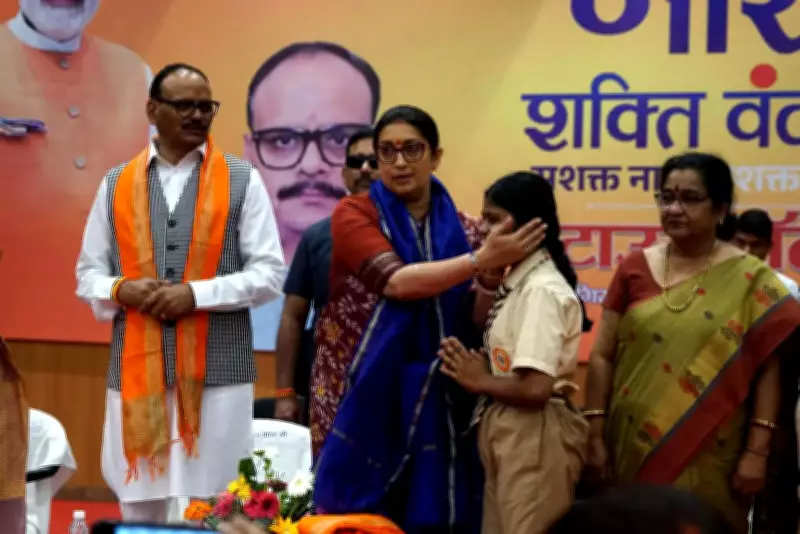
Grand Varanasi Event Explores Women's Evolving Role in Indian Democracy
A significant gathering titled 'Nari Shakti Vandan — Sashakt Nari, Sashakt Bharat' took place at the Girjadevi Sanskritik Sankul auditorium in Varanasi on Friday. The event focused on discussing the new and enhanced role of women in the nation's democratic framework through the recently enacted 'Nari Shakti Vandan Adhiniyam', commonly known as the women's reservation law.
High-Profile Inauguration and Key Addresses
The program was formally inaugurated by former Union Minister Smriti Irani and Uttar Pradesh Deputy Chief Minister Brajesh Pathak. Both leaders delivered impactful speeches emphasizing the government's commitment to women's empowerment and the practical implementation of supportive policies.
Smriti Irani Highlights Ground-Level Realization of Women's Empowerment
Addressing the assembled women, Smriti Irani articulated that under the leadership of Prime Minister Narendra Modi, the long-standing resolve to make the daughters of India self-reliant is now being tangibly realized across the country. She elaborated on several key initiatives:

- Beti Bachao-Beti Padhao and the Sukanya Samridhi Yojana have collectively secured the future and financial stability of daughters nationwide.
- The Ujjwala Yojana and Matru Vandana Yojana have brought about revolutionary improvements in the living standards and health of women.
Irani emphasized that the 'Nari Shakti Vandan Adhiniyam' transcends being merely a legislative act; it stands as a profound document of honor and rights for half of India's population, symbolizing a major step toward gender equality in political representation.
Brajesh Pathak Stresses Inclusion for National Development
In his address, Deputy Chief Minister Brajesh Pathak highlighted that the sacred land of Kashi has historically revered and worshipped Nari Shakti (women's power). He underscored the critical importance of including women in the decision-making processes as an essential component for building a developed and progressive India.
Pathak further noted that Prime Minister Narendra Modi has implemented the Sabka Saath Sabka Vikas scheme without any discrimination, ensuring inclusive growth. He added that this approach has also effectively protected the interests and welfare of Muslim daughters, reflecting the government's commitment to equitable development for all communities.
Broader Implications and Future Outlook
The event served as a platform to discuss the multifaceted impact of the women's reservation law, which aims to reserve one-third of seats for women in the Lok Sabha and state legislative assemblies. Participants explored how this legislation could reshape political dynamics, enhance women's participation in governance, and contribute to a more balanced and representative democracy.
Discussions also touched upon the synergy between various government schemes and the reservation law, highlighting how economic empowerment through initiatives like Ujjwala and Sukanya Samridhi complements political empowerment, creating a holistic framework for women's advancement.
The 'Nari Shakti Vandan' event in Varanasi thus marked a significant moment in the ongoing national conversation about women's rights, representation, and their pivotal role in driving India's growth and development forward.