

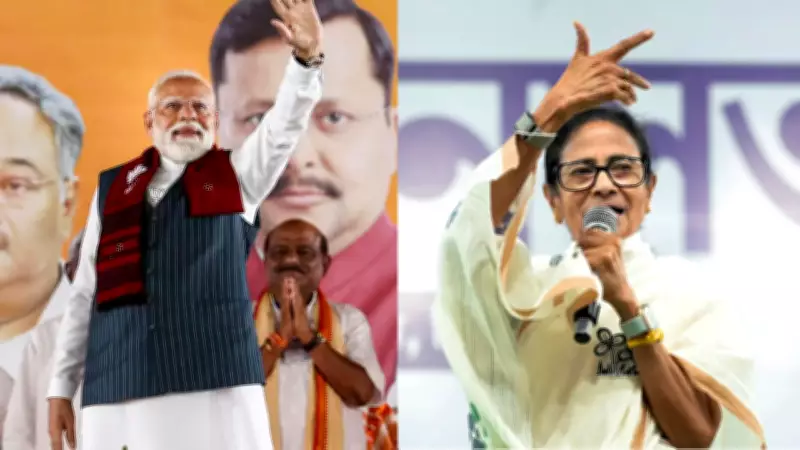
West Bengal Election 2026: A High-Stakes Political Showdown
The political landscape of West Bengal is heating up as the state prepares for a crucial assembly election. At the center of this electoral battle is Chief Minister Mamata Banerjee, who has ruled the state for over fifteen years with her Trinamool Congress (TMC) party. Her primary challenger is the Bharatiya Janata Party (BJP), which has been steadily building its presence in a state where it historically had little foothold.
The Core Contest: TMC vs BJP
This election is largely viewed as a direct confrontation between Mamata Banerjee's TMC and the BJP. The BJP, led nationally by Prime Minister Narendra Modi and Home Minister Amit Shah, has made significant inroads in West Bengal since the last election. In the 2021 assembly polls, the BJP managed to win 77 seats, emerging as the main opposition party for the first time and overtaking both the Left and Congress.
Mamata Banerjee, the country's second-longest serving woman chief minister, faces her toughest challenge yet. The BJP has launched an aggressive campaign, with top leaders including Modi and Shah holding multiple rallies across the state. They have sought to frame the TMC as an "anti-women" party and have criticized Mamata's government on issues ranging from law and order to alleged infiltration from Bangladesh.

Key Issues Shaping the Election
Several controversial incidents during Mamata Banerjee's rule have become central to the election discourse:
- Sandeshkhali: This remote riverine area became a major political flashpoint following allegations of land grab, sexual violence, and intimidation against women, with accusations centered around local TMC leader Sheikh Shahjahan.
- RG Kar Medical College Case: In 2024, a junior doctor was brutally raped inside the campus of RG Kar Medical College and Hospital in Kolkata, triggering massive protests and raising serious questions about safety and administrative accountability.
- Murshidabad Violence: In 2025, violence erupted in Murshidabad during protests against the Waqf Amendment Act, leading to deaths, injuries, and displacement, with security forces deployed to restore order.
- Post-Poll Violence: Following the 2021 elections, approximately 1,300 incidents of violence were reported across the state, reinforcing Bengal's long-standing association with electoral unrest.
The Third Front: Congress and Left's Struggle for Relevance
While the TMC vs BJP contest dominates the political narrative, other parties are fighting to remain relevant. The Congress, which last formed a government in West Bengal several decades ago, has been pushed to the margins by both the TMC and BJP. The party retains some historical influence in districts like Malda and Murshidabad but faces significant organizational challenges.
The Left, once dominant under towering leader Jyoti Basu, continues to fight for political space. After ruling the state for decades, the Left suffered major setbacks with Mamata Banerjee's rise in 2011 and the BJP's emergence as the principal opposition in 2021. The Left now struggles with a shrinking voter base and cadre erosion to rival parties.
SWOT Analysis of Major Parties
TMC: Welfare Strength vs Governance Pressure
Strengths: Mamata Banerjee maintains strong grassroots connections, particularly among women and economically weaker sections who benefit from her welfare schemes. The party has a robust booth-level organization and continues to enjoy consolidation of minority votes.
Weaknesses: Anti-incumbency sentiment has been building after more than 15 years in power. The party faces repeated allegations of corruption, governance issues, and political violence that have affected its credibility.
BJP: Momentum vs Local Gaps
Strengths: The leadership of Narendra Modi provides strong national appeal, and the party has significantly expanded its organizational base since 2019. Its clear ideological positioning has enabled consolidation of a sizeable section of Hindu voters.

Weaknesses: The absence of a strong and widely accepted chief ministerial face weakens its local positioning. The perception of being an "outsider" party continues to affect its acceptance among Bengali voters, and its grassroots penetration in rural areas remains weaker than TMC's.
Congress: Relevance vs Revival Challenge
Strengths: The party retains pockets of historical influence in certain districts and maintains some acceptability among minority voters in select constituencies. Its centrist positioning appeals to voters seeking an alternative to both TMC and BJP.
Weaknesses: Organizational decline has significantly reduced its electoral competitiveness. The absence of strong state-level leadership limits its ability to mount an effective challenge, and continuous cadre erosion to TMC and BJP has weakened its grassroots network.
Left: Legacy Erosion vs Survival Fight
Strengths: The Left retains a strong ideological base and a committed core cadre despite electoral setbacks. Its historical governance legacy under leaders like Jyoti Basu still resonates with older voter segments.
Weaknesses: The party has faced a steep electoral decline with minimal recent success in the state. A shrinking voter base and ageing leadership have limited its mass appeal, and it struggles to connect with younger voters.
Election Schedule and Significance
Polling for West Bengal's 294 assembly seats will take place in two phases on April 23 and April 29, with counting and results scheduled for May 4. These elections coincide with polls in three other states and a Union Territory, making this a significant political moment for the country.
The stakes are particularly high for both major contenders. For the BJP, eclipsing TMC in Bengal would represent a major strategic win in its national expansion. For TMC, Bengal represents its core and only stronghold, and losing it would significantly weaken one of the strongest forces countering BJP's national dominance.
As West Bengal heads to the polls, the battle for Kolkata's throne remains one of India's most closely watched political contests, with implications that extend far beyond the state's borders.





