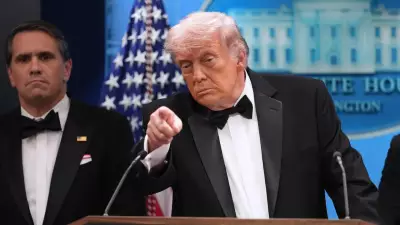
Uttar Pradesh Chief Minister Yogi Adityanath, on Monday, launched a sharp historical critique, holding the Congress party and Muhammad Ali Jinnah responsible for India's cultural division and the eventual Partition. He identified the political controversy surrounding the national song 'Vande Mataram' as the first and most dangerous consequence of the Congress's policy of appeasement.
The Assembly Debate on a National Symbol
Initiating a special discussion in the Uttar Pradesh Legislative Assembly during the winter session, CM Adityanath made the state assembly the first such house to formally debate the history of Vande Mataram. He asserted that the compromise made by the Indian National Congress over the song directly fueled separatist sentiments.
The Chief Minister argued that as long as Jinnah remained within the Congress fold, Vande Mataram was not a contentious issue. "Once Jinnah left the Congress, he made it a tool of the Muslim League and deliberately gave the song a communal colour. The song remained the same, but the agenda changed," Yogi stated, framing the shift as a calculated political move.

A Timeline of "Appeasement and Surrender"
Yogi Adityanath presented a detailed chronology of events to substantiate his claims. He recalled that on October 15, 1937, Jinnah launched a slogan against Vande Mataram from Lucknow, while Jawaharlal Nehru was Congress President. Merely five days later, on October 20, 1937, Nehru wrote to Subhas Chandra Bose expressing that the song's background was making Muslims uncomfortable—a letter the CM termed a "clear admission of the Congress's appeasement policy."
The situation escalated quickly. On October 26, 1937, the Congress Working Committee decided to drop certain portions of the song in the name of "harmony." Adityanath described this as a "sacrifice of national consciousness." By March 1938, Jinnah demanded the song be changed entirely. The Congress's lack of resistance, according to Yogi, emboldened the Muslim League, sharpened separatist tendencies, and marked the first major compromise on a national cultural symbol. He contended that this sequence laid the foundational stone for India's Partition.
He emphasized that the opposition to Vande Mataram was not religious but purely political, rooted in the Khilafat movement politics of the 1920s, as seen in Mohammad Ali Jauhar's 1923 protest.
Contrasting Historical Support and Political Compromise
The Chief Minister painted a vivid picture of an earlier era when Vande Mataram was sung without controversy at Congress conventions between 1896 and 1922. "Bharat Mata ki Jai and Vande Mataram reverberated from every stage then. Even freedom fighters like Maulana Abul Kalam Azad supported it. No one termed it 'anti-Islam'," he noted.
He pointed out that despite Congress leaders like Rafi Ahmad Kidwai calling the song a symbol of the freedom struggle, the party never promoted him. Instead of defending the song, Congress formed committees and ultimately decided in 1937 that only two stanzas would be sung, and that too not mandatorily—a decision Yogi branded a "national surrender."
Yogi Adityanath further alleged that the truncated version of Vande Mataram later recognized by the Constituent Assembly on January 24, 1950, was a direct result of this entrenched appeasement policy. "The nation adopted the song, but the Congress had already cut it," he claimed.
He invoked the endorsements of Mahatma Gandhi, who called it a 'national spirit,' Rabindranath Tagore, who termed it the 'soul of India,' and Sri Aurobindo, who described it as a 'mantra.' He highlighted its iconic role in the freedom struggle, noting it was inscribed on the first tricolor hoisted abroad by Madam Bhikaji Cama and was the last words of revolutionary Madan Lal Dhingra.
In a concluding warning, the Chief Minister said that some political forces are still trying to revive the same divisive mindset. He also accused the Congress of insulting the song's legacy by imposing the Emergency in 1975, during the centenary year of its composition. Yogi Adityanath concluded by stating that the vision of 'Ek Bharat Shreshtha Bharat' under the Modi government is fulfilling the dreams of the song's creator, Bankim Chandra Chattopadhyay.