

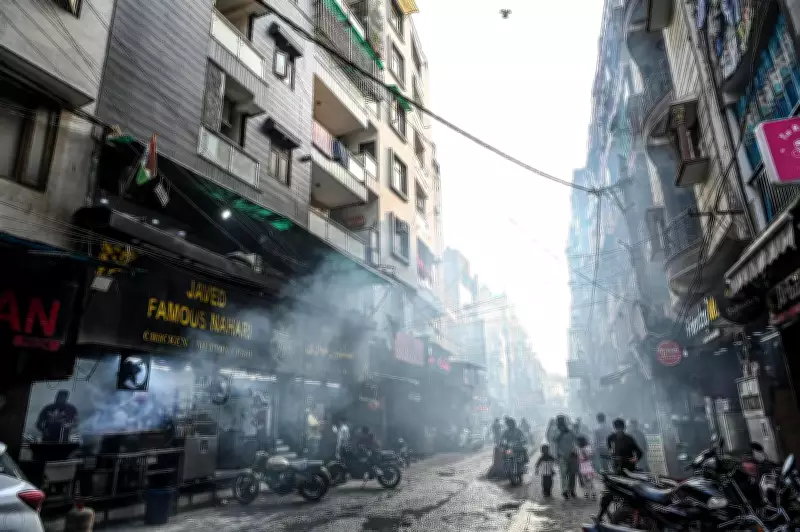
Delhi's Mixed-Use Markets Grapple with Severe Fire Hazards and Regulatory Gaps
New Delhi: Over ten days after a devastating fire claimed nine lives at Palam's Ram Chowk Market, the acrid odor of charred wood and melted plastic continues to linger. Behind yellow police barricades, the gutted building shell exposes a perilous reality widespread across Delhi's congested neighborhoods: families reside on upper floors of commercial structures, sleeping directly above unregulated shops stocked with flammable materials, with their sole escape route often being a single staircase that doubles as storage space.
Electrical Overloading and Frayed Infrastructure
A TOI visit to Palam, Chandni Chowk, and Shaheen Bagh revealed conditions that, block by block, mirror the urban chaos—overloaded electrical systems, absent fire exits, missing extinguishers, and no safety inspections—that led to the Palam tragedy. In Chandni Chowk's Vaidwara lane, the first alarming sight is the electrical wiring. Thick, knotted bundles of black cables run between buildings, loop around tilted utility poles, and droop at eye level across narrow lanes barely wide enough for two people to pass. High-end lehengas and sarees, highly flammable, hang precariously near these wires.
Locals explained that the electrical mesh installed decades ago for small family households now powers rows of display lights, industrial air conditioners, and refrigeration units. While a typical household might use 1-2 kilowatts, shops operating from the same space often draw 10-15 kilowatts or more to run heavy equipment. Despite this surge in power consumption, wiring and meters are rarely upgraded, forcing systems designed for small homes to handle commercial loads. Residents attribute this "overloading" to constant pressure on frayed wiring, increasing risks of overheating and short circuits—common triggers for market fires.

Pointing to a leaning pole, 78-year-old Shravan Kumar remarked, "Over the last five decades, I have watched this pole tilt further due to the sheer weight of wires it supports." Sanjeev Sharma, 49, showed a video on his phone of a tree engulfed in flames outside his window less than six months ago, ignited by a short circuit. Residents doused the fire with water from balconies, preventing it from spreading to shops. "Their quick thinking saved the block. If the fire had reached a shop, the entire lane would have been destroyed," he said.
Absence of Fire Safety Measures and Regulatory Blind Spots
TOI entered numerous shops in these areas to check for fire extinguishers, often receiving blank stares in response. Emergency exits beyond the single front entrance are virtually nonexistent. In many cases, staircases connecting ground-floor commercial units to residential floors above serve as informal storage for excess stock, boxes, and waste material. During a fire, such staircases become chimneys, trapping residents.
Critically, most such buildings are not legally required to obtain a fire no-objection certificate (NOC), as structures under prescribed height and area limits fall outside mandatory safety inspection norms. For commercial units, only those above nine meters or with ground-plus-two floors undergo checks. This creates a regulatory blind spot across vast swathes of Delhi, including markets like Amar Colony, Lajpat Nagar, Karol Bagh, and Rajouri Garden, where mixed-use zoning allows hazardous setups to operate unmonitored for years without inspections of wiring, storage, or emergency exits.
Encroachments and Compounded Risks
In Shaheen Bagh, the danger is exacerbated by rampant encroachment. Once passable roads in front of residential buildings have narrowed significantly as ground-floor restaurants and eateries expand outward with awnings, seating, and gas cylinder storage edging into streets, making them too tight for fire tenders to navigate. Upper-floor residents highlighted the evident risk. Shandar Ali, a local, noted, "In the 2024 fire that gutted Hotel Zaika, Zahra, and Bismillah, access was choked by encroachments and parked vehicles. The restaurants reopened, but the street remained as narrow as before."

Nineteen-year-old Alia Tabbassum emphasized that risks spike during monsoon, with short circuits "sparking on poles like fireworks," and called for mandatory fire audits for small establishments. Back at the Palam blaze site, residents reported that fire extinguishers were distributed post-incident, but clothes were still seen hanging dangerously close to exposed wires. Locals cited friction between residents and shopkeepers over goods piled in staircases and balconies.
Historical Precedents and Systemic Challenges
A senior fire officer referenced the 2019 Anaj Mandi fire in Sadar Bazaar, which killed 45 people, as exposing a major regulatory gap. "In cramped structures, firefighters often lack basic information on occupancy or layout. Many markets have grown organically without proper mapping or planned road access. Consequently, spare space is crammed with flammable goods, waste material, and LPG cylinders, while narrow lanes hinder firefighting efforts," the officer added.
An official from a private discom stated that Delhi discoms are proactively strengthening networks and monitoring systems to address electrical overloading risks, particularly in mixed-use areas. However, the pervasive issues of overloaded wiring, absent safety measures, and regulatory oversights continue to pose significant threats to Delhi's urban safety landscape.





