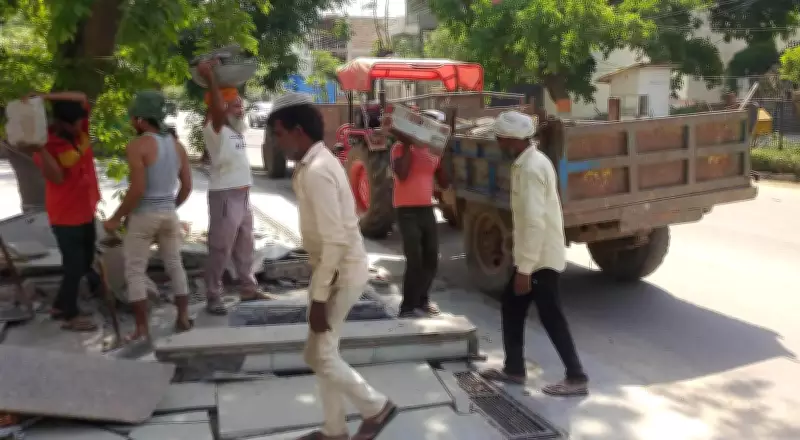
The Department of Town and Country Planning (DTCP) has started clearing demolition debris in Palam Vihar, Gurgaon, days after a standoff with the Municipal Corporation of Gurgaon (MCG) over responsibility for the exercise.
Officials said that construction and demolition (C&D) waste generated during the recent anti-encroachment drive is being collected by an authorised vendor and transported to the Basai C&D processing plant, as identified by MCG. Palam Vihar saw some of the highest volumes of debris from the drive, which left broken boundary walls, ramps, fencing, and guard rooms strewn along internal roads and public spaces.
"Lifting has started in Palam Vihar and will be extended to other licensed colonies in a phased manner," said district town planner (enforcement) Amit Madholia.

This move marks DTCP's first structured intervention since the demolition drive. Debris removal had been slow due to a dispute over roles. While DTCP wrote to MCG and developers to ensure clearance, MCG cited C&D waste rules placing disposal responsibility on the "waste generator," creating ambiguity. With DTCP now stepping in directly, priority is being given to clearing main carriageways, intersections, and stretches where debris has severely impacted movement.
Residents said the situation is improving. "There were heaps of debris where boundary walls and ramps were removed. Now trucks have started lifting the waste and roads are becoming accessible again," said a Palam Vihar resident.
Meanwhile, DLF Utilities has initiated a structured right of way (ROW) clearance drive in DLF Phases 1 and 2, deploying teams to remove debris from roads, green belts, and public spaces. "Roads that narrowed over the years are opening up," said a DLF Phase 2 resident.
However, concerns remain over sustained enforcement. "Clearing debris is just one part. Continuous monitoring is needed to ensure encroachments do not return," said a DLF Phase 1 resident.
Thousands of illegal extensions were razed during the five-day operation. While enforcement teams kept roads motorable during the drive, large volumes of debris remained, triggering resident complaints. The next phase will focus on monitoring cleared areas and ensuring long-term compliance, as the administration works to convert enforcement gains into sustained urban order.